
Most people see a ladybird land on their arm and think “cute.” What they don’t think about is that this tiny red beetle has been carrying profound cultural and spiritual weight for over a thousand years across dozens of languages and civilisations. The name itself is a prayer. The spots were once counted as sacred. A Norse legend says it arrived via lightning bolt.
Yeah. Let’s get into this.
Quick Facts
| Info | Details |
| Scientific family | Coccinellidae (from Latin coccineus — scarlet) |
| Most common species | Seven-spot ladybird (Coccinella septempunctata) |
| Name first recorded | 1674 in English (as “ladybird”) |
| “Lady” refers to | The Virgin Mary — “Our Lady” |
| The seven spots | Originally associated with Mary’s seven sorrows AND seven joys |
| German name | Marienkäfer — Mary’s Beetle |
| Danish name | Mariehøne — Mary’s Hen |
| Swedish name | Jungfru Maria Nyckelpiga — Virgin Mary’s Key Maid |
| French old name | Bête à bon Dieu — God’s Little Creature |
| Amharic (Ethiopia) | Ye Mariam Tinziza — Mary’s Beetle |
| Norse belief | Arrived on Earth via a bolt of lightning |
| Bad luck if you kill one | According to UK folklore — nine days in the Virgin Mary’s bad books |
| Core spiritual themes | Good luck, protection, transformation, love, divine messages |
The Name Is Literally a Prayer and Nobody Knows It
Here’s what blows people’s minds when they first learn it. The word “ladybird” — and the American “ladybug” — both contain the word “Lady” as a direct reference to the Virgin Mary. In medieval England, “Our Lady” was the standard way to refer to Mary. Lady chapels, Lady Day (March 25th, the feast of the Annunciation), Lady’s Fingers — all named for her.
When these red beetles appeared in farmers’ fields after a plague of pests had devastated crops, the farmers saw them as an answer to prayer. They called them “Our Lady’s birds.” The beetles had come, eaten the aphids and mealybugs that were killing the crops, and saved the harvest. Divine intervention delivered by a six-legged red creature with spots.
That’s the origin story. Medieval farmers praying to Mary, beetles arriving to save the grain, farmers naming the beetle after the one they’d prayed to. The name “ladybird” first appears in written English in 1674 — but the naming tradition it records is centuries older.
See also “Joining Quiz.com (JoinMyQuiz): The Most Underexplained Thing in Classroom Tech“
The Spots Are Sacred. Every Single One.
The most common ladybird across Europe is the seven-spot. Specifically seven. And that number is not coincidental to the spiritual tradition.
Medieval Christians associated the number seven with the Virgin Mary’s seven sorrows — events from her life including the prophecy of Simeon, the flight to Egypt, losing the child Jesus in the Temple, witnessing the crucifixion, and others. Seven is also the number of Mary’s joys in the parallel tradition. The spots were counted as proof of divine connection. The red wings were connected to the red cloak Mary is shown wearing in Byzantine and early medieval iconography.
That’s a lot of theological weight on a beetle with a body the size of a fingernail.
The German language kept this most obviously. Their word Marienkäfer translates directly as “Mary’s Beetle.” The alternative German word Glückskäfer means “lucky beetle” — which tells you what happened to the religious meaning over time as Europe secularised. Mary’s Beetle became Lucky Beetle. The luck stayed. The attribution shifted.
Languages Across the World Reached the Same Spiritual Conclusion
Here’s the part that genuinely fascinates me. Cultures that had no contact with each other all looked at this insect and assigned it divine or sacred status. That’s not nothing.
In Croatia: Bubamara, meaning Mary’s Beetle. In Danish: Mariehøne, Mary’s Hen. In Sweden: Jungfru Maria Nyckelpiga — Virgin Mary’s Key Maid. In Ethiopia (Amharic): Ye Mariam Tinziza — again, Mary’s Beetle. In Spanish, Mariquita derives from María. An older Spanish name, Vaca de San Antón, means Saint Anthony’s Cow — back to religious attribution through cattle imagery.
The French kept the sacred reference in their old names — bête à bon Dieu, “God’s good creature” — even though modern French just uses coccinelle (from the Latin for scarlet). The religious name survived in folk speech long after the formal language moved on.
You can go from England to Ethiopia to Sweden and find that this small red beetle was, independently, placed in the category of “belongs to the divine.” That pattern across isolated traditions carries real weight. Whatever you believe spiritually, the consensus is striking.
The Norse Origin Story: It Arrived on Lightning
Okay so this is the one that genuinely surprised me when I came across it. European ladybird folklore mostly centers around Christianity and the Virgin Mary. But there’s a Norse thread that runs much older and much stranger.
According to one Nordic legend, the ladybird didn’t walk to earth or arrive with the first farmers. It rode a bolt of lightning down from the sky. Which is, frankly, the most dramatic origin story any creature could have. It came from above. Via electricity. To eat your aphids.
This fits the broader Norse spiritual framework in which objects, creatures, and events from the natural world carried direct messages from higher powers. The ladybird wasn’t sacred because a medieval legend attached itself to the creature — it was sacred because its arrival was considered supernatural in origin. Different theological system, same elevated spiritual status.
The lightning myth also explains why harming a ladybird carries such consistent bad luck associations across Northern European folklore. You don’t casually harm something that arrived from the sky with celestial authority.
“Ladybird, Ladybird, Fly Away Home” — That Nursery Rhyme Isn’t Sweet
Most people know this nursery rhyme as a gentle children’s chant. The actual context is darker than that.
Ladybird, ladybird, fly away home. Your house is on fire, and your children will burn.
That’s a threat, not a lullaby. The most credible historical explanation is agricultural: in medieval England, it was common practice after the hop harvest to burn the vines to clear the fields. Farmers would chant this warning to any ladybirds still clinging to the vines before lighting the fire, giving them a chance to escape.
The chant preserved both practical concern (these are useful predators, we don’t want to kill them needlessly) and the older belief that ladybirds were sacred and shouldn’t be harmed carelessly. Burning a ladybird that couldn’t escape was considered genuinely unlucky — some British folk beliefs specified that killing a ladybird put you in the Virgin Mary’s bad books for nine full days.
That’s a specific number of days. Someone counted. Medieval folk tradition took this seriously.
The Transformation Angle: Metamorphosis as Spiritual Symbol
Beyond the Mary-connection and the luck associations, ladybirds carry a third spiritual thread that’s somewhat separate from the specifically Christian framing. And that’s transformation.
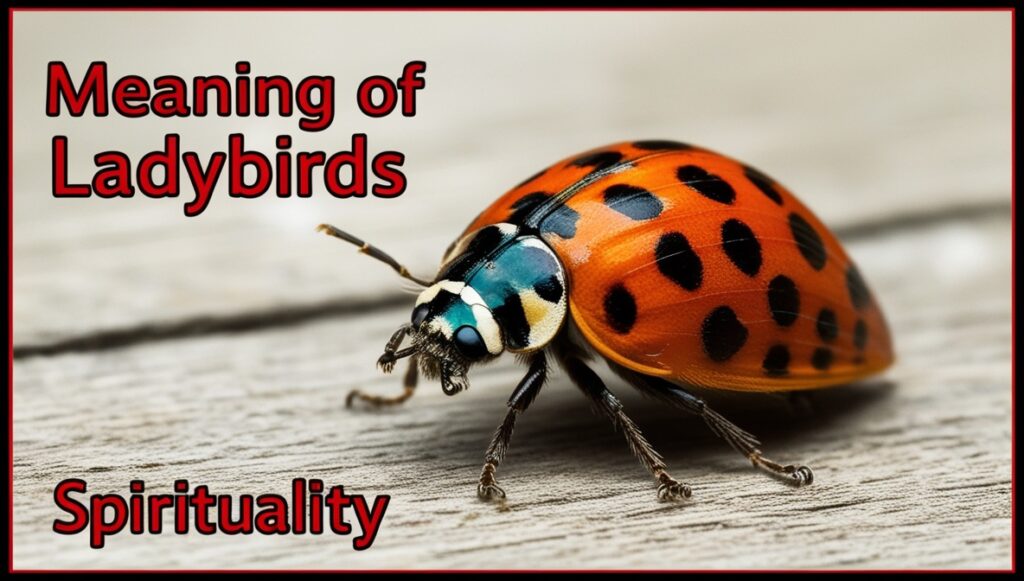
A ladybird’s life cycle — egg, larva, pupa, adult — is a complete metamorphosis. The creature that emerges as the red-winged, spotted adult bears no visible resemblance to what it was before. In spiritual traditions that read nature symbolically, this is significant.
The larva is dark, strange-looking, and somewhat alarming. The adult is universally beloved. The journey between them is the point. Many spiritual teachers who work with animal symbolism use the ladybird as a specific prompt to ask: what phase are you in? Are you in the dark, unrecognised larval stage? Are you mid-transformation in the pupa? Or have you already become the creature that gets to fly?
That’s a genuinely useful frame for personal reflection, regardless of your spiritual background. You don’t need to believe in omens to find that meaningful.
When One Lands on You: What Cultures Actually Believe
Here’s the part most people search for. What does it mean when a ladybird actually lands on you?
The near-universal answer across European and many Asian traditions: good fortune is coming. The British folk belief specifically says the redder the ladybird, the better the luck. There’s also a connected belief that if you count the spots, the number corresponds to months until your good luck arrives — or, in some versions, the number of good things heading your way.
The wish-granting tradition is widespread: a ladybird lands on you, you make a wish, and when it flies away the wish travels with it. This is documented across multiple European and North American folk traditions. Let the ladybird walk across your palm, make the wish silently, watch it fly. If it goes straight up without circling, some traditions say the wish is guaranteed.
In Chinese tradition, the ladybird carries an association with prosperity and love. If one lands on a woman, some beliefs hold that it signals the arrival of her true love — or that she’ll soon hear from someone significant. In East Asian tradition more broadly, the ladybird’s connection to celestial omens runs deep.
Native American traditions across different tribes generally frame the ladybird as a messenger from the earth — not a divine creature per se, but a signal of being in harmony with the natural world. The landing carries significance as a communication from the living systems around you, a reminder of interconnection.
What’s interesting about all of these interpretations is that none of them are negative. You look hard across world folklore for a culture that considers the ladybird unlucky or malevolent and you basically don’t find one. The only bad luck involved is in harming one yourself. The creature is universally categorised as a bringer of good, a signal of positive change.
The Red and Black Combination
The color symbolism is worth sitting with on its own terms. Red and black together carry significant weight across spiritual traditions.
Red is the color most consistently associated with life, energy, passion, blood, and in the Mary tradition — her protective cloak. It’s an active color. It demands attention. There’s a reason a red creature is the one that became the luck-bearer and not, say, a brown one.
Black spots against red create a specific visual pattern — high contrast, immediately recognisable, impossible to mistake for anything else. In terms of spiritual visual language, this creates clarity. You know what you’re looking at. There’s no ambiguity about whether you’ve seen a ladybird. That certainty, that unmistakable presence, contributes to why the sighting feels significant.
The spots themselves — beyond the theological seven — have been associated with completeness and divine order across various traditions. Patterns that repeat, that appear systematic, that look designed rather than random, tend to attract spiritual interpretation. The ladybird’s spots look designed. They are, of course — they serve as warning coloration to predators. But the spiritual reading of “these spots mean something” isn’t entirely irrational. They do mean something. Just biologically rather than cosmically.
The Skeptic’s Corner: Why We See Meaning
Let’s be honest about this for a second. Part of why ladybird sightings feel significant is documented cognitive science, not just folk tradition.
When a bright red creature lands on your skin, your brain flags it immediately — high contrast colors on skin tones are a visual interruption the brain is wired to notice. That noticing breaks you out of autopilot. You stop whatever you were doing. You pay attention to something small and present. And in that moment of paying attention, your mind tends to drift to what’s relevant in your life.
The wish-making tradition isn’t just magical thinking — it’s a structured moment to articulate what you actually want. Counting the spots is a moment of close attention to something beautiful and tiny. The belief that the sighting is a message invites you to ask: what would that message be about, for me, right now?
Whether or not the ladybird is literally carrying a message from the universe, the practice of receiving it as one is genuinely useful. It creates reflection. It breaks mundane routine. It asks you to consider what you’re hoping for.
That’s not nothing. That’s actually a decent spiritual practice regardless of what you believe about beetles.
Final Words
Here’s my honest opinion after sitting with all of this. The ladybird is one of the most extensively documented lucky creatures in human cultural history and most people don’t know the half of it. They know it’s supposed to be lucky. They don’t know it’s named for the Virgin Mary. They don’t know the spots were counted as Mary’s sorrows. They don’t know the Norse version arrived via lightning. They don’t know the nursery rhyme was an agricultural fire warning.
The layers here are genuinely rich. And the cross-cultural consistency — from Ethiopia to Sweden to Japan to the Great Plains of North America — that’s not manufactured. Something about this creature consistently strikes human beings as belonging to a category of meaningful, protective, blessed things.
You don’t have to believe in omens to value that. But if you want to, there is a thousand years of tradition backing you up.
Next time one lands on you, make the wish. Count the spots. Watch which direction it flies. You’ve got nothing to lose and a very long tradition of human beings doing exactly the same thing.
FAQs
1. Why is it called a ladybird?
The “lady” in ladybird refers to the Virgin Mary — “Our Lady” in medieval English. The beetle was named “Our Lady’s Bird” because farmers believed it appeared in answer to prayers to Mary after aphid infestations destroyed crops. The name first appears in written English in 1674.
2. What does it mean spiritually when a ladybird lands on you?
Across most traditions: incoming good fortune, a positive sign, a moment of divine attention. Many folk beliefs hold that you can make a wish when one lands on you, and when it flies away it carries the wish upward. Some traditions say the number of spots tells you how many months until your luck arrives.
3. Why are there seven spots on the most common ladybird?
The seven-spot ladybird (Coccinella septempunctata) is the most common European species. Medieval Christians interpreted the seven spots as representing the seven sorrows of the Virgin Mary (and separately, her seven joys). This theological link reinforced the association between the insect and Mary.
4. What do ladybirds symbolise in different cultures?
In Christianity: divine protection, Mary’s blessing. In Chinese tradition: prosperity and love. In Native American traditions: earth messages, harmony, interconnection. In Norse folklore: celestial origin (lightning-borne). In European folk tradition broadly: good luck, protection, incoming positive change.
5. Is it bad luck to kill a ladybird?
Yes, according to British folk tradition and many European belief systems. Some specifically stated that killing a ladybird put you in the Virgin Mary’s bad graces for nine days. The general consensus across traditions is that harming a ladybird reverses whatever luck it was bringing.
6. What does the red color of a ladybird symbolise spiritually?
Red is associated with life energy, passion, and protection across traditions. In the Mary tradition specifically, red referenced her protective cloak as depicted in early Christian iconography. British folklore adds: the redder the ladybird, the better the luck it carries.
7. What does it mean if a ladybird visits you repeatedly?
Spiritually interpreted: a recurring message or sign you’re being asked to pay attention to. Some traditions see repeated visits as confirmation of incoming transformation or a signal that something significant is about to shift in your life. The practical answer: there may be aphids on a plant near you that’s attracting them.
8. What is the Norse spiritual belief about ladybirds?
A Nordic legend holds that the ladybird arrived on Earth by riding a bolt of lightning from the sky. This places it in the category of creatures with divine or celestial origin in Norse cosmology, explaining both its sacred status and the tradition of bad luck attached to harming one.
9. What does the ladybird nursery rhyme “fly away home” actually mean?
The rhyme — “Ladybird, ladybird, fly away home, your house is on fire and your children will burn” — originated as a genuine agricultural warning. Medieval English farmers burned hop vines after harvest to clear the fields and chanted this to give any remaining ladybirds time to escape before setting the fire.
10. Is the ladybird a spirit animal?
In traditions that use spirit animal frameworks, yes — the ladybird is commonly assigned as a spirit animal representing transformation, good luck, childlike joy, and trust in the process of change. It’s associated with people who are in or approaching a major positive life transition.
11. What does it mean to dream about ladybirds?
Generally interpreted as positive: incoming luck, blessings on the horizon, or a signal to embrace a change you’ve been resisting. The number of ladybirds in the dream is sometimes read as significant, with more bugs suggesting larger-scale positive change.
12. Do different spot counts mean different things?
In folk tradition, yes. Some beliefs hold that counting the spots while the ladybird sits on you tells you the number of months until your good luck arrives. Others say the spots count lucky things coming to you. The seven-spot has the richest specific symbolism due to its Marian connection.
Discover stories that stand at the top with The Pinnacle Magazine.