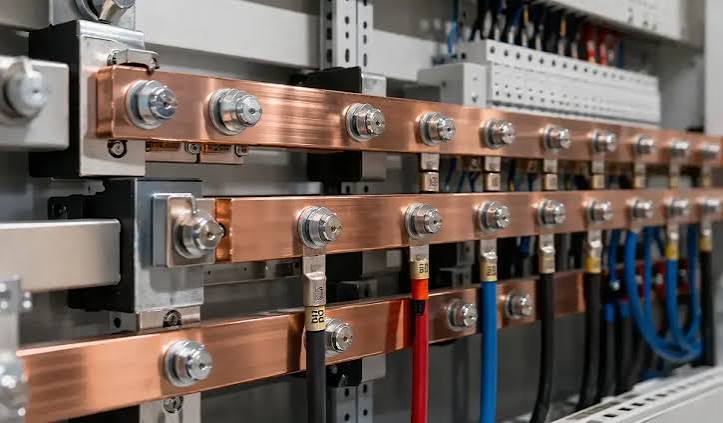

Nobody throws a party for a strip of metal. Yet inside almost every building, factory and data hall, a few unassuming bars are doing some of the hardest work in the whole electrical system. They don’t blink, they don’t beep and they rarely get a second look, right up until something goes wrong.
So What Exactly Is a Busbar?
At their simplest, busbars are solid bars of conductive metal that carry electricity between different parts of a system. They’re usually found inside distribution boards, switchgear and control panels, where they collect power from an incoming supply and share it out to individual circuits.
The appeal is practical. A bar can carry far more current than a cable of similar size, it’s rigid enough to hold its shape, and it can be cut, drilled and bent to suit almost any enclosure. Designers can calculate exactly how much current it’ll handle, which makes planning far less of a guessing game.
Copper Versus Aluminium
Two metals dominate the field. Copper is the classic choice, prized for conductivity and strength. Aluminium is lighter and cheaper, so it tends to win in larger installations where weight and budget matter. Each comes with a catch, though.
Copper oxidises over time, developing a dull film that gets in the way of good electrical contact. Aluminium is even quicker off the mark, forming an invisible oxide layer within moments of being cut or cleaned. That layer is hard and doesn’t conduct well, so bare aluminium joints need careful handling.
Where Things Go Wrong
A bar itself rarely fails. Trouble tends to start where one conductor meets another. Bolted joints rely on firm, clean contact, and anything that interferes with it, whether oxidation, moisture or simple wear, pushes resistance up.
Higher resistance means heat, and heat makes everything worse. Metal expands, bolts loosen slightly, oxidation speeds up and resistance climbs again. Left alone, that loop can lead to weakened joints, wasted energy, short circuits and expensive maintenance. Anyone who’s seen a discoloured, scorched connection inside a cabinet knows how it ends.
Plating to the Rescue
The standard fix is a thin metallic coating applied by electroplating. Tin is the all-rounder: cheap, corrosion resistant and good for electrical contact. Silver is the high performer, offering exceptional conductivity and tolerance for heat. Nickel is the tough one, forming a hard surface that stands up to wear and harsher conditions.
Coating thickness is a design decision rather than an afterthought. Figures between 2.5 and 15 microns are commonly specified, though the right choice depends on the environment, the type of contact and the standards involved. Thickness checks are usually done with X-ray fluorescence, a non-destructive method that measures the layer without harming the part.
Why This Matters Now
Electrification is leaning hard on this humble component. Electric vehicles, data centres, solar farms and battery storage all depend on dense, reliable power distribution. More current in less space means less tolerance for sloppy connections.
That’s driving a shift in how these parts are specified. Surface finish used to be a footnote on a drawing. Increasingly, it’s treated as a performance requirement alongside the base metal and the dimensions.
A Quick History Lesson
Electrical engineers have been using bars of metal to distribute power since the early days of large-scale electricity supply. Power stations needed a way to gather the output of several generators and send it on to the grid, and solid conductors proved reliable, easy to inspect and simple to extend. The principle hasn’t changed much since. What has changed is the scale, the knowledge of materials and the range of places where the technique is used.
Where They Turn Up
Look past the obvious power stations and substations and the same components appear in surprising places. Hospital switchrooms, railway signalling cabinets, factory control panels, solar inverters, wind turbine nacelles and the battery packs of electric vehicles all use them. Anywhere that heavy current needs a tidy, dependable path, a flat conductor is a strong candidate.
Data centres are a particularly demanding example. Racks of servers draw current constantly, cooling systems add to the load, and there’s no appetite for interruptions. Power distribution in these buildings has to be dense, efficient and easy to expand, which plays to the strengths of solid bars.
Reading the Warning Signs
Failing joints rarely do so silently. Discolouration around a bolt, a faint smell of hot insulation or a warm patch on a panel door can all point to a connection that’s struggling. Thermal cameras make the job easier by showing warm spots that the eye can’t pick up, and many maintenance teams now include a survey in their annual routine.
Catching a warm joint early is usually a modest job: clean the surfaces, check the torque and replace anything that looks damaged. Catching it late can mean a burnt-out section of equipment and a shutdown nobody planned.
Simple by Design
The next time a building’s lights stay on through a storm, or an electric car completes a rapid charge without incident, a few well-made bars deserve a quiet nod. They’re simple by design, and that’s exactly why they work.
Good engineering often looks boring from the outside. In power distribution, boring is the goal, and a properly finished conductor is about as boring, and as valuable, as it gets.