
Everyone wants whiter teeth. That part is obvious. What’s less obvious is why the answer to “are these $45 strips safe?” is somehow still a debate in 2025 when the product has been on shelves since 2001. Twenty-plus years of clinical data, ADA seals, dentist endorsements — and people are still searching this question at midnight trying to figure out if they’re about to ruin their enamel for the sake of a few shades lighter.
So let’s actually answer it. Properly. Without the corporate PR spin or the scare-tactic dental office content.
Quick Facts
| Category | Details |
| Product | Crest 3D Whitestrips (various lines) |
| Made by | Procter & Gamble |
| Active ingredient | Hydrogen peroxide (standard lines: 6–6.5%; Supreme line: 14%) |
| Also contains | Carbamide peroxide, sodium hydroxide, PVP, carbomer adhesive agents |
| ADA Seal of Acceptance? | Yes — independently reviewed for safety and effectiveness |
| FDA recognized? | Yes — active ingredients recognized as safe within concentration limits |
| Canadian Dental Association? | Approved as “safe to use” |
| Key side effects | Tooth sensitivity, gum irritation (both typically temporary) |
| Serious risk from overuse? | Yes — enamel erosion, dentin protein degradation from excessive use |
| 35% quit rate? | Yes — sensitivity-related dropout in comparative clinical studies |
| Results vs. professional whitening | 1–2 shades (strips) vs. 5–8 shades (professional), lasting 6–12 months vs. 1–2 years |
| Works on crowns, veneers, fillings? | No — only natural tooth enamel |
| Not for use under | Age 12 (Supreme line: under 18) |
| Pregnancy recommendation | Avoid or consult OB and dentist first |
| Launch date | May 2001 |
The Short Answer You Actually Came Here For
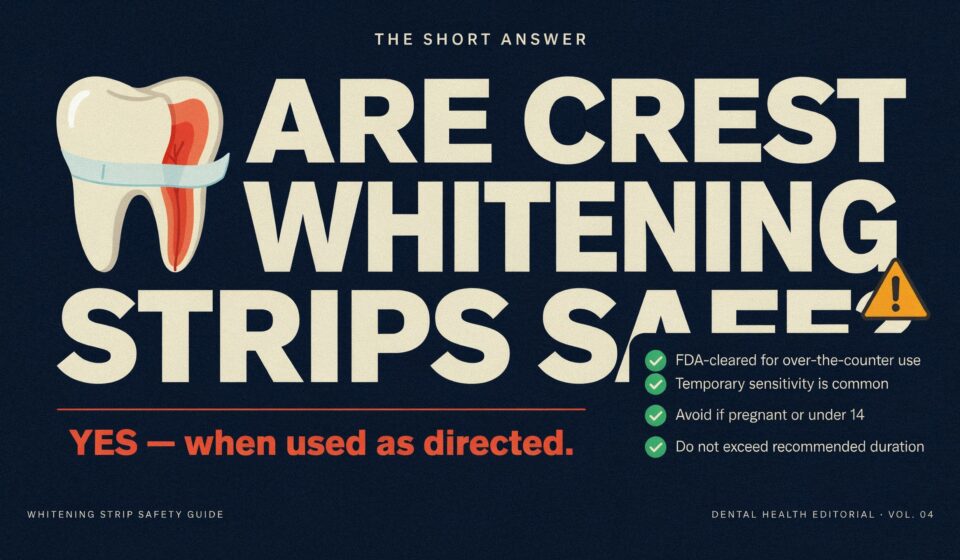
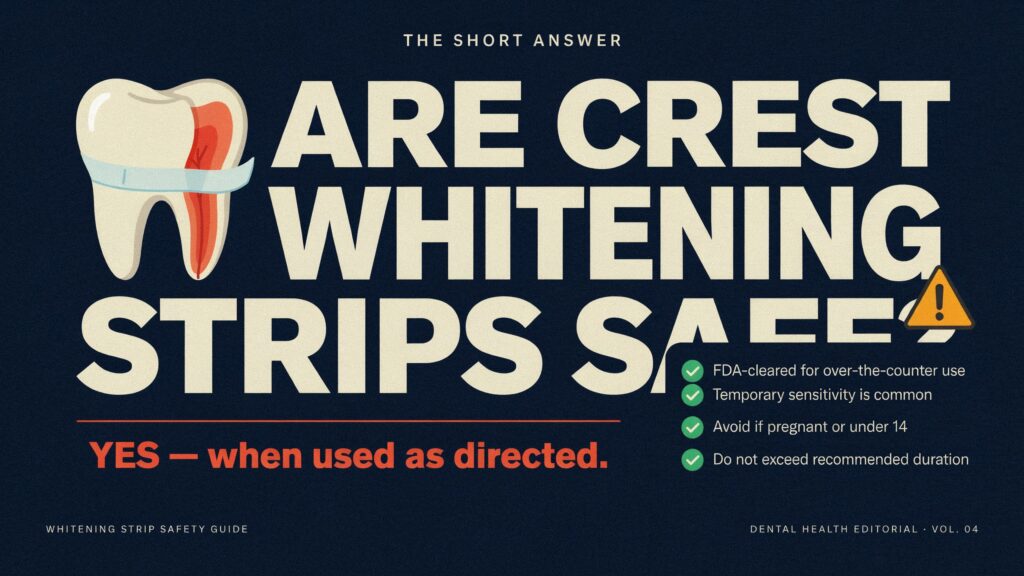
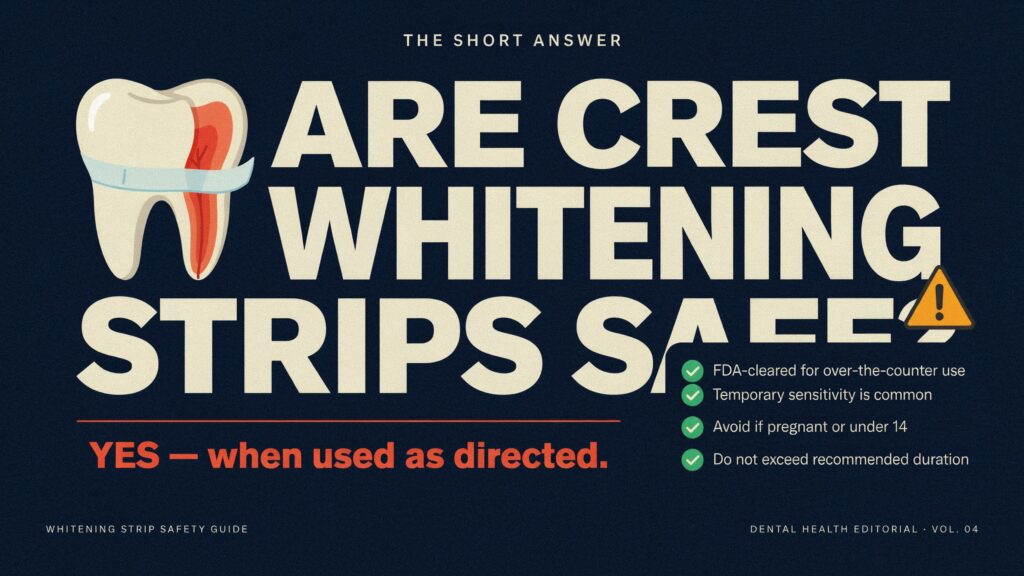
Crest Whitestrips are generally safe for most healthy adults when used exactly as directed. That’s the consensus from the ADA, the Canadian Dental Association, Health Canada, and the FDA. They carry the ADA Seal of Acceptance — which means an independent body reviewed the evidence and confirmed both safety and effectiveness. That’s not nothing.
But “safe when used as directed” is doing a lot of work in that sentence. And that qualifier is exactly where most people run into trouble.
See also “Gateway HMRC Login: Everything They Should Have Told You From the Start“
What’s Actually In These Things
The active ingredient in Crest Whitestrips is hydrogen peroxide. Depending on which line you buy, you’re looking at somewhere between 6% and 14% concentration. The standard Professional Effects line sits at 6.5%. The Supreme Flexfit — the strongest over-the-counter Crest product — runs at 14%.
For context, dentists use hydrogen peroxide in their in-office treatments too. The concentrations are higher in professional settings — sometimes significantly higher — but the mechanism is identical. Hydrogen peroxide oxidizes the organic color molecules inside your enamel, breaking them down until the tooth appears lighter. It’s not magic. It’s chemistry.
The strips also contain sodium hydroxide, which is caustic — meaning it erodes whatever it contacts. It’s there for pH adjustment but it’s another reason why leaving strips on longer than directed or using them more frequently than recommended isn’t just overkill. It’s genuinely damaging.
The Sensitivity Issue Is Real and Underreported
Here’s what Crest’s own marketing glosses past faster than you can say “whiter in three days.” Tooth sensitivity is extremely common with whitening strips. Not a rare side effect. Not something that happens to sensitive people. Common.
In a 2025 peer-reviewed clinical trial comparing Crest 3D Whitestrips to a competing product, one participant in the Crest group had to withdraw entirely because the dentin sensitivity became unbearable after two weeks of use. In comparative studies that tracked sensitivity-related dropout rates across whitening products, Crest Whitestrips showed a 35% quit rate tied directly to sensitivity.
Thirty-five percent. That’s not a footnote. That’s more than one in three participants stopping because it hurt too much.
Here’s what’s happening physiologically. Hydrogen peroxide temporarily opens microscopic channels in your enamel. Through those channels, the peroxide contacts the nerve-rich inner layer of your tooth — the dentin. Your tooth’s nerve endings get irritated. You end up wincing when you drink cold water or eat something sweet. This effect is temporary in healthy teeth with normal use. But it’s real, it’s common, and anyone who tells you otherwise is selling you something.
The Enamel Debate: Who’s Right?
This is where it gets genuinely complicated, because the science isn’t entirely settled and both sides have legitimate evidence.
Crest’s own research and multiple clinical trials conducted under normal usage conditions have found that hydrogen peroxide gel at 6.5% concentration produces no measurable changes to enamel hardness or structure — even under conditions of severe overuse (think five consecutive full kits). A 2009 Consumer Reports review named Crest Whitestrips Supreme the top performer out of eight tested whitening products. The ADA doesn’t hand out its seal of acceptance casually.
On the other side: a study that’s been widely cited in dental literature found that hydrogen peroxide weakens the dentin layer by shrinking the proteins within it. Teeth treated with whitening strips three times in the study showed greater collagen protein degradation each time. Enamel is the hardest substance your body produces. It doesn’t regenerate. Once it’s gone, it’s gone.
The honest synthesis? At recommended concentrations and frequencies, Crest Whitestrips don’t meaningfully damage enamel in most people. The risk of actual enamel erosion comes from chronic overuse — using strips far more frequently than directed, leaving them on longer than the timer says, or running through multiple kits back to back chasing a whiter result. That’s where the evidence of real harm comes in.
The People Who Shouldn’t Use These. Full Stop.
This section matters more than the general safety consensus and gets buried in most reviews.
If you have untreated cavities, stop. Hydrogen peroxide in an open cavity is not whitening — it’s irritating an already-compromised structure. Get the cavity treated first.
If you have active gum disease or receding gums with exposed root surfaces, whitening strips can make things significantly worse. Gum tissue burns chemically when it comes into sustained contact with peroxide gel. If your gums are already irritated or compromised, you’re multiplying that risk.
If you’re pregnant or nursing, skip it entirely until after. The safety data during pregnancy is limited. Hydrogen peroxide gets absorbed through gum tissue into the bloodstream. Nobody has run the clinical trials on pregnant women that would let you say definitively it’s fine — so precaution wins here.
If you’re under 12, the strips aren’t for you. Under 18 for the Supreme high-strength line. The ADA has been clear on this.
If you have dental restorations — crowns, veneers, fillings, bonding, bridges — here’s the critical thing most people don’t realize until it’s too late: the strips will whiten your natural teeth and do absolutely nothing to the restoration. Your crown stays exactly the shade it was. Your natural teeth get lighter. The mismatch this creates on your front teeth is not subtle.
The Overuse Trap
People see results and want more results. So they use another kit. Then another. Then decide to do monthly maintenance instead of every six months. Then run a kit every few weeks because they had a lot of coffee. This is the path to actual damage.
Crest’s own labeling recommends touch-up treatments every four to six months after completing a full regimen. Not monthly. Not biweekly. Four to six months. The professional dental community often suggests checking in with your dentist before doing repeated whitening courses specifically because individual variation matters — your enamel thickness, your existing sensitivity levels, any micro-cracks your dentist can spot that you can’t feel yet.
Overuse demineralizes enamel over time. Demineralized enamel is more porous, more vulnerable to staining, more sensitive to temperature and pressure, and more susceptible to cavities. You’d be whitening yourself into a more stainable tooth that hurts when it rains. That’s not the goal.
Strips vs. Professional Whitening: The Real Comparison
Since dentist offices very much want you to understand the difference, and since Crest very much wants you to think their product delivers “professional level” results, let’s be clear about what the actual gap looks like.
Crest Whitestrips typically deliver one to two shades of improvement with results lasting around six to twelve months. Professional in-office whitening using higher-concentration bleaching agents under controlled conditions delivers five to eight shades of improvement with results that can hold for one to two years.
That’s a meaningful gap. It’s also a meaningful price gap — a box of Crest Professional Effects runs around $45. An in-office professional whitening treatment runs several hundred dollars. The $45 option is genuinely useful for maintaining results or making modest improvements. It’s not a substitute for significant whitening needs.
Also worth knowing: Crest markets certain lines as delivering “20 levels whiter” results. That figure uses a dental shade guide that includes very small increments between levels. It’s technically accurate but describes a measurement system most consumers have no frame of reference for. One to two observable shades is the practical expectation.
What Peroxide-Free Strips Are About
There’s a newer category that’s been getting attention in 2025 and 2026: PAP+ peroxide-free whitening strips. These use phthalimidoperoxycaproic acid — a different oxidizing agent — instead of hydrogen peroxide. Research has found that PAP+ strips achieve statistically equivalent whitening (7.11 vs. 7.19 lightness units in lab testing — a difference below the perceptibility threshold). With substantially lower sensitivity rates.
If sensitivity is why you keep abandoning your whitening routine halfway through, PAP+ strips are worth knowing about. They’re not a Crest product — they’re from competing brands — but they’re a legitimate option if peroxide is consistently causing you problems.
Final Words
Crest Whitestrips are legitimately safe for most healthy adults who use them exactly as directed, don’t have existing dental problems, aren’t pregnant, aren’t children, and don’t have restorations on their front teeth that would create a color mismatch. That’s a lot of qualifiers because the product genuinely has a lot of conditions on its safety profile.
The ADA Seal isn’t a rubber stamp. The clinical data is real. The product works and doesn’t harm healthy teeth when used correctly. That’s true.
What’s also true: the sensitivity rates are high enough that a third of people in studies couldn’t complete the regimen. Overuse genuinely damages enamel. The “professional level” marketing language sets expectations that the product doesn’t deliver relative to actual professional treatments. And the people who most need to know the warnings — those with restorations, gum recession, untreated cavities, or pregnancies — are the least likely to get that information from a drugstore shelf.
So yes, Crest Whitestrips are safe. Used correctly. By the right people. For appropriate expectations. That’s the honest answer that the marketing never fully gives you, and that some dental-office scare content overstates in the other direction.
If you’re healthy and you follow the instructions, try them. If your teeth hurt badly mid-regimen, stop. Check in with your dentist before multiple rounds. And know that if you’re chasing eight shades lighter for a special occasion, the strips won’t get you there — the dentist will.
FAQs
1. Are Crest Whitening Strips actually safe for my teeth?
For most healthy adults with no untreated dental issues, yes. They carry the ADA Seal of Acceptance and have been through extensive clinical testing. The active ingredient — hydrogen peroxide — is the same bleaching agent dentists use, just at lower concentrations. The safety condition that matters is “used exactly as directed.” Overuse, extended wear time, and repeated consecutive kits are where problems develop.
2. Do Crest Whitening Strips damage enamel?
Used as directed, studies have found no measurable damage to enamel hardness or structure even under significant overuse conditions. The concern arises with chronic, repeated overuse — using strips far more frequently than recommended, leaving them on too long, or doing multiple back-to-back kits. That pattern has been linked to dentin protein degradation and enamel demineralization. Follow the instructions and take the recommended breaks between regimens.
3. Why do my teeth hurt so much when I use whitening strips?
Tooth sensitivity during and after whitening is the most common side effect and affects a significant portion of users. Hydrogen peroxide temporarily opens microscopic pores in your enamel, allowing it to contact the nerve-rich dentin layer underneath. That irritation causes sharp pain with temperature changes, sweets, or pressure. The effect is temporary in most cases but genuinely uncomfortable. People with pre-existing sensitivity, thin enamel, or exposed dentin experience it more severely. If sensitivity is severe, stop and consult a dentist.
4. Can I use Crest Whitening Strips if I have crowns, veneers, or fillings?
You can use them, but you need to understand what will happen. The strips only affect natural tooth enamel — they have zero effect on crowns, veneers, fillings, bonding, or bridges. If those restorations are on your front visible teeth, whitening your natural teeth around them will create a noticeable color mismatch. Your natural teeth get lighter; your restorations stay the same shade. This can look worse than before you started. Consult your dentist before whitening if you have front-tooth restorations.
5. Are Crest Whitening Strips safe during pregnancy?
No — or at least not without explicit medical clearance. The safety data during pregnancy is insufficient to make a definitive call. Hydrogen peroxide is absorbed through gum tissue and enters the bloodstream, and no clinical trials have evaluated that exposure during pregnancy. The precautionary recommendation from the dental and medical communities is to wait until after pregnancy and nursing before whitening.
6. How white will Crest Whitening Strips actually make my teeth?
Realistically, one to two observable shades for most users. Crest’s “20 levels whiter” marketing refers to increments on a professional dental shade scale that most consumers have no frame of reference for. Professional in-office whitening delivers five to eight observable shades with longer-lasting results. Strips are appropriate for modest brightening and maintenance — not for dramatic transformation.
7. Can I leave Crest Whitening Strips on longer for better results?
No. Leaving them on longer doesn’t meaningfully improve whitening results because the hydrogen peroxide depletes over the treatment window. What it does is extend your gum tissue’s exposure to the peroxide gel, increasing the risk of chemical irritation and burns to gum tissue. Stick to the time listed on the packaging.
8. How often can I use Crest Whitening Strips?
After completing a full regimen, touch-up treatments are generally recommended every four to six months — not monthly, not biweekly. Using strips more frequently than the product directs risks enamel demineralization over time, which paradoxically makes teeth more porous, more sensitive, and more susceptible to future staining.
9. Why do my gums turn white or hurt after whitening strips?
That white discoloration or burning sensation on gum tissue is a chemical irritation from the peroxide gel contacting soft tissue. It’s temporary and typically resolves within an hour but indicates that the gel is reaching your gums. Trim the strips to fit closer to your teeth and avoid the gumline, or switch to a lower-concentration formulation like the Sensitive line.
10. Are there people who should absolutely never use Crest Whitening Strips?
Yes. People with untreated cavities (treat the cavity first), active gum disease, significantly receding gums with exposed root surfaces, or cracked teeth should not use whitening strips without dental clearance first. Children under 12 should not use standard Crest strips; under-18 for the Supreme high-concentration line. Pregnant and nursing women should avoid them without medical clearance.
11. Do Crest Whitening Strips work on yellow teeth from coffee or red wine?
Yes — extrinsic stains from food, coffee, tea, and red wine respond well to hydrogen peroxide whitening. Where strips struggle is with intrinsic staining — discoloration from aging, trauma, antibiotics like tetracycline, or fluorosis baked into the dentin layer. Those deeper, darker stains require higher-concentration professional treatments or may not fully respond to any bleaching approach.
12. What’s the difference between Crest’s different whitening strip lines?
The main differences are hydrogen peroxide concentration and treatment duration. Standard 3D White strips use lower concentrations over longer treatment periods. Professional Effects use 6.5% hydrogen peroxide over a 20-day regimen. Supreme FlexFit uses 14% — the highest available OTC — and delivers faster results with higher sensitivity risk. The Sensitive line uses lower concentrations specifically formulated for people prone to tooth sensitivity. The right line for you depends on your baseline sensitivity and how quickly you need results.
Discover stories that stand at the top with The Pinnacle Magazine.