Mel Gibson walked into a meeting with the Prime Minister of Malta in September 2024 with a TV pitch about 700 knights holding off 40,000 Ottoman soldiers. And honestly? That’s one of the best Mel Gibson sentences ever written.
Quick Facts
| Info | Details |
| Project title | “Siege” (working title) |
| Format | Limited TV series |
| Gibson’s role | Producer (possibly acting role TBD) |
| Historical event | Great Siege of Malta, May 18 – September 11, 1565 |
| Script status | “3 hours” written (as of late 2024) |
| Location scouted | Valletta, Mdina, Birgu — confirmed |
| Gibson’s Malta visit | September 2024, 5 days, 11-person team |
| Who he met | Maltese Prime Minister Robert Abela |
| Production stage | Early development, filming “in the coming years” |
| Writer | Described as “very talented” — name not disclosed |
| Passion of the Christ gross | $612 million worldwide |
| Braveheart Oscars | 5 Academy Awards including Best Picture, Best Director |
He Went to Malta for One Thing and Came Back Talking About Another
The original plan was The Passion of the Christ sequel. That’s why Gibson flew to Malta with an eleven-person team in September 2024. Location scouting for The Resurrection — the long-delayed sequel he’s been promising since 2016. He met with Prime Minister Robert Abela, toured the island’s ancient fortifications, checked out Valletta and Birgu and Mdina.
And somewhere in the middle of all that, the 1565 story got under his skin.
You can imagine the moment, honestly. You’re standing in these fortresses — actual 16th-century stone fortifications — and someone tells you that right here, on this exact ground, 700 knights held off 40,000 Ottoman soldiers for nearly four months. And won. The walls are still there. The harbor is right there. The whole thing is just… sitting there, waiting to be made.
Gibson came home talking about two projects instead of one.
See also “Kibard: The Typo That Launched a Thousand Fake Tech Articles“
What Even Happened at Malta in 1565?
If you don’t know this story, you need to. Not because a TV series is coming — because it’s genuinely one of the most extraordinary military events in recorded history and barely anyone outside of Malta talks about it.
May 18, 1565. An Ottoman armada darkens the horizon off the Maltese coast. Sultan Suleiman the Magnificent — the same ruler who took Rhodes from the Knights in 1522, the one who’d been systematically dismantling Christian military resistance in the Mediterranean for decades — sends somewhere between 22,000 and 48,000 of his best soldiers and sailors toward this small limestone island.
Waiting for them: the Knights Hospitaller, also called the Knights of St. John. About 700 of them. Plus roughly 8,000 Maltese soldiers and civilians. And three fortifications: Fort St. Angelo, Fort St. Michael, and the newly constructed Fort St. Elmo at the entrance to the Grand Harbour.
The defender commanding them was Jean Parisot de Valette. Seventy years old. Tall. Still physically formidable. Fluent in Italian, Spanish, Greek, Latin, Arabic, and Turkish. A man who had actually served time as an Ottoman galley slave after being captured in a raid earlier in his life. He knew the enemy approaching Malta better than virtually any Christian commander in Europe. That detail alone is extraordinary.
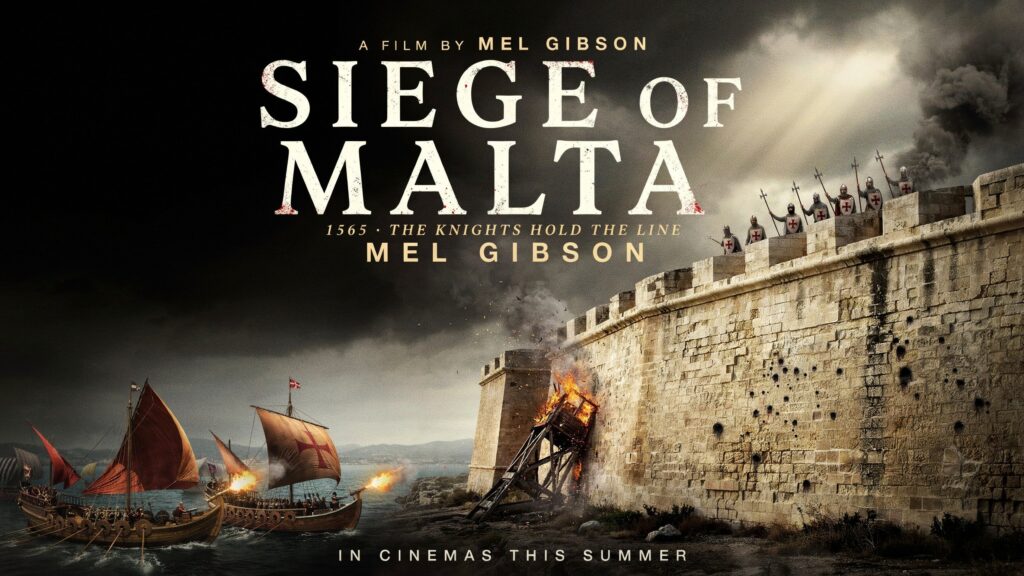
The Battle Within the Battle
The Ottomans made their first tactical mistake immediately. Instead of attacking the main fortifications at Birgu and Senglea — where the knights were concentrated — they went for Fort St. Elmo first. The small fort guarding the harbor entrance. They calculated it would fall in three days. Maybe five.
It held for thirty-one.
Thirty-one days of siege against the full weight of the Ottoman force. The fort’s defenders knew they were holding a death assignment. De Valette sent replacements across the harbor at night. The wounded got evacuated. And still the garrison held. When it finally fell at the end of June, the Ottoman losses were so catastrophic that one of their commanders allegedly looked at the fort’s smoldering ruins and said that if this small fort had cost so much, what would the main fortifications cost them?
The answer was: everything. The Ottomans never took the main harbors. They besieged Birgu and Senglea for months. They tried tunneling. They tried mass assault. They launched repeated attacks that cost them thousands of soldiers each time. Dragut Reis — the legendary Barbary corsair who was one of the most feared naval commanders in the Mediterranean — was killed by shrapnel during the siege of St. Elmo. The loss hit Ottoman morale hard.
September came. A relief force finally arrived from Sicily, smaller than hoped but enough. The Ottomans had lost somewhere between 25,000 and 35,000 men. They withdrew.
Voltaire later described it as the best-known event of the era. That’s not hyperbole for his time. In 1565, Europeans saw the Ottoman advance as basically inevitable. This was the empire that had taken Constantinople, taken Rhodes, taken half of Hungary. The idea that a few hundred knights on a limestone island could turn them back — it mattered. It changed the perception of what was possible.
Why Gibson for This Story?
There’s a pattern to what Mel Gibson makes as a director. You’ve noticed it even if you haven’t said it out loud. He keeps coming back to small groups of outnumbered people holding against overwhelming force through some combination of faith, stubbornness, and sheer physical courage.
William Wallace at Stirling Bridge. Jesus in Jerusalem. The Hacksaw Ridge story of Desmond Doss. And now — 700 knights in Malta.
The thematic fit is almost too obvious. But here’s the thing about obvious fits: they usually work. Gibson knows how to direct combat. The St. Elmo sequence alone — a garrison making a last stand in a disintegrating fort knowing that nobody is coming to save them — that’s the exact kind of material he can do in his sleep.
He also has the serious Catholic faith angle that gives these stories texture in his hands. The Knights of St. John were a religious military order. Their faith wasn’t background flavor — it was the actual motivation. De Valette wasn’t fighting for territory or gold. He was fighting for what he genuinely believed was Christendom’s survival. Gibson is one of the only filmmakers working today who could make that sincere without it feeling like a lecture.
What He’s Actually Said About It
Here’s the exact quote, because it’s worth reading:
“I’m also working on a TV limited series about the Siege of Malta, which is an incredible story, and there’s only one place to film that, I mean, in Malta. Because that’s where it happened, at these fortresses where 700 knights defended Malta against an onslaught from the Turkish and Suleiman sent 40,000 men and ships and, wow, the knights won. So, it’s a pretty crazy, great story.”
That word “wow” sitting in the middle of that sentence is very Mel Gibson. He’s been making movies for forty years and he still sounds like someone who just discovered an incredible story and can’t quite contain his excitement about it.
He also told LifeSite separately that three hours of script have been written for a series called “Siege.” That’s not nothing. Three hours of script is multiple episodes. That’s a real project with real work behind it, not a vague intention.
As for whether he’ll act in it himself — he was honest about the uncertainty. He said he’d like to be in it but doesn’t know if his schedule will allow it. He’s producing for certain. The acting is genuinely undecided.
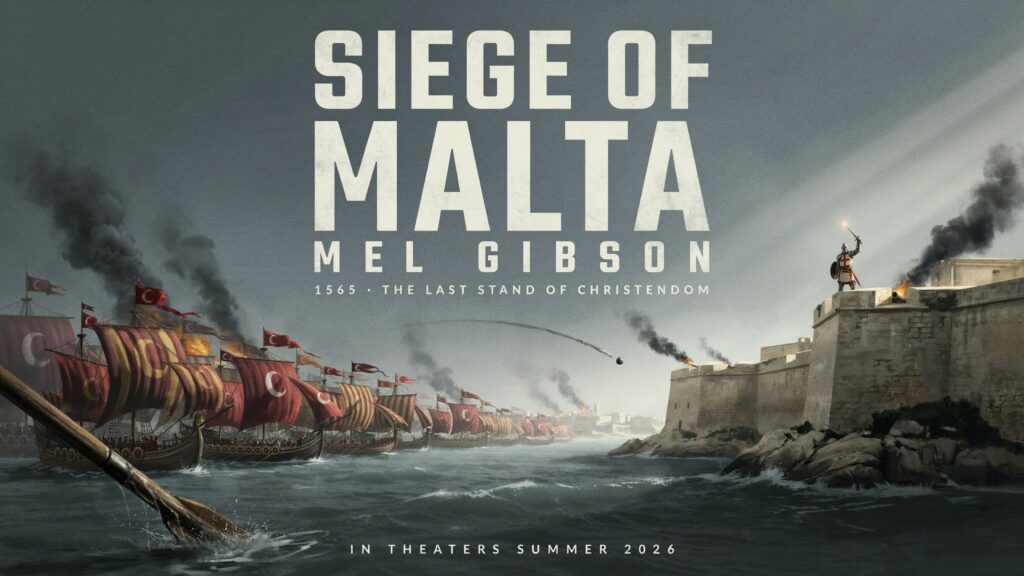
The Passion of the Christ Shadow Hanging Over All of This
You can’t talk about Gibson’s Malta projects without talking about The Passion of the Christ and its sequel. Because they’re happening simultaneously, with the same island as the backdrop, and because The Passion defines what his second act as a director looks like.
$612 million worldwide. From a movie in Aramaic and Latin with subtitles. That Gibson self-financed because no studio would touch it. It was the highest-grossing R-rated film ever made until Deadpool & Wolverine dethroned it in 2024. That’s an insane run for a movie Hollywood refused to distribute.
The sequel — The Passion of the Christ: Resurrection — has been in development since 2016. Six drafts of the script. Multiple revisions. Jim Caviezel confirmed returning as Jesus. Randall Wallace, who wrote Braveheart, co-writing. Gibson described the script as an “acid trip” in 2022 and noted it would partially take place “in other realms.” Whatever that means. Filming was supposed to start in 2025.
So Gibson is in Malta with two enormous religious-historical projects running in parallel, scouting locations for both, meeting the Prime Minister about what’s essentially a double film commission pitch. Only Mel Gibson.
The 2006 Elephant in the Room
Let’s talk about it, because not talking about it would be dishonest.
Gibson’s 2006 DUI arrest — and what he said during it — destroyed his Hollywood standing for years. The anti-Semitic remarks were genuinely ugly and got amplified in every direction. He apologized. Then apologized again. The apologies were debated for years in terms of their sincerity. His public standing cratered.
He came back. Hacksaw Ridge in 2016 got him Best Director and Best Picture Oscar nominations. The work spoke again. But the 2006 incident is always there in the background of any Gibson piece, and ignoring it in favor of just celebrating his comeback would be doing you a disservice.
What you can say honestly is this: whatever you think of the man personally, his track record as a director of large-scale historical epics with genuine faith dimensions is essentially unmatched in Hollywood right now. Nobody else is making these stories. Nobody else is putting real budget and real craft into medieval knights and biblical events and World War II conscientious objectors.
The Siege of Malta is exactly the kind of project that only exists because Gibson exists. Make of that what you will.
Malta’s Perspective: This Matters More Than You Might Think
For Malta, this is genuinely big. The island has been building a film production industry for decades — Gladiator was shot there in 1999, and Russell Crowe came back in 2024. Ridley Scott’s Napoleon filmed in Malta. The Jurassic World franchise uses it.
But a prestige limited series about the Great Siege — the defining event in Maltese national identity, the battle that gave them Valletta, named for the Grand Master who defended it — that’s different in kind. Not just economically. Culturally.
Prime Minister Abela met with Gibson directly. The Malta Film Commission facilitated the visit. The Maltese press covered it with notable enthusiasm. For a small island nation, having the biggest story in their history turned into an international prestige production is not a small thing.
And filming in the actual fortresses where it happened — Gibson was explicit about this being non-negotiable — means you’re looking at a production that would also function as a kind of national memorial in moving pictures. The stakes feel different when the walls in the background are the actual walls.
How Far Along Is This, Really?
Honest answer: early. Very early.
Three hours of script is meaningful. Location scouting is meaningful. But Gibson’s own language — “it’s going to be good for somebody,” “start filming in the coming years” — signals that this is a pre-production project, not a production one. There’s no announced network or streaming platform. No cast announced. No production timeline with specific dates.
The comparison that’s slightly worrying: The Passion of the Christ: Resurrection has been “in development” since 2016. Eight years of development with six drafts and still no greenlight announcement as of early 2025. Gibson works on his own timeline, which is one of the things that makes his projects distinctive and also one of the things that makes them take forever.
The Siege of Malta series could be two years away. It could be five years away. It could be one of those projects that spends a decade in development hell and emerges completely transformed. That’s the honest reality of where it sits right now.
But if it gets made — if Gibson actually produces this series on location in those 16th-century fortifications with a budget worthy of the story — it has the potential to be one of the most visually extraordinary historical series anyone has ever produced. The story is that good. The location is that good. And Gibson, whatever else you say about him, knows how to make these stories feel real in a way almost nobody else does.
Final Words
Straightforward opinion time. The Great Siege of Malta is one of the most extraordinary events in European history and it has never received a major screen treatment worthy of it. There have been minor documentaries. A 1953 British film that’s now largely forgotten. Nothing that matches the story’s scale.
A proper limited series — prestige budget, shot on location, written with real craft, produced by someone who genuinely cares about the faith dimension that drove these people — would be remarkable. The story has everything. Insane odds. A 70-year-old commander who’d been enslaved by the very enemy he’s now fighting. A fort holding out for a month past when it should have fallen. An empire that had never been stopped finding its limits on a limestone island in the middle of the Mediterranean.
If Mel Gibson makes this, watch it. Whatever complicated feelings you have about the man, his historical epics earn your attention. Braveheart is still in the cultural conversation thirty years later. Hacksaw Ridge changed how people thought about Desmond Doss.
The Siege of Malta deserves that treatment. It’s the last time someone gave it.
FAQs
1. Is Mel Gibson making a movie about the Siege of Malta?
It’s a limited TV series, not a film. Gibson announced in September 2024 that he’s developing a series called “Siege” about the Great Siege of Malta of 1565. Three hours of script had been written as of that announcement.
2. What is the Great Siege of Malta?
The defining military event of 1565, when an Ottoman force of 22,000–48,000 soldiers tried to take the island of Malta from the Knights Hospitaller. Around 8,500 defenders — including roughly 700 knights — held them off for nearly four months. The Ottomans withdrew in September 1565 having lost tens of thousands of soldiers.
3. Will Mel Gibson act in the Siege series?
He said he’d like to act in it but isn’t sure he’ll have time. His confirmed role is as producer.
4. Where will the Siege series be filmed?
Gibson explicitly said Malta is the only place to film it — because it happened there. He visited Valletta, Mdina, and Birgu during his September 2024 location scouting trip.
5. Who was Jean de Valette?
The Grand Master of the Knights Hospitaller who led the defense of Malta in 1565. He was 70 years old during the siege, fluent in six languages including Arabic and Turkish, and had personally been enslaved by Ottoman corsairs earlier in his life. Valletta — Malta’s capital — is named after him.
6. Why did Mel Gibson visit Malta in 2024?
Initially to scout locations for The Passion of the Christ: Resurrection. He met with Prime Minister Robert Abela and the Malta Film Commission. During the visit he became captivated by the Great Siege story and announced the limited series.
7. Is the Passion of the Christ sequel also filming in Malta?
Yes — The Passion of the Christ: Resurrection has Malta as one of its planned filming locations, alongside Israel, Morocco, and Italy. Gibson was reportedly considering a 2025 production start.
8. How much script has been written for the Siege series?
Gibson told LifeSite that he and his team had written “3 hours of a series called Siege” as of late 2024.
9. Who is writing the Siege script?
Gibson described his collaborator as “a very talented writer” but did not name them publicly.
10. When will the Siege series start filming?
No specific date has been announced. Gibson said it would “start filming in the coming years.” It remains in early development.
11. Is there a network or streaming platform attached?
Not as of the last public announcements in late 2024. No distributor or network has been named.
12. What other historical epics has Mel Gibson directed?
Braveheart (1995), which won five Academy Awards including Best Picture and Best Director. The Passion of the Christ (2004), which grossed $612 million. Apocalypto (2006). Hacksaw Ridge (2016), which earned Best Director and Best Picture nominations.
Discover stories that stand at the top with The Pinnacle Magazine.