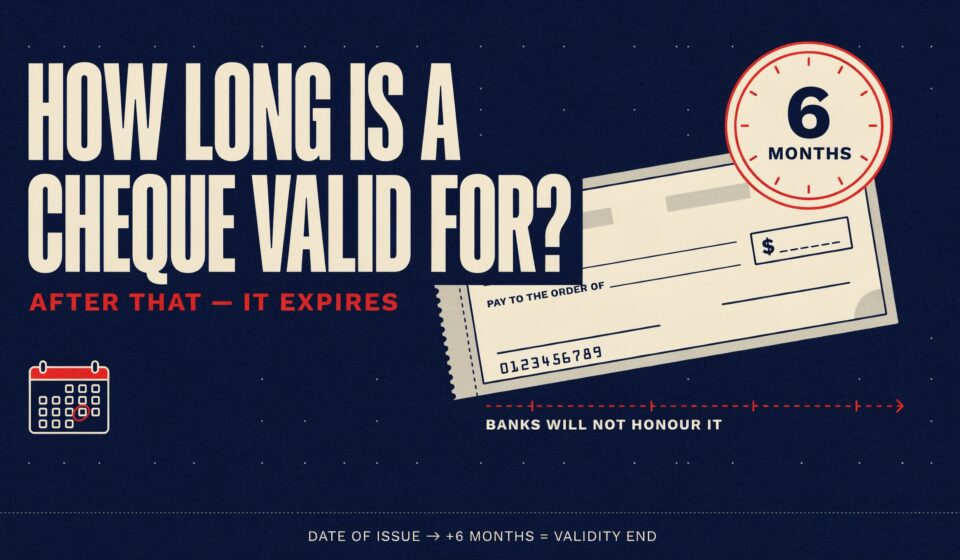

Quick Facts
| Category | Details |
| UK Standard Validity | 6 months from date written |
| UK Legal Maximum | Up to 6 years (Statute of Limitations) — banks won’t honor it though |
| US Standard Validity | 6 months — governed by UCC Section 4-404 |
| US Treasury Checks | 1 year from issue date |
| Australia Standard Validity | 15 months under the Cheques Act 1986 (Cth) |
| Canada Standard Validity | 6 months from date of issue |
| India Standard Validity | 3 months from date of issue |
| UAE Standard Validity | 6 months from date written |
| “Stale” Definition | A cheque that’s past the standard validity window |
| UK 2024 Cheque Volume | 91 million cheques processed — down 17% on prior year |
| Australia: Cheques ending | System being wound down — expected completion 2030 |
| Australia 2024–25 Stale Returns | 1.8 million cheques returned as stale |
| Bank Draft / Cashier’s Cheque | Often valid longer — bank is the guarantor |
| Certified Cheques (US) | Excluded from 6-month UCC rule — bank has guaranteed them |
| UK 2018 Phase-Out Attempt | Government tried to abolish cheques — plan scrapped |
You found an old cheque at the back of a drawer. Maybe it’s a birthday gift you forgot to bank, a client payment that slipped through the cracks, or a rent deposit you never got around to depositing. Now it’s been sitting there for seven months. Eight months. Maybe longer.
Here’s the thing most people don’t know: the answer to “is this still valid?” is not as clean as you’d hope. And the answer is also different depending on which country you’re in.
The Universal Truth: Six Months Is the Magic Number (Mostly)
Almost everywhere in the world, six months is the standard threshold. UK, US, Canada, UAE — they all land on roughly the same number. But the reasons differ, the legal weight differs, and what happens after six months differs significantly.
In the UK, six months isn’t a hard legal expiry — it’s banking industry practice. The Statute of Limitations technically allows a cheque to remain enforceable for up to six years. But your bank will almost certainly refuse to process anything older than six months without a fight. They’ll call it “stale” and hand it back to you.
See also “The Google Gnome Launch Game: Why You Lost an Hour to a Trebuchet in 2018 (And Maybe Again Today)“
The UK Situation Specifically
Let me be specific about what “stale” means in practice in the UK. It means your bank considers the cheque suspicious. Too much time has passed. The account holder may have changed banks, closed the account, or stopped payment. The risk calculus shifts.
UK Finance data shows 91 million cheques were still processed in 2024 — a 17% drop from the year before, but still an enormous number. The UK tried to kill off cheques entirely in 2018 and backed down because enough people and businesses still depend on them. Cheques aren’t going anywhere in the near term, so this question matters.
Most individual cheques printed in the UK don’t have an expiry date stamped on them. The six-month rule exists as policy rather than print. But some cheques — particularly corporate or government-issued ones — will say “Valid for 90 days” directly on the face of the document. That printed instruction overrides the six-month norm. Ignore it at your own risk.

The US: A Law Called UCC 4-404
American cheques have actual legislation behind the six-month rule. The Uniform Commercial Code — which governs commercial transactions across US states — includes Section 4-404, which explicitly states that a bank is not obligated to honour a cheque presented more than six months after the issue date.
The exact language is worth noting: not obligated doesn’t mean they must refuse. Banks in the US have discretion to honour a stale cheque in good faith if the account has funds and the payment looks legitimate. Some do. Many don’t. Your mileage genuinely varies depending on your bank, your relationship with them, and whether the account still exists.
The terminology in the US is slightly different — it’s “stale-dated” rather than “expired.” And that distinction matters. A stale check is not an invalid check in a strict legal sense. The bank can choose. That’s the rule.
Government checks work differently. US Treasury checks are valid for twelve months from issue. After that, if your federal tax refund cheque is sitting in a pile somewhere, you need to contact the IRS directly for reissuance. State and local government cheques follow varying state laws — sometimes six months, sometimes a year. You have to check with the specific issuing agency.
Australia Is Different and Nobody Talks About It
This is the one that surprises people. Australia has a longer window than almost anywhere else.
Under the Cheques Act 1986 (Cth), a cheque becomes stale after 15 months from the date it was drawn. Not six months. Fifteen. That’s more than double the UK and US standard.
The practical picture is messier though. Australian banks often treat personal and business cheques as stale after just six to nine months, regardless of the 15-month legislative benchmark. Bank cheques — where the bank itself is the drawer — are more likely to be accepted up to the 15-month mark. Personal cheques between individuals? Some banks are tightening that window significantly.
In the 2024–25 financial year, Australian financial institutions returned 1.8 million cheques as stale. That’s a real number representing real money that didn’t reach its intended recipient. And the clock is already ticking on the whole system — Australia’s Treasury has published a formal transition plan to wind down the national cheque infrastructure entirely by around 2030.
The Post-Dated Cheque Complication
Post-dated cheques — where the date written on the cheque is in the future — work differently in different places. And getting this wrong costs people money.
In Canada, banks are specifically not supposed to cash a post-dated cheque before the written date. If they do it by accident, the account holder has grounds to demand correction. In Australia, post-dated cheques are legally not payable before the date on their face. The legislation is clear.
In the UK and US, the rules are softer. Post-dated cheques are technically negotiable instruments — meaning a bank could process them early. In the UK, post-dating a cheque carries no legal weight and a bank can cash it before the written date. This catches people completely off guard.
Practically speaking, if you write a post-dated cheque and expect someone to wait, the only safe approach is to directly instruct your bank in writing not to process it before a specified date. Don’t assume the date on the cheque will hold things up.
Cashier’s Cheques and Bank Drafts: A Different Category
Bank-issued instruments operate under different rules from personal cheques. This distinction matters enormously if you’re sitting on one.
In the US, certified cheques are explicitly excluded from UCC 4-404’s six-month rule. The bank has already guaranteed that payment — the funds are earmarked. The legal deadline for enforcing a certified cheque, cashier’s cheque, or teller’s cheque is three years after you demand payment from the issuing bank, not six months from the written date.
In the UK, bank cheques don’t technically expire at all — the bank as issuer remains liable. In practice, taking a very old bank cheque to a teller will still raise eyebrows and may result in a phone call to verify. But the legal position is different from a personal cheque someone signed in their kitchen.
Australia follows a similar pattern: bank cheques are treated more generously, with the 15-month window being more reliably observed for them than for personal cheques.
What to Actually Do With an Old Cheque
Here’s the practical guide, because that’s ultimately what you’re here for.
If the cheque is under six months old: Deposit it. Immediately. Today. Don’t let it sit another week. The longer you wait, the more variables can go wrong. Account closures, stop payments, changed circumstances. Get it in.
If the cheque is between six and twelve months old (UK): Try to bank it. Some banks will process it, particularly if you have a good relationship with them. If the teller pushes back, ask for it to be manually reviewed rather than automatically rejected. If that fails, contact the issuer and explain the situation. Most will issue a replacement without drama.
If the cheque is over twelve months old: Don’t walk into a bank and hope for the best. Contact the person or organisation that wrote it first. Be direct — explain you still have the original, that you never got around to depositing it, and ask whether they’d prefer to issue a replacement or whether you can try to bank the original. Replacing is usually cleaner for everyone.
If you’re in Australia and it’s under 15 months: You have more runway than you think, but don’t test it with a personal cheque. Call your bank before depositing.
The Real Reason This Matters More Than People Realise
Here’s something most articles skip: cheque validity matters for businesses in a way it doesn’t for individuals.
If your company accepts cheques as payment and you let one sit in a drawer for eight months, you could end up in a situation where the bank won’t honour it and you’re chasing a customer for a payment they thought they already made. That’s an awkward conversation and a potential cash flow problem.
The rule applies from the date written on the cheque — not the date you received it. So if a client sends you a cheque dated the first of the month and it takes two weeks to reach you in the post, your six-month clock started two weeks ago. Not from today.
Australia returned 1.8 million stale cheques in a single year. The administration costs for businesses and individuals chasing replacements for that volume of payments is real and significant.
Is There Anything You Can Do With a Truly Expired Cheque?
Let’s be blunt: after six months in the UK, twelve months in the US, or 15 months in Australia, your options narrow considerably.
Legally, you might have grounds under the Statute of Limitations — six years in the UK, for example. But you’re not going to march into Barclays with a 2022 personal cheque and win that argument at the counter. The bank’s operational policy and the legal position are different things.
Your realistic options are: contact the issuer for a replacement, take the matter to small claims court if the issuer refuses and the amount is significant, or accept the loss if neither is worth pursuing. Small claims court for an expired birthday cheque from your aunt is probably not where you want to spend an afternoon.
Final Words
Here’s my honest take. The six-month rule is almost universal. And most people who end up with stale cheques got there through simple procrastination. You got the cheque, put it somewhere safe, forgot about it, and now it’s March and the thing is dated August.
The solution isn’t complicated. Bank cheques immediately or within a week of receiving them. Every time. No exceptions for “I’ll do it next week.” One in 1.8 million Australians who got stale-cheque returns last year said the same thing to themselves at some point.
Different countries, different rules — but the behaviour that prevents problems is identical everywhere. Deposit fast. If you’ve missed the window, contact the issuer. Don’t assume the bank will be flexible just because the legal maximum is technically six years. Banks operate on policy, not legal maximums.
And honestly? If you’re still receiving regular payments by cheque in 2026, it might be worth having a quiet conversation with your payer about bank transfer instead. Faster, cleaner, no expiry date.
FAQs
1. How long is a cheque valid in the UK?
Six months from the date written on the cheque — that’s the standard banking practice. Technically the Statute of Limitations allows up to six years, but UK banks almost universally refuse to process cheques older than six months. Some cheques have shorter windows printed on them, like 90 days, which takes precedence.
2. How long is a check valid in the US?
Six months under UCC Section 4-404. After that it becomes “stale-dated” and banks are no longer obligated to honour it — though they can choose to do so at their discretion. US Treasury checks are valid for one year from issue.
3. How long is a cheque valid in Australia?
15 months under the Cheques Act 1986 (Cth). However, many Australian banks treat personal and business cheques as stale after 6–9 months. Bank cheques are more likely to be honoured up to the 15-month mark. Australia is also phasing out cheques entirely by around 2030.
4. What happens if I try to deposit an expired cheque?
Most banks will reject it. Some may process it if the account has sufficient funds and the payment looks legitimate, particularly for cheques not too far past the threshold. Your best move is to contact the cheque issuer and request a replacement rather than hoping the bank will let it through.
5. Does the six months start from when I received the cheque or when it was written?
When it was written — the date printed on the cheque itself. Not the postmark, not when you received it, not when you tried to deposit it. This is a common misunderstanding that catches people out when postal delays eat into their window.
6. Can a bank still process a cheque after six months?
Yes — discretionally. Banks aren’t required to honour stale cheques, but they’re also not required to refuse them. Some banks will process stale items if the account is active and funded and the bank acts in good faith. Some charge a fee for this. None of them are obligated to do it.
7. Are certified cheques and cashier’s cheques subject to the same rules?
No. In the US, certified cheques are excluded from the UCC’s six-month rule because the bank has already guaranteed the funds. The legal deadline for enforcing one is typically three years after you demand payment. Bank drafts and cashier’s cheques follow similar logic across most countries.
8. What does “stale cheque” mean?
A cheque that’s past the standard validity window — typically six months for most personal cheques, 15 months in Australia. “Stale” doesn’t mean legally void; it means the bank is no longer obligated to process it and may refuse at its discretion.
9. Can I post-date a cheque to delay when it’s cashed?
This depends on your country. In Canada and Australia, banks generally won’t cash post-dated cheques before the written date. In the UK, a post-dated cheque has no legal protection — a bank can process it early. If you need to delay payment, speak to your bank directly and put the instruction in writing.
10. What should I do if someone refuses to honour an expired cheque I wrote?
If you’re the cheque writer and someone is trying to deposit an old cheque you’ve already accounted for as void, you can contact your bank. Most banks allow stop payment orders, though these have their own validity periods. If the money has already been reissued, explain that to the payee and to your bank.
11. Are cheques being phased out?
In some countries, yes. Australia has a formal government-backed plan to wind down its cheque infrastructure by around 2030, with the final cheques expected to become stale by September 2029. The UK attempted to phase out cheques in 2018 but reversed the decision due to ongoing demand. Cheque volumes have fallen dramatically globally but haven’t reached zero anywhere yet.
12. Can a cheque expire before I even receive it?
Practically, it would take extraordinarily slow mail. But yes — if someone writes you a cheque in February with a date of August the previous year, you’d be trying to deposit a six-month-old cheque on arrival. Always check the date when you receive a cheque, not when you go to deposit it.
Discover stories that stand at the top with The Pinnacle Magazine.