What Is Manspreading: The Word That Broke the Internet, Got People Arrested, and Still Hasn’t Been Settled

Here’s a fact that still makes people do a double take: in 2015, two men were reportedly arrested on the New York City subway for sitting with their legs spread too wide. Not for drugs. Not for threatening anyone. For how they were sitting. The charge was “improper use of a subway seat,” which is technically a real thing, and the arrests were later cited in a police reform report as an example of selective enforcement against Latino men. A debate that started on Tumblr about personal space etiquette had officially made it into civil liberties territory.
That’s manspreading. Start to finish, it’s more complicated than it sounds.
Quick Facts
| Info | Detail |
| Term | Manspreading (also: manspread) |
| Definition | A man sitting in public with legs spread wide, occupying space beyond his own seat |
| Origin | Tumblr shaming blogs, 2013; term coined in print by AM New York, October 6, 2014 |
| Oxford Dictionary | Added August 2015 |
| Cambridge Dictionary | Also defines it; informal designation |
| First mainstream coverage | New York Times, December 20, 2014 |
| MTA campaign | “Courtesy Counts” — “Stop the Spread, Please,” launched December 2014 |
| Cities that banned it | Madrid (buses, 2017); New York City campaign (not outright ban) |
| Arrests? | Two men reportedly arrested May 2015, later cleared — cited in NYPD reform documents |
| Word family | Modeled on “mansplaining”; coordinate term “womanspreading” exists |
| Most manspread age group | Studies suggest men 30–49 are the most common offenders |
| 2019 design response | Laila Laurel’s anti-manspreading chair won a London design award |
Where It Started: Tumblr, Shame Blogs, and Subway Photography
The word didn’t emerge from a dictionary committee or a transit authority memo. It came from ordinary people on Tumblr who were fed up and started taking photos.
Around 2013, a handful of accounts dedicated themselves to documenting the specific annoyance of men taking up more than one seat on public transit — legs flung outward into adjacent space, knees practically in the next zip code. The most recognized was “Men Taking Up Too Much Space on the Train,” which became a reference point for the entire conversation. Anyone could submit a photo. The submissions kept coming.
The word itself first appeared in print on October 6, 2014, in AM New York — a free paper handed out to commuters. A local reporter quoted subway riders complaining about the habit. Two days later, the New York Times picked it up in the context of the MTA announcing a new courtesy campaign. From local transit blog to the paper of record in 48 hours.
See also “BigCashWeb Review: The $1 Payout App That Actually Does What It Says — Mostly“
The MTA Campaign That Made It Global
New York’s Metropolitan Transportation Authority has been running etiquette campaigns since basically the beginning of mass transit. A 1940s poster from artist Amelia Opdyke Jones said simply: “Don’t Be a Seat-Hog.” A 1970s Tokyo subway poster featured a wide-legged silhouette with the caption “The Seat Monopolizer.” This is not a new complaint.
But the MTA’s December 2014 “Courtesy Counts” campaign accidentally detonated something. Their posters said “Stop the Spread, Please” and showed riders taking up unnecessary space. They pointedly did not use the word “manspreading” — the agency knew the political charge on it and kept their language gender-neutral. But by that point, the internet had already attached the word to the concept and wasn’t letting go.
By December 23, 2014 — barely three days after the campaign launched — the Times of India was running pieces about Mumbai’s own version of the problem. The term appeared in publications across England, Australia, the Netherlands, Germany, and South Korea that same week. Helen Mirren told an interviewer she’d personally experienced a fellow rider doing “the classic manspreading thing” and observed: “They’ve always done it!” Tom Hanks had to publicly defend his subway posture after being photographed mid-commute.
A transit etiquette campaign about seat hogging had become an international gender debate. In about 72 hours.
What Manspreading Actually Looks Like (And How Wide Is Too Wide)
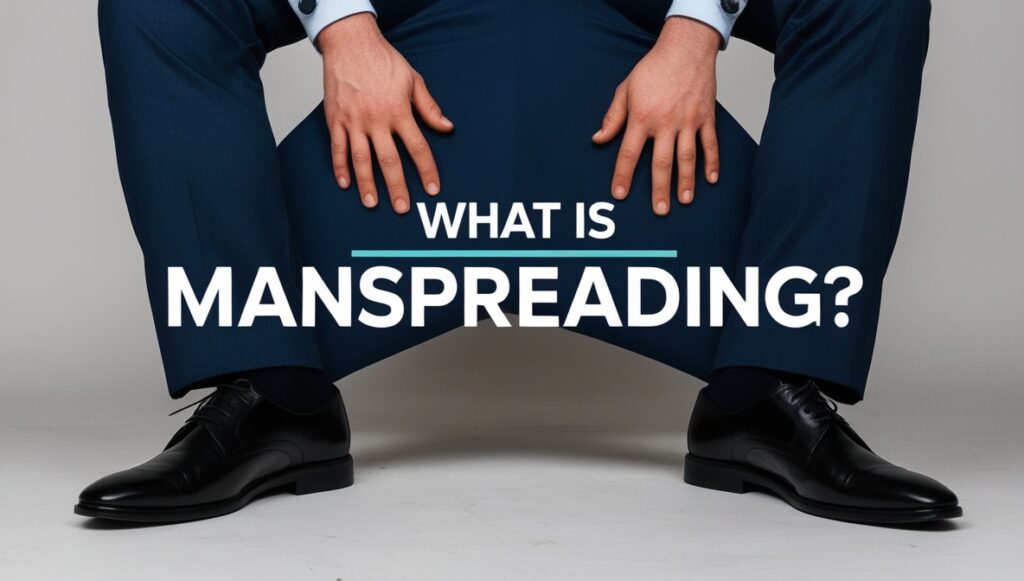
The behavior itself isn’t complicated to describe. Man sits down on public transit — subway, bus, commuter train. Instead of keeping his legs relatively parallel and within the boundaries of his assigned seat, he angles his knees outward, feet planted wide apart, thighs spread into the seat on either side of him. The person next to him either gets pushed against the edge of their own seat or loses half of it entirely.
That’s the complaint. The extreme version — legs genuinely extending past 45 degrees in either direction into neighbor territory — is what the photographs documented and what the campaigns targeted.
The non-extreme version is where it gets more subjective. A man sitting with his feet a few inches apart, legs at a comfortable angle, not actually touching anyone? Most of the people who coined the term weren’t talking about that. But that nuance got lost almost immediately once the debate went international and became a political football.
The Biology Argument: Is There Anything to It?
Here’s where the debate gets genuinely complicated rather than just culturally noisy.
Some researchers and kinesiologists have argued there’s a partial anatomical basis for why men tend to sit with their legs wider than women. The average man’s shoulders are roughly 28% wider than his hips, compared to about 3% for women. Women tend to have a wider pelvis and a bone structure that naturally angles the knees inward toward the body’s midline when sitting. Men’s knees may angle slightly outward by default, though the degree varies significantly by individual.
Additionally, anyone who has stood on a moving subway car knows that a wider stance feels more stable. Sitting may follow similar logic — a broader base in a lurching vehicle is instinctively more secure.
The counterargument, raised by multiple anatomists and physiologists, is that these structural differences explain a modest natural lean — not 18 inches of knee spread into adjacent seats. There’s no established medical reason why men need to occupy two seats to maintain their reproductive health or any other physiological function. Biology professors who reviewed the “manspreading is natural” argument pointed out that bone structure guides a tendency, not a mandate. Men who dance, do martial arts, or work desk jobs cross their legs, sit with knees together, and manage fine.
No single controlled scientific study has definitively resolved the question. The Wikipedia entry on manspreading states this plainly: there is no scientific study explaining the physiology of the phenomenon. What we have is anatomical theory, competing claims, and a lot of people in comment sections very certain about things they’ve never actually measured.
Madrid Said No, and Here’s How That Went
In 2017, Madrid became the first city to formally prohibit manspreading on public buses. The city’s Municipal Transport Company kitted out 2,000 buses with pictogram stickers — a man sitting with knees spread wide, red bar across the image, “Respect other people’s space” in text alongside it.
The campaign was launched in connection with the feminist collective “Women Fighting” and their #MadridSinManspreading Twitter campaign. The stickers went next to signs about phone usage and cleanliness. A formal ban, not just a request.
Some Madrid riders welcomed it emphatically. Others thought it was an overcorrection. The broader debate about whether banning specific sitting postures was enforceable, constitutional, or genuinely necessary got about as heated as you’d expect. But the stickers stayed.
The Arrest Situation: What Actually Happened in 2015
In May 2015, the advocacy group Communities United for Police Reform released a document that included reports of NYPD enforcement actions. Within it: at least two men had been arrested on subway cars and charged with “improper use of a seat” — essentially for sitting with their legs too wide apart.
Gothamist covered it. National outlets picked it up. The phrase “arrested for manspreading” was everywhere.
The full picture was more complicated. The charges were subsequently cleared. The report used the incidents as examples of broken windows policing tactics that the group argued disproportionately targeted men of color — specifically Latino men in these cases. The question wasn’t really whether sitting with wide legs warranted a courtesy nudge. It was whether it warranted handcuffs, and whose legs were getting that level of law enforcement attention versus whose weren’t.
The arrests became a flashpoint for a much larger argument about selective policing that had nothing to do with transit etiquette specifically.
The Anti-Manspreading Chair That Won a Design Award
In 2019, British design student Laila Laurel submitted a project for the New Designers award at the London Design Fair. One piece: a chair built specifically to prevent manspreading. The seat was designed with inward-angled curves that encouraged sitting with legs closer together.
She won the award in her category. The internet rediscovered manspreading all over again. The arguments that had dominated 2014 and 2015 restarted more or less from scratch.
There was also a companion chair designed to encourage women to take up more space when seated. The pairing was intentional — the commentary was about who gets permission to take up space in public and who doesn’t. Whether you found that insightful or heavy-handed probably depended significantly on where you already stood on the original debate.
The Power Display Theory: Is It About Dominance?
Here’s the psychological angle that doesn’t get enough attention in the anatomy-versus-etiquette debate. Nonverbal behavior researchers have consistently linked expansive postures — wide stances, spread limbs, taking up space — to perceived dominance, status, and social power.
A UC Berkeley study found that people who took up more physical space in photographs were rated as more desirable romantic partners. Body language researchers going back to at least Erving Goffman’s 1979 work Gender Advertisements documented systematic differences in how men and women position themselves in public — with men consistently occupying more physical space. Sociologist Raewyn Connell frames this as part of what she calls the “patriarchal dividend” — the collection of accumulated advantages that accrue to men in social structures organized around male dominance, including the unstated permission to physically claim shared space.
This doesn’t prove that every guy whose knees drift outward on the L train is consciously signaling status. Most of them aren’t thinking about it at all. But the patterns of behavior that we learn and normalize exist in a social context, and that context shapes what feels natural to whom.
Final Words
Here’s my actual position on this, after going through everything. Manspreading at its core isn’t complicated. If your legs are genuinely occupying a seat that another person could use in a crowded vehicle, that’s a problem of basic consideration — the same problem as a giant backpack taking up a rack, or feet on a seat, or a phone on speaker. It has nothing to do with gender theory or feminism or any of the larger frameworks that got imported into the conversation.
The anatomy argument has a grain of truth and a lot of exaggeration. Yes, male skeletal structure may create a slight natural tendency toward a wider stance. No, that does not physically require a man to seat himself with his knees in two separate time zones. People adjust how they sit in crowded spaces all the time, based on context and consideration. Men do it too, when they choose to.
The debate became so politically charged so quickly that the original complaint — could you move your knee, you’re sitting on half my seat — got buried under an avalanche of cultural commentary. Which is its own kind of irony: a conversation about taking up too much space got taken over by people taking up too much space in the conversation.
The practical answer is simple: in a full transit car, keep your legs within your seat’s footprint. The political answer is more complicated and probably never getting fully resolved.
FAQs
1. What does manspreading mean?
It describes a man sitting in a public space — most commonly on public transit — with his legs spread so wide that he takes up more than his allocated seat space, pushing into adjacent seats or crowding neighboring passengers. It’s primarily an etiquette issue about shared space on crowded transport.
2. Where did the word come from?
Tumblr blogs photographing and shaming the behavior starting around 2013, with the actual word first appearing in print in AM New York on October 6, 2014. The New York Times picked it up two days later and it went global within a week. Oxford Dictionaries added it officially in August 2015.
3. Is manspreading illegal?
Not as a standalone crime anywhere. Madrid banned it on buses in 2017. New York’s MTA ran a campaign against it but didn’t criminalize it. The two men reportedly arrested in New York in 2015 were charged under an existing ordinance about improper use of a seat, and those charges were cleared.
4. Is there a biological reason men spread their legs?
Partially, and contested. Men’s hip structure and slightly higher center of mass may create a natural tendency toward a wider stance. Women’s wider pelvis and inward-angling femur may make sitting with knees together more natural for them. However, no controlled study has established that these differences require the degree of spreading that the term describes, and physiologists note that anatomy guides tendencies, not mandates.
5. Did the MTA ban manspreading?
No. The MTA launched its “Courtesy Counts” campaign in December 2014 — which included “Stop the Spread, Please” messaging — but specifically avoided using the word manspreading in their official materials. It was a courtesy campaign, not a legal prohibition.
6. Is manspreading a feminist issue?
It became one in public discourse. The behavior was framed in some analyses as an expression of male entitlement to public space, connected to broader patterns of how men and women occupy shared environments differently. Others argued the feminist framing was an overreach applied to simple bad manners. Both perspectives have significant representation in the literature.
7. Have other cities addressed it beyond New York and Madrid?
The Toronto Transit Commission was pressured to adopt a ban and declined, citing concerns that the term unfairly targeted male passengers. Tokyo has had subway etiquette campaigns addressing the behavior (without the word) since at least the 1970s. The debate appeared in Australia, Netherlands, Germany, South Korea, and India following the 2014 MTA campaign.
8. Who is most likely to manspread according to studies?
The limited data available suggests men between 30 and 49 are most commonly observed engaging in the behavior. Beyond that, research is sparse — there’s no comprehensive demographic study.
9. What is the Laila Laurel chair?
A chair designed by British student Laila Laurel to structurally discourage wide-leg sitting, submitted to the New Designers award at the London Design Fair in 2019. She won her category. The project was paired with a chair designed to encourage women to take up more space when seated.
10. Is there a “womanspreading” equivalent?
The term exists — it appears as a coordinate term in Wiktionary — but refers less to legs and more to bag placement: taking up extra seats with bags, placing belongings on adjacent seats, or otherwise occupying space beyond one’s own. It’s considerably less culturally prominent in the debate.
11. Does manspreading signal dominance?
Research on nonverbal behavior has connected expansive sitting and standing postures to perceptions of dominance, confidence, and social status. A UC Berkeley study found people in expansive poses were rated as more romantically attractive. Whether individual men who manspread are consciously doing this is a separate question — most aren’t. But the broader pattern fits within documented research on gendered use of public space.
12. What’s the simplest rule to follow?
If the train is full, your legs should fit within the width of your seat. If there are empty seats on both sides of you, no one cares. Context and consideration are the variables.
Discover stories that stand at the top with The Pinnacle Magazine.