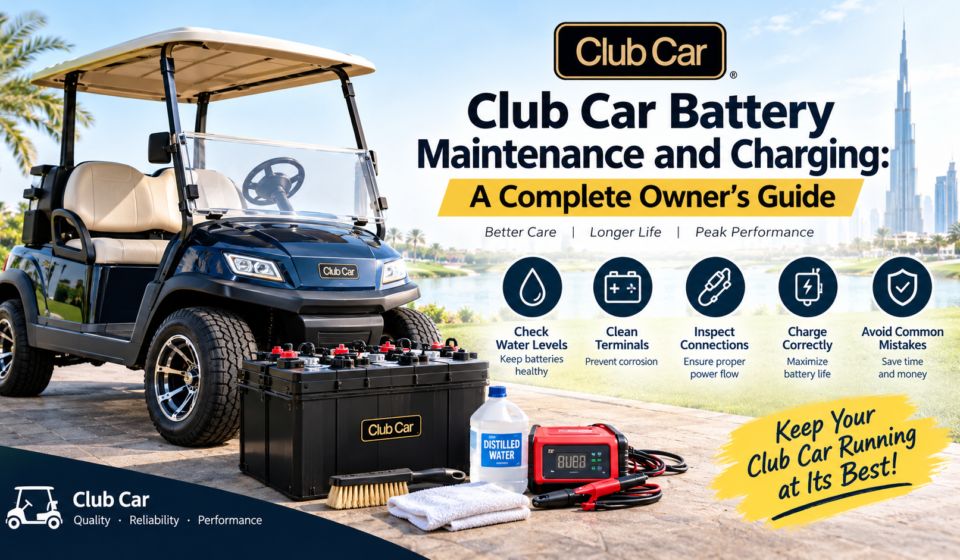

If you own a Club Car golf cart, proper battery care is essential for maximizing performance, extending battery life, and avoiding costly replacements. Whether you use your cart for golf courses, resorts, communities, or commercial purposes, following a regular club car battery maintenance routine can significantly improve efficiency and reliability.
This guide covers everything you need to know about battery maintenance, charging practices, and troubleshooting tips.
Why Club Car Battery Maintenance Matters
The battery pack is the heart of any electric Club Car vehicle. Neglecting maintenance can lead to reduced driving range, slow charging, corrosion, and premature battery failure.
Regular club car battery maintenance helps:
- Extend battery lifespan
- Improve driving range
- Reduce replacement costs
- Prevent corrosion and electrical issues
- Maintain optimal performance throughout the year
Club Car recommends regularly checking water levels, cleaning battery terminals, and ensuring proper charging habits.
Understanding Club Car Batteries
Most Club Car electric golf carts use deep-cycle lead-acid batteries, although some newer models may feature lithium battery systems.
Lead-acid batteries require:
- Regular watering
- Proper charging
- Clean terminals
- Routine inspections
Without proper care, battery capacity can decrease significantly over time.
Club Car Battery Maintenance Checklist
1. Inspect Water Levels Regularly
One of the most important parts of club car battery maintenance is checking electrolyte levels.
Best practices include:
- Check battery water levels monthly.
- Use only distilled water.
- Add water after charging whenever possible.
- Never overfill the cells.
- Ensure battery plates remain covered.
Using tap water can introduce minerals that may reduce battery performance and lifespan. Distilled or deionized water is recommended.
2. Keep Battery Terminals Clean
Corrosion on terminals can reduce power flow and charging efficiency.
To clean batteries:
- Disconnect the cart.
- Mix baking soda and water.
- Clean battery tops and terminals carefully.
- Rinse gently and allow to dry.
- Apply terminal protection spray if available.
Club Car recommends cleaning terminals regularly to prevent resistance and power loss.
3. Check Cable Connections
Loose battery connections can create resistance, increase amperage draw, and reduce run time.
Inspect:
- Terminal bolts
- Battery cables
- Wire insulation
- Corrosion buildup
Replace damaged cables immediately and ensure all connections remain secure.
4. Inspect Battery Hold-Downs
Battery movement during operation can shorten battery life and damage internal components.
Make sure:
- Batteries are securely mounted.
- Hold-downs are not overly tight.
- There is no excessive vibration during operation.
Proper Club Car Battery Charging Practices
Correct charging habits are just as important as maintenance.
Charge After Every Use
A common mistake is waiting until batteries are nearly empty before charging.
Experts recommend:
- Charging batteries after each use.
- Avoiding long periods in a discharged state.
- Keeping batteries fully charged whenever possible.
Avoid Deep Discharges
Deep discharges place additional stress on lead-acid batteries.
For optimal battery life:
- Try not to discharge below 50%.
- Avoid leaving batteries completely drained.
- Recharge promptly after use.
Use the Correct Charger
Always use a charger compatible with your Club Car model and battery type.
Using an incorrect charger can:
- Cause undercharging
- Cause overcharging
- Reduce battery lifespan
- Damage battery cells
If batteries are replaced with a different type or brand, charging settings may need adjustment.
Charge in a Well-Ventilated Area
Lead-acid batteries can release gases during charging.
Safety recommendations include:
- Charging in open or ventilated spaces
- Keeping sparks and flames away
- Inspecting chargers regularly for damage
Common Battery Maintenance Mistakes
Avoid these mistakes to get the most from your batteries:
Adding Water Before Charging
Adding water before charging may cause overflow and acid loss.
Instead:
- Charge first.
- Add distilled water afterward.
- Only add water before charging if battery plates are exposed.
Using Tap Water
Tap water often contains minerals that can damage battery cells over time.
Use only:
- Distilled water
- Deionized water
Leaving Batteries Discharged
A discharged battery can suffer permanent damage if left unattended.
Recharge batteries as soon as possible after use.
Signs Your Club Car Batteries Need Attention
Watch for these warning signs:
- Reduced driving range
- Longer charging times
- Slow acceleration
- Corroded terminals
- Swollen battery cases
- Excessive water consumption
If these symptoms persist, professional testing may be necessary.
Battery Storage Tips
If your Club Car will be stored for an extended period:
- Fully charge batteries before storage.
- Store in a cool, dry location.
- Inspect batteries periodically.
- Keep terminals clean.
- Recharge as needed during storage.
Conclusion
Consistent club car battery maintenance is the key to maximizing performance, extending battery life, and reducing operating costs. By checking water levels, cleaning terminals, using proper charging techniques, and avoiding common mistakes, owners can keep their Club Car golf carts running efficiently for years.
Following a regular maintenance schedule not only protects your investment but also ensures reliable performance every time you hit the road, course, or community trail.