

Here’s something most people don’t realize: before the Ironman was a household name, before every suburban dad was training for a “sprint tri,” a group of sorority women at the University of Tennessee were already doing it. And they were doing it for kids with cancer.
That’s the TriDeltathon story. And it’s messier, more human, and way more interesting than its Wikipedia stub suggests.
Quick Facts
| Detail | Info |
| Full Name | TriDeltathon |
| Origin Year | 1984 |
| Location | University of Tennessee, Knoxville, TN |
| Organized By | Delta Delta Delta (Tri Delta) sorority + Greater Knoxville Triathlon Club |
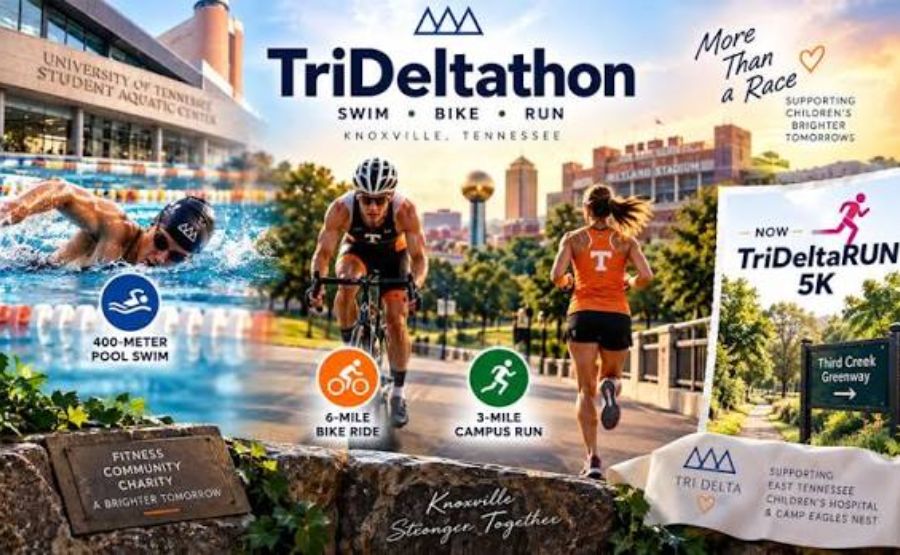
| Race Format | 400m pool swim → 6-mile bike ride → 3-mile run |
| Charity Beneficiary | East Tennessee Children’s Hospital / Camp Eagle’s Nest |
| Claimed Title | Oldest running pool triathlon in the United States |
| Peak Annual Participants | 400+ |
| 2020 Status | Canceled (COVID-19/UTK campus closure) |
| Current Evolution | TriDeltaRUN (5K, since 2022) |
| Tri Delta’s National Total for St. Jude | $185 million since 1999 |
This Race Started Before Most People Knew What a Triathlon Was
TriDeltathon reportedly kicked off in 1984, right when triathlon was still figuring itself out as a sport nationwide. Think about that timeline. The Ironman had only launched in 1978. Triathlon wasn’t even in the Olympics yet. And here’s this sorority chapter in Knoxville saying, “Yeah, let’s do a swim-bike-run, but make it a fundraiser.”
That’s genuinely wild. It’s the kind of origin story that sounds made up.
By 2020, the race was marketing itself as being in its 36th year, calling itself the oldest continuously running pool triathlon in the entire country. Whether you fully buy that claim or not — and you should approach organizer superlatives with healthy skepticism — 36 years of anything is legitimately impressive. Most charity 5Ks can’t survive a decade.
See also “trwho.com: The Tech Site That Wants to Teach Everyone — But Should It?“
The Course Was Actually Kind of Perfect
You want to know what made this race different from every other charity triathlon? The pool.
Swimmers tackled a 400-meter distance inside a heated facility, moving up one lane, ducking under the lane rope, crossing to the next, and weaving through the entire pool until the distance was covered. The three-mile run wound past Neyland Stadium and Thompson-Boling Arena, with water stations at miles one and two. The bike leg was a two-lap campus tour of roughly six miles with some rolling terrain broken up by a flatter stretch along Neyland Drive.
That pool setup is clever. Open-water swims terrify a huge chunk of the population. Indoor pool? Way more people say yes. Even a seven-year-old girl reportedly competed in it every year. That’s the range we’re talking about. First-timers and competitive triathletes side by side.
The course itself was basically a tour of one of college football’s most iconic campuses. You’re biking past Neyland Stadium. You’re running by Thompson-Boling Arena. If you’re a Tennessee fan, this race doubles as a nostalgia trip.
Why Sorority Women Were Running This Thing in 1984
Let’s talk about Tri Delta for a second, because they’re central to this whole story and not in the way you’d expect.
Delta Delta Delta — known everywhere as Tri Delta — is an international collegiate women’s fraternity whose commitment to children’s cancer charities stretches back to the early 1970s. At their 1974 convention, three separate charitable causes were consolidated into one unified philanthropy around children’s cancer.
That’s not PR fluff. That’s decades of institutional commitment before it became fashionable for brands to slap a pink ribbon on everything.
In 1999, Tri Delta formalized a partnership with St. Jude Children’s Research Hospital, and the numbers since then have been staggering. By early 2026, the sorority had raised more than $185 million for St. Jude total.
In 2024, Tri Delta became the first Greek organization in history to hit $100 million raised for St. Jude — a milestone that made national headlines in the philanthropy world.
Do you see what’s happening here? The TriDeltathon in Knoxville wasn’t some isolated cute event. It was one small gear in a massive philanthropic machine that these women had been building for fifty years.
The 400 Participants Who Showed Up Every Spring
At its peak, the TriDeltathon was drawing 400-plus participants annually, with Tri Delta members lining the entire course cheering on competitors. Race organizers pitched it specifically as an excellent beginner race.
That’s the detail that matters. This wasn’t a race for experienced triathletes to put on their résumés. It was a race designed so that someone who had never done a triathlon before could actually show up, finish, and feel like a hero.
The relay option made it even more accessible. You could enter as a solo competitor or as part of a relay team with each person covering one discipline. So you could grab two friends, divide up the swim, bike, and run, and suddenly a triathlon doesn’t feel like this impossible thing anymore.
That’s smart event design. And it kept the community coming back.
The Money Going to Kids Who Needed It
Here’s the part that actually matters. All of this — the early Sunday mornings, the chlorine smell, the hilly campus bike loop — was feeding money to sick kids.
Proceeds from the TriDeltathon went to East Tennessee Children’s Hospital, which houses Camp Eagle’s Nest, a summer camp specifically for children battling cancer.
That’s the kind of destination for race proceeds that makes you feel something. Not a vague “children’s fund.” An actual summer camp where kids with cancer get to just be kids for a little while.
In one early year of the race, Tri Delta had already secured over $8,600 through business donations before the event even happened. Pre-event corporate sponsorship wasn’t a given for charity events back then. That’s organizational hustle.
The 1999 edition was recognized as the top philanthropy event in the entire University of Tennessee Greek system. Against every other sorority and fraternity doing their own thing — and UT is not a small Greek community — this race won. That’s not nothing.
2020 Canceled It, and Something Shifted
The 2020 race was listed, registered, promoted — and then COVID-19 ended it. When the University of Tennessee moved to online learning for the rest of that academic year, the TriDeltathon was officially canceled.
It never quite came back in its original form.
What emerged instead was TriDeltaRUN, a 5K race that carried forward the connection between Tri Delta, charity fundraising, and the Knoxville community.
The TriDeltaRUN runs through the UT Gardens along the Third Creek greenway, still benefits East Tennessee Children’s Hospital and Camp Eagle’s Nest, and by 2026 had completed its fifth year.
It’s a different kind of event. Easier to organize, broader participation potential, no pool logistics. But you feel the DNA of the original. Same cause, same community, different format.
Whether the simplification is a loss or an evolution depends entirely on what you valued about the original. For the purists who loved the genuine triathlon challenge? Probably a bit of both.
What This Event Actually Represents
Here’s the thing nobody says out loud: the TriDeltathon mattered because it was weird and local and stubbornly itself.
It wasn’t backed by a major sports brand. It wasn’t trying to become a franchise. It was a sorority chapter at a state school in Tennessee throwing a triathlon in a pool they already had access to, for a children’s hospital in their own backyard.
Tri Delta has now committed to raising $100 million for St. Jude by 2038, the year of the organization’s 150th anniversary. The national ambition is enormous. But it all filters down through thousands of small events at chapters across the country.
The TriDeltathon was one of those events. It was doing something meaningful for 36 years before anyone wrote a magazine article about it.
That’s actually the best version of philanthropy. Quiet, consistent, effective.
Final Thoughts
Look, the TriDeltathon will never get a Netflix documentary. It’s not going to trend. But the numbers tell a real story: four hundred people showing up every spring for thirty-six consecutive years, money going directly to kids with cancer, college women learning what it feels like to organize something that matters.
The triathlon world obsesses over Kona and IRONMAN and all the high-gloss stuff. This event was the opposite. Heated pool, campus roads, cheer squad in letters, finish line somewhere near Neyland Stadium. That’s it.
And honestly? That’s enough. That’s more than enough.
The TriDeltaRUN version continues that spirit in a simpler package. The cause is exactly the same. The women running it are the same. The kids benefiting from it are real.
You don’t need to be in peak physical condition. You don’t need a wet suit. You just need to show up and swim your lane.
FAQs
1. What exactly is the TriDeltathon?
It was a charity triathlon held annually at the University of Tennessee in Knoxville, organized by Tri Delta sorority. The race included a 400-meter indoor pool swim, a six-mile campus bike ride, and a three-mile run.
2. When did the TriDeltathon start?
It reportedly began in 1984, making it one of the longest-running pool triathlons in the country when it was eventually discontinued.
3. What charity did it support?
Proceeds went to East Tennessee Children’s Hospital and Camp Eagle’s Nest, a summer camp for children diagnosed with cancer and rare blood disorders.
4. What made the TriDeltathon unique compared to other triathlons?
The indoor pool swim set it apart from most triathlons, which use open water. This made it significantly more accessible for beginners and people who aren’t comfortable in lakes or the ocean.
5. How many people typically participated?
At its peak, the event regularly drew more than 400 participants each year. It accommodated both solo competitors and relay teams.
6. Was it a USAT-sanctioned event?
No. The TriDeltathon was not sanctioned by the USA Triathlon. It operated independently as a community charity event.
7. Why was the 2020 race canceled?
The University of Tennessee’s decision to shift entirely to online learning in spring 2020 due to COVID-19 made it impossible to hold the race.
8. Did the TriDeltathon ever come back after 2020?
Not in its original triathlon format. A related event called TriDeltaRUN, a 5K race, emerged as the successor and continues to maintain the charitable connection to Tri Delta and East Tennessee Children’s Hospital.
9. What is the relationship between Tri Delta and St. Jude Children’s Research Hospital?
Tri Delta began its formal partnership with St. Jude in 1999 and in 2024 became the first Greek organization to raise $100 million for the hospital. The TriDeltathon was part of the chapter-level fundraising that contributed to these national totals.
10. Can beginners do the TriDeltathon (or TriDeltaRUN)?
Absolutely. The original TriDeltathon was explicitly designed to welcome participants of all fitness levels, with organizers noting you didn’t need to be in top shape — people participated just to support the hospital. The TriDeltaRUN 5K continues that welcoming approach.
11. What was Camp Eagle’s Nest?
Camp Eagle’s Nest is a summer camp for children with cancer, which served as the primary local philanthropy for Tri Delta’s Delta Sigma chapter at the University of Tennessee and was one of the main beneficiaries of TriDeltathon funds.
12. How big is Tri Delta’s overall philanthropic footprint?
As of June 2026, Tri Delta has raised $25 million toward a new $100 million commitment to St. Jude, with its cumulative total since 1999 sitting at $185 million. Events like the TriDeltathon were part of the grassroots chapter-level fundraising that built that number over decades.
Discover stories that stand at the top with The Pinnacle Magazine.