
You’ve been offered a 4000£ sponsorship video by a brand. Your contract says that you are an independent contractor. Great! But then the emails start coming in. They want you to deliver it at a set time, have 3 approvals and be flexible next month. Accountants for youtubers spend a lot of time working out what happens. The title in your contract doesn’t matter as much as you would think. HMRC are interested in how the work is actually carried out.
Let’s look at what they are looking for, what parts of your contract to read again and what to do before signing.
Can a brand deal turn you into an employee?
It is uncommon. If you’re only doing one advert and getting paid, or putting ‘freelancer’ on your contract, that does not mean you are an employee.
There are two types of agreements legally. A contract of employment means you are working as part of a team. Contract for services means you are running your own business and providing an outcome.
Chloe has negotiated her fees, filmed using her own equipment at home and has creative control over the video. Dan receives daily direction and needs to be available when the brand requires him. Chloe looks much more like a business whereas Dan appears to be an employee. However, HMRC will look at all the facts.
Why does HMRC care about your contract?
Primarily. If you are an employee, the brand should have taken off PAYE and National Insurance before paying you. If you are self-employed, you’ll be declaring your profit in your Self Assessment return. It is up to the brand to ensure that this is done correctly for all their staff.
But there’s a catch! Tax status isn’t the same as employment rights. There are 3 categories of staff in Great Britain (Employee, Worker and Self-Employed) and Northern Ireland has its own system.
The factors HMRC weighs
Whilst there isn’t a one size fits all answer there are some common elements you can look out for.
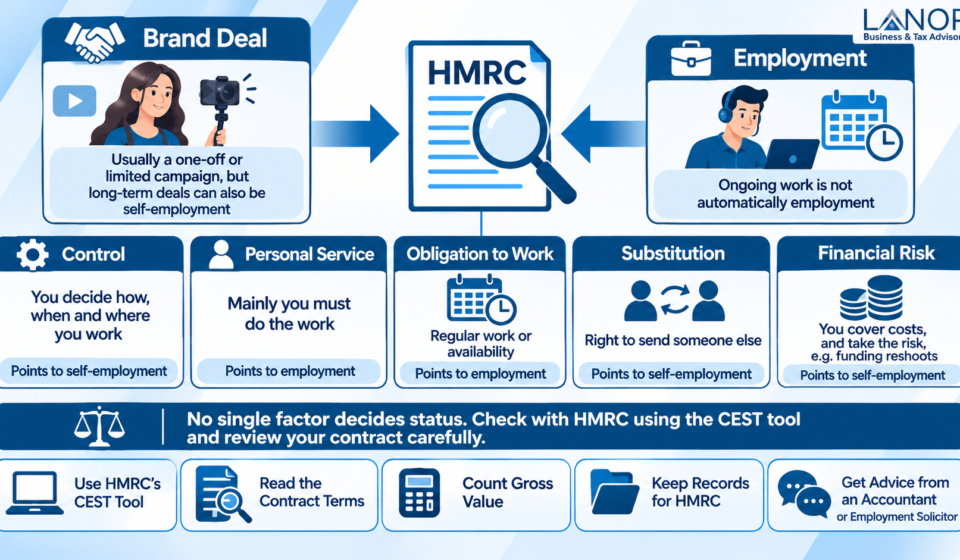
Control. Having control over the process, when and where. You should be able to request a product demo, a hashtag, disclaimer and publish date. You’ll also be taking on a management role by having control over your time and approving all stages of the production.
Personal service and substitution. Although it’s very common to use an editor, you should have the right to substitute them. If the clause doesn’t allow you to use anything that you wouldn’t actually be able to you won’t get much out of it.
Obligation to work and accept work. If you are working on a monthly ambassador basis, with you available during any periods of work, this will lean more towards work. Where there are separate works you may wish to decline some.
This will provide an element of agency. However, as noted above by the Supreme Court in 2024 there can also be elements of mutual obligation and control where there is a close relationship.
Financial Risk & Autonomy. When you are funding the reshoot, setting your own rates and have other clients, you will look like you are running a business. This can help although will not ever be conclusive.
Reading the contract like a sceptic
Skip the paragraph that calls you self-employed. Read everything else.
| Clause | Ask yourself |
| Working hours | Fixed hours, or just a publishing deadline? |
| Content approval | Is the brand checking the brief or running the shoot? |
| Exclusivity | Can you still take other brands? |
| Personal service | Must it be you, personally? |
| Substitution | Could you really send someone else? |
| Payment | Paying for a deliverable, your time or your availability? |
| Ongoing duties | Are you committed to future campaigns? |
| Costs | Who pays for reshoots and extra edits? |
Exclusivity is a factor that is often underestimated by many. It’s common to avoid a direct competitor during your campaign, but having exclusivity for months across an entire industry can be a great advantage. Not only will they ask you to mention the top 3 features of their product, they’ll also tell you how to film these.
What about long-term ambassador deals?
Not every deal will be an ongoing deal. One ambassador will have a set of posts each month with complete creative freedom and work with multiple brands. The other will have set hours, set tasks and no other sponsors. Which do you think we will look at more closely?
When the contract and reality don’t match?
Despite what the forms may tell you, you will have no flexibility and the brand will prevent you from using any other sponsors. Whilst you are employed you must be working online at 9AM. You will also want to ensure HMRC are happy with how things are running. If you are essentially employed then saying you are self-employed will not help.
Leave your emails and campaign instructions as they are. If the reality doesn’t match up with your contract then make sure its resolved.
Limited companies and IR35
Using your own company does not remove the issue entirely. If you provide services using a company then the off-payroll working rules (IR35) may apply. It will only affect some creators and situations where they would be an employee if directly hired.
If HMRC decides its employment
You may have employment income and you will pay tax through PAYE and various National Insurance. You will need to consider previous years. The brand may also have a liability to pay PAYE and employer’s National Insurance. We cannot guarantee what you will pay.
Checking before you sign
Using the above factors and your contract you can use HMRC’s Check Employment Status for Tax (CEST) tool. This is free to use and asks about substitution, control, risk and mutuality. This does not address any employment rights but just gives you tax status. The tool is only as good as the information you put in and will sometimes say it cannot make a determination because you have given conflicting information.
Have a folder of:
- Signed Contracts and Amendments
- Briefs and Emails regarding deadlines
- Invoices and Payment Records
- Evidence of other clients
- Receipts for equipment and evidence of changes to your campaigns.
When to call an accountant?
Long ambassador offers, exclusive requirements, one sponsor paying monthly, branding you like an employee, a limited company or a letter from HMRC. A good accountant for youtubers will be able to advise you on how to report your income and identify any issues early.
If you need any legal advice on employment rights or a disputed contract then an employment solicitor may be the right choice. We are happy to help with our influencer accounting service.
Frequently Asked Questions
Can HMRC treat you as an employee?
Yes. It depends on whether your YouTuber relationship is an employment relationship for tax purposes.
Can HMRC disregard any contract stating I am self employed?
Yes. HMRC will look at how the relationship works.
If I receive a sponsorship payment every month does this mean I’m an employee?
No. Just because you receive regular payments does not necessarily mean you’re an employee.
Can I invoice a brand instead of being paid via PAYE?
No. Just because you are invoicing a brand does not mean you’re self employed.
Can YouTubers be caught by IR35 if they have a limited company?
Possibly. If you’re working through an intermediary and you meet the off-payroll requirements then you may fall under IR35.
Conclusion
Whilst a single brand deal will not create a self-employment arrangement, or longer term sponsorships will create an employment relationship, it is important to consider how the relationship will operate. If you are unsure as to what type of relationship you have, please consult a specialist accountant for youtubers at Lanop Business & Tax Advisors.