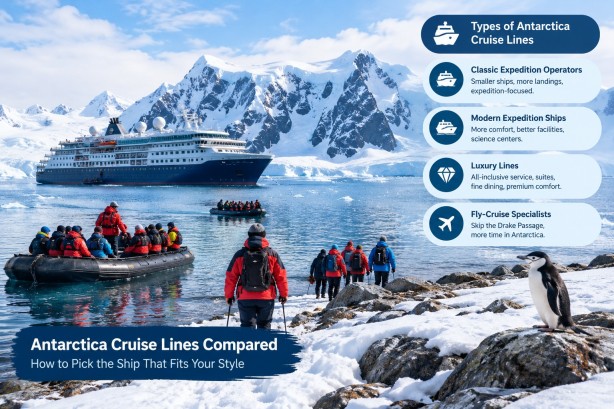

Choosing an Antarctica cruise is less like booking a holiday and more like choosing a basecamp. The ship is your hotel, your restaurant, your lecture hall, and your launch pad for every landing. And because the season is short and the fleet is small, the ship you pick will shape the whole trip.
Here’s how the main types of Antarctic cruise lines compare, and who each one tends to suit.
Why ship size matters more than anything
Under guidelines followed by the International Association of Antarctica Tour Operators (IAATO), ships carrying more than 500 passengers can’t land guests at all, and only 100 people can generally be ashore at a single site at one time. That rule quietly shapes every itinerary.
- Under 200 passengers: Everyone can usually land at each stop with minimal waiting. This is the sweet spot for most travelers who want time ashore.
- 200 to 500 passengers: Landings happen in rotations. You’ll still get ashore, but sometimes for less time.
- Over 500 passengers: Scenic cruising only. You’ll see Antarctica from the deck but won’t set foot on it.
The main categories of cruise lines
Classic expedition operators
Think of these as the specialists. Lines such as Quark, Oceanwide, and Albatros have been running polar trips for years. Their ships are often smaller and more functional, with a strong focus on landings, guides, and lectures. Fares on classic 10 to 12 day Peninsula voyages often start around $9,000 to $11,000 per person.
Best for: Travelers who care most about wildlife, landings, and expedition atmosphere.
Modern expedition ships
Newer polar-class vessels from lines like HX (Hurtigruten Expeditions) and Lindblad-National Geographic blend comfort with expedition credentials: bigger windows, better cabins, science centers, and sometimes hybrid engines.
Best for: Couples and families who want comfort without losing the expedition feel.
Luxury lines
Silversea, Seabourn, Scenic, and Viking bring all-inclusive service to the ice. Expect suites with balconies, butler service on some ships, multiple restaurants, and drinks included. Starting fares are generally higher, often around $18,000 to $20,000 per person and up.
Best for: Travelers who want Antarctica without giving up five-star comfort.
Fly-cruise specialists
Some operators fly passengers from Punta Arenas, Chile, to King George Island, then cruise from there. That skips the two-day Drake Passage crossing each way.
Best for: Anyone short on time or worried about seasickness, as long as they’re comfortable with possible weather delays.
Other things to compare
- Ice class: Higher ice-class ships can push farther into icy waters, sometimes reaching the Antarctic Circle.
- Activities: Kayaking, camping, snowshoeing, and paddleboarding vary by line and often sell out early.
- Guide ratio: More guides usually means smaller Zodiac groups and better interpretation ashore.
- What’s included: Parkas, boots, drinks, gratuities, and Wi-Fi differ widely from line to line.
Getting a fair comparison
Cruise line websites naturally show their own ships in the best light. An independent side-by-side view helps. This guide with the best Antarctica cruise lines compared lines up fleets, passenger numbers, prices, and the kind of traveler each line suits.
The bottom line
There’s no single best Antarctica cruise line. There’s the best fit for you. A wildlife photographer, a retired couple celebrating an anniversary, and a family with teenagers might all choose different ships, and all have the trip of their lives.
Start with your priorities: time ashore, comfort, budget, or a quick crossing. The right ship usually becomes obvious from there.