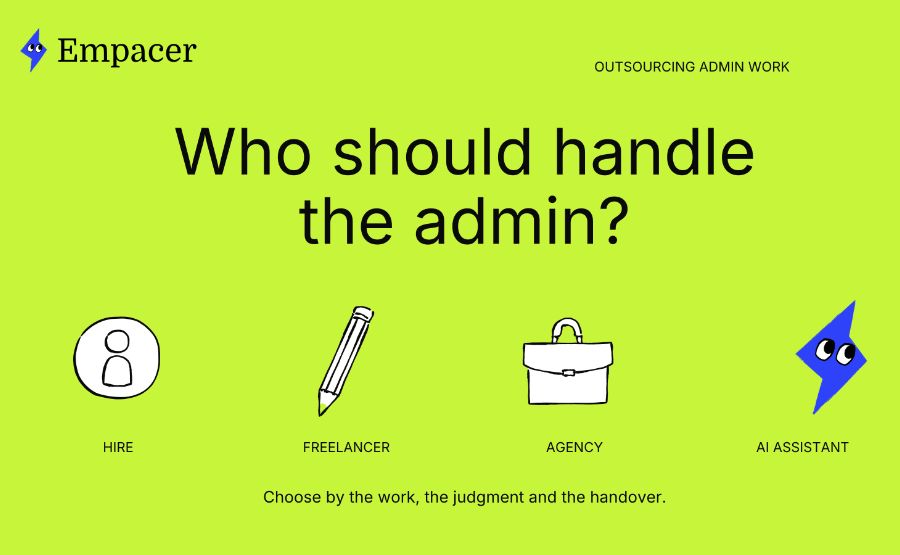

Outsourcing admin work means handing the recurring office side of your business, such as replies, quotes, invoices, scheduling and posts, to someone or something outside your own working hours. For a small service business the realistic options are a part-time hire, a freelancer, an agency or an AI assistant, and each one fits a different kind of admin.
This guide helps you choose by the work itself, not by the price tag alone. It sorts what admin actually means in a trade business, compares the four options on the criteria that matter, and is plain about where an AI assistant fits and where a person is still the better choice. The example is Abe, who runs a locksmith business with one van and a phone that rings at awkward hours.
What admin work can you outsource
Before deciding who does it, sort what you have. Abe’s admin falls into four kinds, and each one outsources differently.
- Writing tasks. Quotes for rekeying a house after a move, replies to messages about availability, supplier emails for key blanks and cylinders, invoices for finished jobs, a check-in message after a lock upgrade. These can be prepared by someone else and checked by you.
- Phone tasks. Urgent lockout calls, callbacks to people who left a voicemail, a call to the supplier about a late delivery. These need a live person.
- Judgment tasks. Whether to take an emergency job at 2 a.m., how to settle a complaint about a repair, which supplier gets a large order. These mostly stay with the owner.
- Systems tasks. Bookkeeping catch-up, filing receipts, updating records in other software. These need someone with access and some training.
Most owners find that writing tasks take the most hours and phone tasks cause the most stress. That split decides a lot of what follows.
Four ways of outsourcing admin work
Part-time hire. Someone on your payroll for set hours, often working where you work. Strong on continuity: they learn your business over months and can cover the phone during opening hours. The cost is wages and employer obligations for fixed hours, whether the work is there that week or not.
Freelancer. An independent admin or virtual assistant paid by the hour, by package or by project. Flexible and quick to start. The hidden cost is your time explaining context, and their availability depends on their other clients.
Agency. A company that assigns staff, usually with a manager and backup cover. Steadier coverage and someone accountable for quality. You pay a monthly fee that includes the management layer, and you have less say over who does the work.
AI assistant. Software that prepares the work for you to check. It’s available whenever a task comes up and needs no onboarding beyond a short setup. The cost is a subscription plus your review time, and it doesn’t make phone calls or judgment calls for you.
Five criteria to compare the options
The hourly or monthly figure hides most of the difference. Compare on these instead.
| Criterion | Part-time hire | Freelancer | Agency | AI assistant |
|---|---|---|---|---|
| Context about your business | Builds over months | Builds slowly, lost if they leave | Resets when staff rotate | Stored facts you can correct |
| Availability | Set hours | Their schedule | Set hours with cover | Whenever you give a task |
| Cost structure | Wages for fixed hours | Hourly, package or project | Monthly fee with management | Subscription |
| Review before anything goes out | You or a supervisor | You | Agency, then you | You approve each result |
| Phone calls | Yes | Often | Yes | No |
Two questions settle most decisions. First, does your admin mostly end in writing or in conversations? Second, does it arrive in a steady block each week, or in scattered moments between jobs? Writing that arrives in scattered moments suits an assistant on your phone. Conversations in a steady block suit a person with set hours.
Where Empacer fits in a locksmith business
Empacer is a voice-first business assistant for owners who are also the whole team. Its pricing page describes the difference from a virtual assistant this way: Every time a task arises, it is on your phone, keeps your company information close at hand, and prepares postings, customer responses, and documents for you to examine. You have the last say over what is sent.
For Abe, that covers the writing tasks. Setup is three short questions about the business, answered by voice or text, and his services, prices and tone end up as facts in About you that he can check and correct. Between call-outs, he taps the mic and talks from the van:
- A quote. “Quote the Delgados for rekeying all five locks on their new house, standard cylinders.” The draft uses prices from his business details. If a price isn’t stored yet, say for a new smart lock model, he includes it in the request or updates About you.
- An availability reply. “Tell the bakery on the corner I can come Thursday after three.” Empacer may see his appointments and spare time when Google Calendar is connected, so the times in a response correspond to his actual schedule.
- A supplier order. “Ask the usual supplier for fifty key blanks and ten cylinders.” With Gmail connected, quotes and follow-ups for suppliers come back as drafts.
- An invoice. “Send the invoice for this morning’s lock change.” With QuickBooks connected, invoices can be created after his OK.
- A follow-up after a visit. A short WhatsApp check-in with the Delgados a week after the rekey, drafted for his approval.
Only when a task requires it does Empacer ask to connect a tool; if Abe declines, the completed work remains within the program. The tool, your account, and the permissions you allow determine what activities are available.
Each outcome is sent to him as a card that he can approve, reject, or amend. Empacer is AI and can make mistakes, so he checks the lock count and the price before approving, and once a message is sent it can’t be recalled.
Two more details matter when you compare it with a human helper. If a task stops partway, a card says what broke, what’s already saved and whether anything was sent, plus the one step that gets it moving again, so a half-finished job doesn’t quietly disappear. And on data, Empacer turns what you say into text to work on the request and doesn’t keep the audio, and it doesn’t use your chats or business data to train its own AI models.
The pricing page sets out what you get with an Empacer subscription: the voice assistant, business memory, notifications, tasks, connections, and updates are all included in one package, with a few variations based on the duration of commitment. The actual amount, billing period, and renewal price are displayed prior to payment, and the price is determined by the deal that is accessible to you.
Where a person is the better choice
The constraints must be included in an honest comparison.
- Phone calls. Empacer doesn’t answer calls from your customers; voice is how you give it a task. A locked-out customer at night needs a human, so the emergency line stays with Abe or someone he trusts with the phone.
- Judgment. Whether to take an emergency job, how to settle a complaint, which customer gets priority on a full day. Those stay with you or a person you’ve trained.
- Physical errands. Picking up parts, dropping off keys, meeting a customer on site.
- Bookkeeping and tax work. The assistant isn’t an accounting system. Your books stay in your accounting software, and a bookkeeper or accountant is the right outside help.
Many owners combine options: an assistant for the writing, a freelancer or part-time person for phones during busy hours, and an accountant for the books.
A handover plan for the first month
Whichever option you choose, outsourcing admin work goes better with a short plan.
- Week 1: log. Write down every admin task, its kind (writing, phone, judgment, systems) and the time it took.
- Week 2: pick three. Choose three frequent tasks to hand off first, not the hardest ones.
- Week 2: write the facts down. Prices, service area, opening hours, typical response times, the tone you use. A person needs this as a written brief. In Empacer, you can say it or attach your price list with the plus button, and each fact in About you shows the answer or file it came from.
- Week 3: set the review rule. Decide what you check every time (prices, dates, names, addresses) and what you only spot-check.
- Week 4: measure. Compare the hours those three tasks used to take with the hours you now spend reviewing. With an assistant, the task history at the top of Home lists every task and its status, which makes the count easy. Keep, adjust or switch.
FAQ
What admin work can be outsourced?
Replies, quotes, supplier emails, invoices for finished work, social posts, scheduling, data entry and bookkeeping support can all be outsourced. Work that needs your judgment, such as pricing decisions or complaints, usually stays with you.
Is it cheaper to outsource admin work or hire someone?
It depends on how steady the work is. A part-time hire costs fixed hours whether the work is there or not, a freelancer or agency bills by the hour or month, and an AI assistant is a subscription. Compare total cost, including your own time for onboarding and review.
Can an AI assistant replace a virtual assistant?
For writing that ends in a draft, an AI assistant can take a large share of the work, with you approving each result. For phone calls, errands and judgment calls, a person is still the better fit.
How do I keep control of my accounts when outsourcing?
Give each helper their own access instead of sharing your login, grant only what the work needs, and remove access when the work ends. With an AI assistant, check which tools it connects to and where you disconnect them; in Empacer, that’s Account > Tools or the connected service’s own settings.