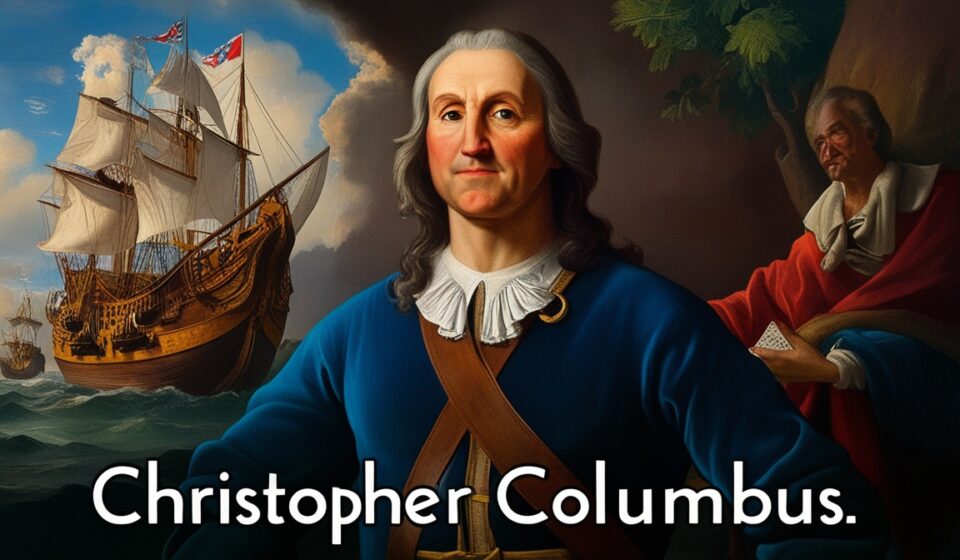

Here’s a fact that’ll mess with your head: a man who never actually set foot on North American soil, got completely lost looking for Asia, and died in disgrace after being arrested for mismanagement — somehow became the subject of a federal holiday AND the most reliably meme-able figure in American history. Every single October, like clockwork, the internet tears Christopher Columbus apart in the most creative, vicious, and sometimes disturbingly funny ways possible.
That’s not an accident. That’s five centuries of mythology finally getting the roast it deserves.
Quick Facts
| Detail | Info |
| Full name | Cristoforo Colombo (Italian), Cristóbal Colón (Spanish) |
| Born | ~1451, Genoa (now Italy) |
| Died | May 20, 1506 — broke, stripped of titles |
| Famous voyage | October 12, 1492 — landed in the Bahamas |
| What he thought he found | India |
| What he actually found | The Caribbean |
| North America visited | Never |
| Federal holiday created | 1937 (lobbied through 1934 under FDR) |
| Original purpose of holiday | Italian-American political legitimacy |
| Most famous meme format | Tony Soprano “Columbus is a hero, end of story” |
| Biggest meme controversy | “What Columbus Saw” viral format (2025) |
| Statues removed/defaced | Multiple cities, 2020 onwards |
A Guy Who Was Lost Became a National Hero. The Internet Noticed.
Before we even get to the memes — think about the absurdity here for a second. Columbus was not trying to discover anything. He was trying to find a shorter trade route to Asia for silk and spices. He miscalculated the size of the Earth so badly that actual Spanish geographers thought he was wrong. And they were right. He landed in the Bahamas and called the people there “Indians” because he genuinely believed he’d arrived in India.
He hadn’t. He was thousands of miles off. He spent years insisting he had reached Asia.
This is the guy with a federal holiday. And you wonder why the internet goes feral about him every October.
The Flat Earth Myth: A Meme That’s Also a Lie
One of the most popular recurring Columbus memes has been around for ages — the joke that Columbus “proved the Earth was round” when everyone supposedly thought it was flat. You’ve seen it. Little cartoons of medieval sailors terrified of sailing off the edge.
Here’s the thing: that’s completely made up. Not an exaggeration — entirely fabricated.
Historians have been saying this for decades. Greeks had calculated the Earth’s approximate circumference over 2,000 years before Columbus. By the 1490s, educated Europeans absolutely knew the planet was a sphere. Nobody needed Columbus to prove that.
The actual flat Earth myth — the idea that medieval people thought the world was flat — was invented in 1828 by Washington Irving in a semi-fictional novel called The Life and Voyages of Christopher Columbus. Irving made up a dramatic scene where Columbus bravely argued against flat-Earth believers at the Spanish court. It never happened. Not even close.
The irony is that Columbus did make a wild miscalculation — he thought the Earth was much smaller than it actually is, which is why he thought Asia was reachable by sailing west. His critics weren’t flat-Earthers. They were mathematically correct people who told him his estimates were wrong. And they were right.
So there’s a meme about Columbus proving the Earth was round that itself demonstrates how myths about Columbus get built, spread, and accepted. Pretty meta.

The Sopranos Meme: When Pop Culture Became Political Reality
If you spend any time on the internet around Columbus Day, you’ve seen the Tony Soprano format. It goes something like: someone criticizes something beloved, and the reply comes back — “in this house, [X] is a hero, end of story.”
This comes directly from Season 4, Episode 3 of The Sopranos, aired September 29, 2002. The episode — written by Michael Imperioli, who plays Christopher Moltisanti — centers entirely on a Columbus Day parade controversy in New Jersey. When Tony finds out his son AJ has absorbed some critical views about Columbus from school, he explodes. “He discovered America is what he did. He was a brave Italian explorer, and in this house, Christopher Columbus is a hero, end of story.”
The line became a meme template on 4chan’s /v/ board as early as 2018. By the early 2020s it was everywhere on Twitter and Instagram. The format is infinitely adaptable — swap “Columbus” for literally anything and it works. Warhammer 40K. Super Mario. Gail Lewis from Target.
Then something genuinely wild happened. In 2025, when President Trump announced plans to install a new Columbus statue at the White House, a White House spokesman named Davis Ingle responded to The Washington Post with: “In this White House, Christopher Columbus is a hero.” Word for word. The Sopranos quote — used unironically, by the actual White House, to defend actual policy.
The internet absolutely exploded. People point out that Tony Soprano, a mob boss and one of television’s defining antiheroes, was now apparently the official rhetorical source for White House PR. And the joke is, the Sopranos episode itself is widely considered one of the worst episodes of the entire run. Critics Matt Zoller Seitz and Alan Sepinwall called it the “nadir of the show, period.”
So we live in a timeline where the federal government quoted a bad episode of a crime drama about the mob — to defend a historical figure — and thought that was normal.
The “What Columbus Saw” Meme and Its Deeply Uncomfortable History
This one requires some care, because the meme is funny on the surface and genuinely dark underneath.
The format is straightforward: “This is what Christopher Columbus saw when he pulled up to America” over an image of an attractive woman styled or cosplaying as an Indigenous person. The meme went megaviral in May 2025 when a version featuring a woman with red paint across her face — resembling a Brazilian imageboard character named Kuruminha — racked up over 300,000 likes and spread across TikTok, X, Reddit, and Instagram.
Know Your Meme documented it thoroughly, and they also documented what the joke is actually referencing: documented historical accounts of Columbus and his crew sexually assaulting Carib women during their voyages. One account, from Columbus’s own contemporaries, specifically describes such an assault.
So what looks like a lighthearted “she was pretty” joke is actually a reference to a very specific, very awful piece of colonial history. People laughed at it. Some people had no idea what they were laughing at. That gap — between what the meme seems to be and what it actually references — is genuinely uncomfortable, and worth sitting with.
The meme isn’t innocent. But it also became a mechanism for a lot of people to learn something they didn’t know before, because the controversy made people look it up.
The Columbus Day Sale Meme: Peak Internet Wit
This one’s clean, timeless, and absolutely brutal. Every October, some variation of this joke sweeps through social media:
“A Columbus Day sale? Does that mean I can go into the store, take everything I want, claim it’s mine, and give the employees smallpox?”
The basic form of this joke has been floating around since at least the early 2010s. The “I assume I can go into a store and take everything I want” version appeared on Facebook and viral meme pages repeatedly around 2016-2020 and remains a perennial October staple. Silicon Republic used a version of it in their Columbus Day meme roundup. It’s been adapted for specific stores. It’s been adapted for real estate. It’s been adapted for your neighbor’s WiFi.
Why does it work so well? Because it translates abstract historical horror into something immediately tangible. Colonialism as a Walmart trip. The dispossession of an entire continent reframed as a parking lot argument. It’s the kind of joke that makes you laugh and then sit uncomfortably for a second.
The format survives because it’s true. Columbus arrived, took things that weren’t his, claimed land that was already inhabited, and got a holiday. The meme just says the quiet part out loud.

The Leif Erikson Meme Situation
There’s a whole separate category of Columbus memes built around the fact that Vikings arrived in North America around 500 years before Columbus did. Leif Erikson. Norse settlement at L’Anse aux Meadows in Newfoundland. Actual archaeological evidence.
The internet loves this because it turns Columbus’s most celebrated achievement — “discovering” America — into not even a silver medal situation. He’s further down the podium than that. Indigenous peoples had been there for tens of thousands of years. Norse explorers had been there 500 years earlier. And there are legends of Chinese explorers and Irish monks making the trip even before Erikson.
Columbus didn’t discover anything. He showed up to a party that had been going on for millennia and announced he’d found the venue.
The meme usually goes something like “Fun fact: Leif Erikson arrived in America in 1000 AD, 492 years before Columbus” alongside some variation of mocking the holiday. Sponge Bob. Surprised Pikachu. Whatever template was popular that week.
Why Columbus Became the Holiday: The Actual Political Story
Here’s what most of the memes miss, and it’s honestly more interesting than the memes themselves. Columbus Day only exists because Italian-Americans in the late 19th century were being brutally discriminated against and needed a cultural symbol.
The direct trigger for pushing the holiday was a massacre. In 1891 in New Orleans, eleven Italian Americans were killed in a mass lynching — one of the largest in American history. The Italian-American community, fighting for legitimacy in a country that treated them as second-class citizens, latched onto Christopher Columbus — a Genoese navigator who had sailed under Spanish sponsorship — as their founding father figure.
An Italian immigrant named Angelo Noce, who ran Colorado’s first Italian newspaper, pushed for a state Columbus Day holiday. Colorado became the first state to adopt it in 1903. Fourteen other states followed within five years. In 1934, intense lobbying by the Knights of Columbus pushed FDR to proclaim national Columbus Day observances. It became an official federal holiday under LBJ beginning in 1971.
None of this was really about Columbus the man. It was about Italian-Americans trying to survive discrimination by attaching themselves to a pre-existing American myth. The irony is that the myth was mostly invented by Washington Irving in 1828 — 60 years after Columbus died — and was already substantially fictional.
So the holiday is built on a myth about a myth, deployed as a political tool, for a community that had nothing to do with Columbus’s actual voyages. And now it’s the funniest meme every October.
The Statue Removal Era: Memes Got Physical
When the 2020 protests reshaped the conversation about public monuments, Columbus statues across America got targeted. A statue in Boston’s North End was beheaded. Statues came down in multiple cities. Twitter went absolutely off.
“Throw every Christopher Columbus statue in the ocean and let that dizzy b*tch think he discovered Atlantis,” someone posted — and it got massive traction. It’s perfectly constructed. Funny, specific, historically accurate in its savagery.
The defacing of Columbus statues also generated a whole new wave of memes pointing out that Columbus never even set foot in North America. A statue in an American city, honoring a guy who never visited, for a holiday that exists because of 19th century anti-Italian discrimination. Every layer of it is prime meme fuel.
Trump’s response to all of this — including calling Columbus “the original American hero” and announcing a new statue at the White House — generated its own entire meme ecosystem in 2025, including the Sopranos situation described above.
Final Words
Look, most memes are just memes. They come, they get overused, they die.
But Columbus memes are different. They’ve been running for over a decade and they genuinely shift how people think about this holiday. The flat-Earth meme made people look up whether that was true (it isn’t). The Columbus Day sale joke makes colonialism viscerally understandable. The Tony Soprano format being used unironically by the actual White House is the kind of thing that makes you realize how deep the mythology runs.
The memes work because the underlying story is so genuinely absurd. A lost explorer. A holiday built on a political strategy. A myth invented by a novelist. Statues in cities Columbus never visited. A White House quoting a mob boss to defend it all.
Columbus isn’t really the butt of the joke. American mythology is. Columbus just happens to be the convenient face on it.
And every second Monday of October, the internet reminds you of that, with increasing creativity and declining restraint.
FAQs
1. What is the “What Columbus Saw” meme?
It’s a format where someone posts a photo of an attractive woman styled as or resembling an Indigenous person with the caption “This is what Christopher Columbus saw when he pulled up to America.” It went massively viral in May 2025. Beneath the surface joke, it references documented historical accounts of Columbus and his crew committing sexual assault against Carib women during their voyages.
2. Where does the Tony Soprano Columbus meme come from?
Season 4, Episode 3 of The Sopranos, aired September 2002 and written by Michael Imperioli. Tony confronts his son AJ after he learns AJ has heard critical views about Columbus at school, declaring “He was a brave Italian explorer, and in this house, Christopher Columbus is a hero, end of story.” It became a meme template by 2018 and went explicitly political in 2025 when a White House spokesman quoted it verbatim.
3. Did Columbus actually prove the Earth was round?
No. This is a myth invented by Washington Irving in his 1828 semi-fictional novel The Life and Voyages of Christopher Columbus. Educated Europeans in the 1490s already knew the Earth was a sphere — Greek scholars had calculated this over 2,000 years earlier. Columbus’s critics weren’t flat-Earthers; they correctly argued he had underestimated the Earth’s size.
4. Did Columbus ever land in North America?
Never. He landed in the Bahamas, parts of the Caribbean, and the coast of Central and South America. He never touched what is now the United States. Columbus Day is a holiday in North America for a man who has never visited North America.
5. Why does Columbus Day exist as a holiday?
It exists primarily because of Italian-American political activism in the late 19th and early 20th centuries. Italian-Americans faced serious discrimination and saw Columbus as a cultural symbol they could use to assert their legitimacy. The holiday became federal in 1937 largely due to lobbying by the Knights of Columbus under FDR.
6. Why are people replacing Columbus Day with Indigenous Peoples’ Day?
Because Columbus’s documented historical record includes enslaving Taíno people, initiating the Transatlantic slave trade, ordering brutal crackdowns on Indigenous resistance, and overseeing the near-total destruction of the Taíno population. South Dakota first celebrated Native American Day in 1993. Hundreds of cities and several states have since replaced or renamed the holiday.
7. What happened to Columbus statues during 2020?
Multiple statues were vandalized and removed, including one in Boston that was decapitated. This generated significant meme content, including viral jokes about throwing Columbus statues into the ocean.
8. Is the “Columbus Day sale” meme original?
The format has circulated online since at least the early 2010s. The core joke — that a Columbus Day sale logically means you can walk in and take things that aren’t yours — has been adapted countless times. It’s a perennial October meme.
9. Did Columbus actually “discover” America?
Depending on your definition: no. Indigenous peoples had lived in the Americas for tens of thousands of years. Norse explorers under Leif Erikson had reached Newfoundland around 1000 AD, approximately 492 years before Columbus arrived. Columbus was the first European in the modern era to make sustained contact with the Caribbean, but he absolutely was not the “discoverer” of a continent full of millions of people.
10. What is Kuruminha and how does she relate to the Columbus meme?
Kuruminha is a mascot character created for BRchan, a Brazilian imageboard. When a woman posted a photo wearing red face paint that resembled the character, it became widely shared within the “What Columbus Saw” meme format in 2025, driving the meme to mainstream viral status.
11. Was Columbus arrested?
Yes. In 1500, a royal investigator named Francisco de Bobadilla arrived in Hispaniola, heard testimony from hundreds of witnesses about Columbus’s brutal governance, and had him arrested and shipped back to Spain in chains. He was stripped of his titles and never fully restored. He died in 1506 still trying to reclaim his privileges.
12. Why do memes about Columbus keep coming back every year?
Because Columbus Day is the second Monday in October — it’s a recurring, predictable cultural moment. And because the gap between how Columbus is officially celebrated and what he actually did is enormous enough to generate infinite content. The controversy isn’t going away. If anything, it’s getting louder.
Discover stories that stand at the top with The Pinnacle Magazine.