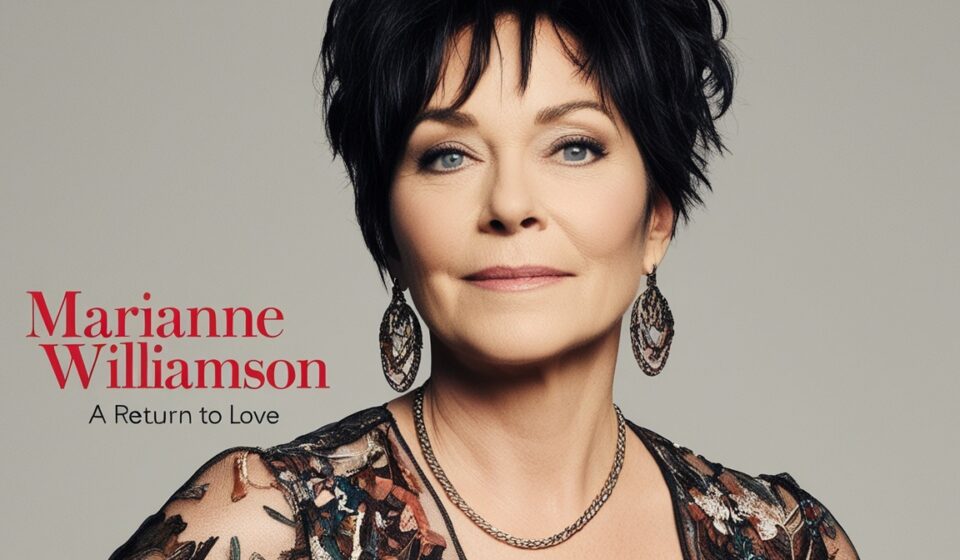
Marianne Williamson A Return to Love: The Book That Changed Millions, Got Misquoted Constantly, and Refuses to Go Away

Here’s something nobody tells you upfront: the most famous quote from A Return to Love isn’t from Nelson Mandela. Never was. Mandela never said it. Didn’t include it in any speech. Didn’t use it at his inauguration. The whole thing was a rumor that spread like wildfire in the nineties and the internet burned it into permanence.
It came from Marianne Williamson. A woman who, at the time she wrote it, had been a cocktail waitress, a metaphysical bookstore manager, and a spiritual lecturer who ran prayer circles in her Hollywood apartment with a teenage Laura Dern as her roommate. That’s the actual origin of one of the most shared inspirational passages of the last thirty years.
Quick Facts
| Detail | Info |
| Book Title | A Return to Love: Reflections on the Principles of “A Course in Miracles” |
| Author | Marianne Deborah Williamson |
| Published | 1992 (HarperCollins) |
| Born | July 8, 1952, Houston, Texas |
| Education | Attended Pomona College (did not graduate) |
| Source Text | A Course in Miracles (Helen Schucman, 1976) |
| NYT Bestseller | 39+ weeks; #1 for 35+ weeks |
| Publisher’s Weekly | #1 nonfiction for 11 weeks |
| Copies Sold | Reported 1.5 million+ |
| Structure | Two parts: “Principles” and “Practice” |
| Famous Misattribution | “Our deepest fear…” — wrongly credited to Nelson Mandela |
| Key TV Moment | Oprah Winfrey Show, 1992 — record viewer mail |
| Other Works | 17 books total; 4 are #1 NYT bestsellers |
| Political Runs | Democratic presidential nominee bids 2020 and 2024 |
The Woman Behind the Book — And She Was a Mess, In the Best Way
Before any of this, Marianne Williamson was adrift. Genuinely, spectacularly adrift.
She spent most of her twenties doing what she later called a “wasted decade” — drifting around, experimenting with drugs, trying to launch a singing career, waitressing, and generally not having a plan. She dropped out of Pomona College in 1972 after two years, floated through New York attempting to be a cabaret singer, and by her own admission moved through a string of unhappy relationships and serious personal crises.
It was 1977 when she first stumbled across A Course in Miracles at a friend’s apartment in New York City. She saw the books sitting on a coffee table and picked one up. Her first reaction, by most accounts, was skepticism — too many Christian references for a woman raised in a Conservative Jewish household in Houston, Texas.
But she kept reading. And it cracked something open.
What A Course in Miracles Actually Is — And Why It Matters for the Book
Before you understand A Return to Love, you need to know what it’s a response to. Because this book is not an original spiritual text. Williamson herself calls it “CliffsNotes” for A Course in Miracles.
The Course is a 1,300-page spiritual document first published in 1976. Helen Schucman, a clinical psychologist at Columbia University, claimed the text was dictated to her directly by Jesus through a series of dreams and visions. She transcribed it. The language is dense, abstract, and genuinely difficult — it reads nothing like most people’s idea of a Jesus voice.
Williamson discovered it at a low point in her life and it reorganized her entire worldview. She went from skeptic to true believer to working as a volunteer at the Foundation for Inner Peace, which published the Course. By 1983 she was in Los Angeles giving weekly lectures on it at the Philosophical Research Society.
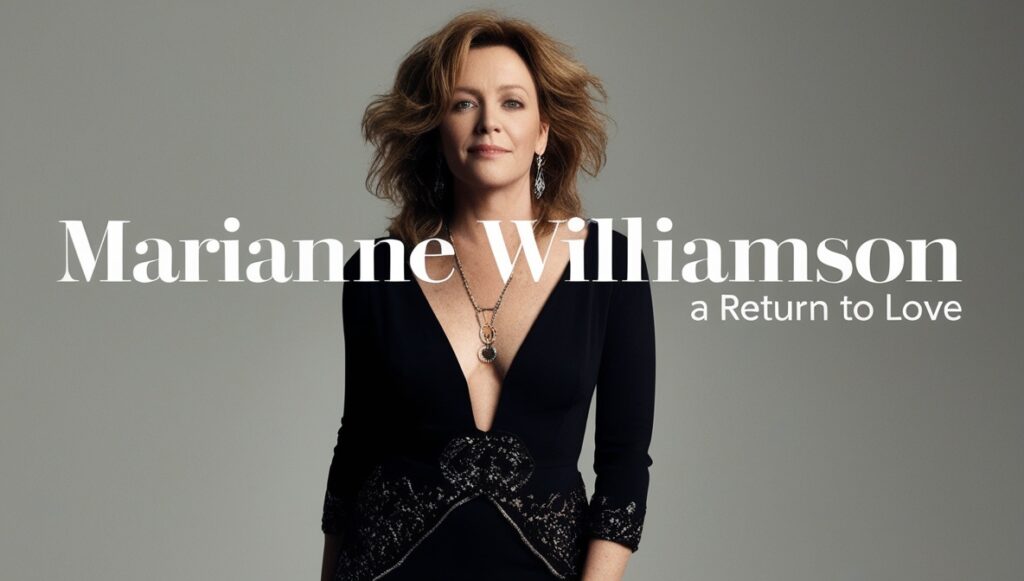
The Hollywood Years Nobody Puts in the Headline
Here’s the part that gets glossed over when people talk about Williamson as a spiritual authority. She was, for a significant stretch of her early thirties, just a woman trying to make something work in Los Angeles.
She ran a secretarial job. She lectured about the Course at small venues. Her roommate — at one point — was seventeen-year-old Laura Dern, who later said Williamson held prayer groups in their shared living room. In the mid-1980s she founded the Los Angeles Center for Living to serve people with AIDS during the worst years of the epidemic. She launched Project Angel Food in 1989, a meals-on-wheels program for people with life-threatening illness that continues to operate.
That’s not the resume of a charlatan. That’s the resume of someone who actually put the philosophy to work in the hardest possible conditions. When AIDS was a death sentence and a source of widespread social fear, Williamson showed up and organized meals. That happened before any bestseller deal.
The Book Itself: Two Parts, One Argument
A Return to Love was published in 1992 when Williamson was 40. The structure is clean — two sections called “Principles” and “Practice.” Inside those, chapter titles like “Hell,” “God,” “You,” “Surrender,” “Miracles,” “Relationships,” “Body,” “Work,” and “Heaven.”
The central thesis is not complicated. Fear is the root problem. Love is the solution. The ego keeps you trapped in patterns of fear, separation, and suffering. Connecting with something bigger than your ego — whether you call it God, love, or the divine — is the way out.
The book applies this argument across different life domains. Relationships. Career. Health. The framework is always the same: wherever you feel stuck, blocked, or in pain, the underlying issue is fear. The fix is always a form of surrender to love.
She builds heavily from the Course’s idea that we are all inherently holy — not because we earned it, but because it’s what we actually are underneath all the noise of ego and self-preservation. The “darkness” she writes about is defined as internalized fear, not sin in any traditional sense.
Oprah Changed Everything. Full Stop.
The reason this book exploded is not mysterious. In 1992, Oprah Winfrey had Williamson on her show. The segment generated more positive viewer mail than anything else that program aired that year. Oprah championed the book openly and publicly. She cited the “Our deepest fear” passage as one of her personal favorites — and still does decades later.
Williamson’s own description of what happened is matter-of-fact: the book became the fifth bestselling book in America that year, climbed to #1 on the New York Times list, and stayed on the list for nearly forty weeks. She hadn’t done any of that without the platform Oprah handed her.
You can talk about the merits of the spiritual content all you want. But Oprah was the distribution mechanism. And Williamson knows this.
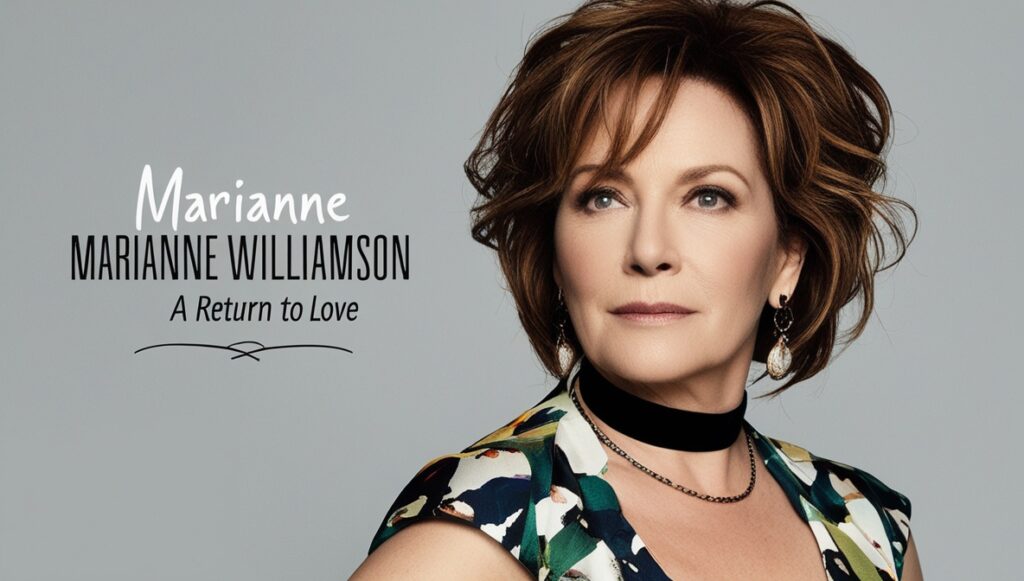
The Misattribution Problem Is Actually Fascinating
Let’s spend a minute on this because it tells you something real about how cultural ideas move.
The “Our deepest fear” passage circulated widely through the nineties and into the internet era, often attributed to Nelson Mandela’s 1994 inaugural address. The problem: he never said it. The speech doesn’t contain it. The attribution was pure myth.
But the myth was so widespread it seemed like a fact. At some point people just stopped checking. The passage showed up in movies — Coach Carter in 2005, Akeelah and the Bee in 2006 — either paraphrased or in the wrong voice. It became a motivational staple on posters, greeting cards, social media captions. And it kept moving under Mandela’s name even as Williamson was still alive, still publishing, still clearly the author.
What this means: the ideas were powerful enough to travel without the author’s name attached. That’s either a compliment or a copyright nightmare, depending on how you look at it.
The Criticism Is Real — And Fair
Let’s not pretend there’s no legitimate pushback here. There’s a lot.
Critics — and there are serious ones — argue that Williamson’s framework places too much responsibility on the individual for their circumstances. If love and positive thought are the answer to everything, then what does that say about people who are sick, or poor, or oppressed? If your suffering comes from fear, is the implication that you could think your way out of structural injustice?
One critic, journalist Matthew Remski, co-author of Conspirituality, has argued that the whole Course in Miracles tradition — and Williamson’s version of it — is essentially marketed to affluent, middle-class white audiences who want the comfort of spirituality without the accountability that comes with actual religious community. That’s a pointed critique. It’s not entirely unfair.
The chapter on health and illness is particularly contested. The book’s framework, when applied to physical sickness, can slide into implying that disease is somehow a product of disordered thinking — a claim that’s both unscientific and potentially cruel to people with serious conditions.
And then there’s the political phase, where Williamson’s vaccine skepticism during her 2019 presidential campaign drew intense scrutiny. The ideas in the book about the body and conventional medicine suddenly had real-world political stakes.
The Presidential Runs, Briefly
By 2019 Williamson announced she was running for the Democratic presidential nomination in 2020. Then again for 2024. Neither run went anywhere in terms of delegate counts, but her debate performances — particularly in 2019 — generated enormous attention.
Whether that attention was good or embarrassing depended entirely on who you asked. She talked about “dark psychic forces” and the power of love as a foreign policy principle. Some people thought she was ridiculous. Others thought she was the only person on stage actually saying something real.
She suspended the 2020 campaign in January 2020. The 2024 bid also ended without a nomination. But both runs made the ideas in A Return to Love relevant again for a new audience that might never have otherwise picked it up.
What the Book Actually Gets Right (An Honest Take)
Okay, here’s my real opinion after looking at this thoroughly. The core argument — that fear is the engine of most of our self-defeating behavior, and that moving toward love, forgiveness, and connection generally makes life better — is not actually that controversial. Psychologists, therapists, and researchers in relationship science largely agree with the broad strokes.
The problem isn’t the thesis. The problem is when the framework overreaches. When it becomes a totalizing explanation for everything — including illness, poverty, and systemic injustice — it stops being a spiritual insight and starts being a way to avoid uncomfortable complexity.
But for people who read it as personal spiritual guidance rather than social policy? It has genuinely helped a lot of people. Thirty-plus years of consistent readership doesn’t happen by accident.
Final Words
Here’s what nobody can argue with: A Return to Love was published in 1992 and is still being read in 2026. That’s more than three decades. Most self-help books from that era are completely forgotten. This one is still on shelves, still recommended, still showing up in Amazon wishlists.
Williamson is 74 now. She’s written seventeen books. Four have hit #1 on the New York Times list. She ran for president twice. She’s been championed and savaged, sometimes in the same week by the same people.
My honest take? A Return to Love is a flawed, sincere, genuinely useful book that gets into trouble when it tries to explain too much. The spiritual core is solid. The framing is too broad. The “Our deepest fear” passage is genuinely one of the more powerful things written in the last century about self-sabotage and human potential. And it belongs to Marianne Williamson, not to Nelson Mandela.
She earned that quote. She should keep getting credit for it.
FAQs
1. What is A Return to Love about?
It’s Williamson’s interpretation of A Course in Miracles, a spiritual text from 1976. The book argues that fear is the root of human suffering and that choosing love — over ego, defensiveness, and fear-based thinking — is the path to transformation in relationships, work, and inner peace.
2. When was A Return to Love published?
1992, by HarperCollins. It was Williamson’s debut book, published when she was 40 years old.
3. How long was it on the bestseller list?
It spent approximately 39 weeks on the New York Times bestseller list, including over 35 weeks at #1. It also topped Publishers Weekly‘s nonfiction list for 11 weeks.
4. Is the famous “Our deepest fear” quote really from this book?
Yes. It’s from a passage in A Return to Love and begins: “Our deepest fear is not that we are inadequate. Our deepest fear is that we are powerful beyond measure.” It is frequently and incorrectly attributed to Nelson Mandela — he never said it.
5. What is A Course in Miracles and how does it connect to the book?
A Course in Miracles is a 1,300-page spiritual text published in 1976, transcribed by Columbia psychologist Helen Schucman, who claimed it was dictated to her by Jesus. Williamson’s book is a popularized interpretation of its teachings, written for general readers who might find the original too dense or academic.
6. Did Oprah Winfrey really launch the book’s success?
Substantially, yes. Oprah featured Williamson on her show in 1992 and the episode generated record viewer mail. Williamson has acknowledged that Oprah’s platform was a primary driver of the book’s commercial explosion.
7. What are the two main sections of the book?
“Principles” — covering themes like God, the self, surrender, and miracles — and “Practice,” which applies the spiritual framework to relationships, the body, work, and the concept of heaven.
8. Is the book religious or secular?
Neither cleanly. Williamson describes it as non-denominational and inclusive of people across religious backgrounds. Strong Christian references run throughout, but the book explicitly frames itself as being for anyone regardless of their specific beliefs.
9. What are the main criticisms of the book?
Critics argue the framework places too much individual responsibility on people for their circumstances, can slide into victim-blaming, and is particularly problematic when applied to illness. Some see the whole project as aimed at an affluent audience that wants spiritual comfort without structural accountability.
10. How did the book influence Williamson’s political career?
The ideas from the book — particularly about love as an organizing principle for public life — fed directly into her 2020 and 2024 Democratic presidential campaigns. Critics argued her politics were an extension of magical thinking; supporters said she was the only candidate addressing root causes.
11. Is the book still relevant?
It’s still in print, still widely read, and still generating new readers. The core thesis — fear versus love as organizing principles for human behavior — has held up reasonably well, even if the broader applications remain contested.
12. How many books has Williamson written total?
Seventeen books total, four of which reached #1 on the New York Times bestseller list. A Return to Love is still her most widely known work.
Discover stories that stand at the top with The Pinnacle Magazine.