
One day in 2025, the word started popping up across tech blogs and manufacturing websites, and suddenly everyone had a hot take on this thing called “Repmold.” Here’s the kicker though — once you dig past the hype, what you actually find isn’t nonsense. It’s a genuinely useful idea that the industry didn’t have a clean word for. And maybe that’s exactly why this word caught on the way it did.
Quick Facts
| Details | Info |
| Full Name | Repmold (Replication Molding) |
| Type | Digital manufacturing workflow / umbrella concept |
| Core Meaning | Combining CAD design, 3D printing, and mold-making into one connected process |
| Coined Around | 2025–2026 (no confirmed single inventor) |
| Official Standard? | No — not recognized by NIST, ISO, or any standards body |
| Related Terms | Rapid tooling, additive tooling, digital manufacturing, reverse engineering |
| Materials Used | Silicone, epoxy resin, polyurethane, composites, metal-filled resins |
| Typical Timeline | 2–5 days (vs. weeks or months traditionally) |
| Who Uses It | Startups, medical device makers, automotive engineers, aerospace firms, educators |
| Biggest Limitation | Not standardized — definitions vary wildly depending on the source |
Wait, Is Repmold Even Real?
Here’s the thing that every sanitized explainer article skips over. Repmold is not a formally recognized manufacturing process. Full stop.
It doesn’t appear in NIST technical literature as a category. No ISO standard defines it. No single company invented it, launched it, or owns it. The closest official concepts are “rapid tooling,” “additive tooling,” and “digital manufacturing” — all of which have real definitions and research behind them.
So is Repmold just a made-up marketing word? Kind of. But also no.
Think of it like this. “Fintech” wasn’t a category with a standards body either, once upon a time. Somebody just glued together two concepts — finance and technology — slapped a name on what was already happening, and suddenly the word became useful. Repmold is the manufacturing world’s version of that moment.
The underlying technologies — CAD, 3D printing, CNC machining, mold simulation, 3D scanning — are absolutely real and have been around for decades. What “Repmold” does is give a single handle to a workflow that connects all those pieces into one digitally-driven sequence. And honestly? That’s not nothing.
See also “Colorado Rockies vs Dodgers Match Player Stats: Full Box Score, Key Performers & Game Highlights“
Where This Whole Thing Came From
Molding itself is ancient. Cast bronze. Pressed glass. The idea of shaping material around a form is literally thousands of years old.
The modern version of what we’re calling Repmold grew from two things happening at the same time. CAD software matured to the point where engineers could simulate a mold’s behavior before cutting a single piece of steel. And 3D printers dropped in price enough to escape the university lab and land on actual factory floors.
Traditional industrial molding needed months of prep and enormous upfront investment. You’d design a mold, machine it from steel or aluminum, run your first test parts, discover the problems, and then — if you were lucky — spend only another few weeks modifying it. The barrier to entry kept small players out entirely.
Then silicone mold-making became viable. Resin casting got faster. 3D-printed master models replaced hand-carved ones. Manufacturers who were tired of waiting six weeks for first articles started combining these tools themselves. Nobody named what they were doing. They just did it.
That’s the real “origin” of Repmold. It was already happening before anyone wrote an article about it. The word came after.
How the Process Actually Works
Okay so here’s what happens when someone actually runs a Repmold-style workflow. And yes, I’m calling it that because we need something to call it.
You start on a computer. The design lives in CAD software — precise, editable, shareable. Every dimension is locked in digitally before anything physical exists. If you’re copying an existing part instead of designing from scratch, you run a 3D scanner over it and clean up the resulting model in software.
Here’s what most people don’t realize about that scanning step: it’s not magic. A scanner captures whatever’s in front of it. If the part you’re scanning is worn, bent, or slightly deformed from years of use, the scan captures that too. Someone still has to look at the data and decide what was intentional and what was damaged. That judgment call matters.
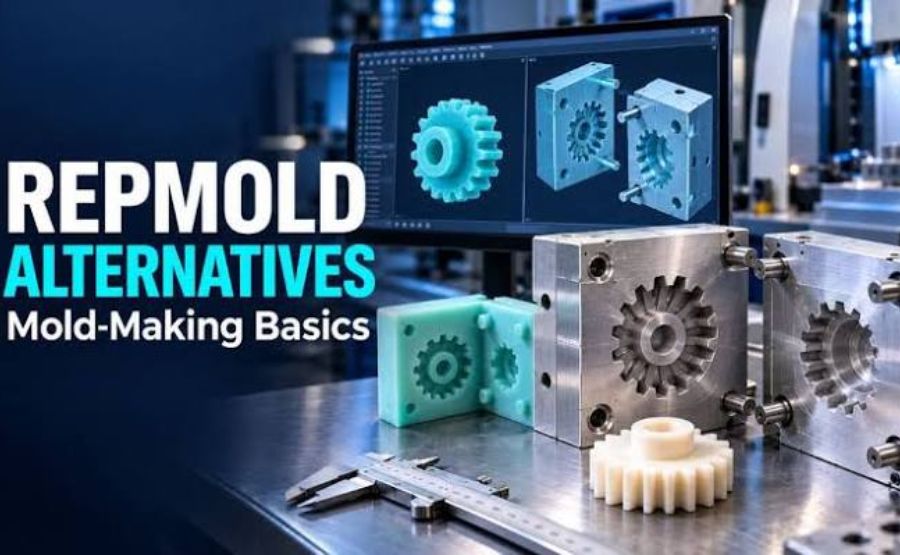
Once your digital model is solid, you print a master. This is the physical reference the mold will be built around. Pour liquid mold material — usually silicone for detailed work, epoxy resin when you need rigidity — over the master and let it cure. When it sets, you have a cavity that’s the exact negative shape of your original.
That cavity gets filled with your production material. Plastic. Composite. Whatever the job calls for. What comes out is a part that matches the digital original down to tight tolerances.
Start to finish? Two to five days. Compare that to traditional tooling timelines that sometimes stretched past three months. That compression alone is why people got excited.
The Part Where I Have to Push Back on the Hype
Look, every new manufacturing concept gets overhyped. Repmold is no exception, and some of the claims circulating out there deserve serious skepticism.
There’s one that keeps showing up — an unnamed electric vehicle company supposedly slashed production time by 40% using Repmold. That number sounds great on a slide deck. But there’s no company named. No production line identified. No measurement methodology explained. That’s not data. That’s a vibe.
Similarly, case studies get mentioned — custom bicycle frames, medical implants, ergonomic kitchen tools — but digging into the actual sources, there’s nothing primary there. No technical reports, no company names, no published production data. These “examples” are doing a lot of persuasive lifting without any evidentiary foundation.
I’m not saying those applications don’t exist. I’m saying you should demand more than a paragraph when someone uses a specific percentage or a specific product to make a sweeping claim about a technology’s capabilities.
This matters especially in medical and aerospace contexts, where “our digitally-made part tested great internally” isn’t the same as “this part has been validated, certified, and cleared for use.” Regulatory approval doesn’t care how modern your workflow is.
Who’s Actually Benefiting From This
Here’s where I’ll flip back to being fair — because there are real people solving real problems with this approach.
The clearest wins are in prototyping. A startup that couldn’t have justified $50,000 in traditional tooling can now produce functional test parts for a fraction of that. They find out if their design works before betting the company on it. That’s genuinely valuable, and it’s why designers and product developers have been among the most enthusiastic adopters.
The automotive sector is leaning into this for composite component development. Oak Ridge National Laboratory — not a blog, an actual research lab — published work on 3D-printed metal molds for large composite parts, aiming for faster revision cycles on automotive panels and structural components. That’s the kind of real-world validation that matters more than any unnamed EV company anecdote.
Medical applications are legitimate too, with the significant asterisk that “digitally produced” doesn’t bypass validation requirements. Custom prosthetics, dental models, and device prototypes are areas where the ability to tweak geometry for individual patients is genuinely transformative. The workflow makes customization cheaper. That’s real.
Small manufacturers might be the most compelling story here, honestly. For a shop that used to tell customers “eight weeks minimum” on tooling, being able to deliver functional test parts in days changes the customer relationship entirely. The competitive pressure that used to favor only large-scale operations with traditional tooling infrastructure loosens up considerably.
The Stuff You Actually Have to Worry About
There’s a gap between “Repmold-made prototype” and “Repmold-made production part,” and it’s bigger than a lot of the promotional content admits.
Silicone and resin molds have heat limits. Push them past those limits and you don’t get production parts — you get scrap. High-pressure injection molding environments can destroy a resin mold that would have worked perfectly for low-pressure casting. Material choice matters enormously, and the selection can’t just be “whatever prints easily.”
The bigger trap is treating a successful prototype as proof that production is ready. It isn’t. A part that works for ten cycles of a test run isn’t the same thing as a mold that will perform across 10,000 production cycles. Those are different engineering problems and they require different answers.
Training is another honest challenge. The workflow demands people who can think on both ends — digital design and physical manufacturing. That’s not every machinist and it’s not every CAD operator. It’s a hybrid skill set that takes time to develop and doesn’t yet exist widely in the workforce.
And cybersecurity, weirdly, is a real concern here. When your mold design and production settings live in digital files on connected systems, that’s intellectual property sitting in a network. Companies have lost product designs to breaches before. The digital-first approach that makes Repmold flexible also creates exposure that physical-only tooling didn’t have.
Where This Is Going Next
The genuinely interesting future of Repmold isn’t the word itself. It’s the connection of tools that the word represents getting tighter, faster, and smarter.
Oak Ridge has been developing self-heating printed molds — tooling with embedded thermal control rather than relying on external heating systems. That kind of built-in functionality is where the real innovation lives. AI-assisted mold simulation is getting to a point where first-pass designs require fewer physical corrections. Digital twin technology lets teams track a mold’s wear history and predict failure before it costs a production run.
The trend toward distributed manufacturing — producing closer to where the product is used rather than shipping from centralized mega-factories — is a legitimately big deal for supply chain resilience. If your mold design is a file and your fabrication equipment is regional, sudden disruptions to ocean freight matter less. Repmold-style workflows enable that kind of flexibility.
Where I’d be cautious: the nanomanufacturing predictions and self-healing mold material headlines. Those are R&D projects, not near-term production realities. Exciting, sure. But the same caution I applied to the unverified case studies applies here.
Final Words
You might be thinking — if Repmold isn’t a formal standard, why write about it at all?
Because language shapes how people think about their options. Manufacturing professionals who thought of their choices as “traditional tooling” versus “3D printing” were leaving a whole middle ground off the table. Having a word — even an informal one — for the connected workflow that combines digital design, additive fabrication, and physical molding means people can search for it, talk about it, and make deliberate decisions about it.
The word’s fuzziness is a feature, not a bug, in that sense. It’s an invitation to think more systemically about how production actually works rather than treating each technology as a standalone option.
What it doesn’t do — and what you should never let anyone convince you it does — is automatically solve your engineering problems, replace proper material validation, bypass regulatory requirements, or guarantee the ROI numbers that some promotional articles throw around without sourcing.
Repmold is a smart framework for thinking about modern mold development. It is not a magic process. Use it like the useful concept it actually is, not like the proprietary system some content farms want to sell it as.
FAQs
1. Is Repmold a real technology or just a buzzword?
Both, depending on how you look at it. The manufacturing methods it refers to — CAD design, 3D printing, mold-making, CNC machining — are absolutely real and widely used. “Repmold” itself is an informal term with no industry-standard definition. Think of it as a useful concept that describes a real workflow without being a formal process name.
2. Who invented Repmold?
Nobody has claimed credit and no company or researcher has been confirmed as the originator. The term began circulating prominently around 2025–2026 across manufacturing and tech publications. It appears to have emerged organically as a descriptor rather than being launched as a branded product.
3. How is Repmold different from 3D printing?
3D printing is one specific method of building objects layer by layer from digital data. Repmold is a broader workflow that might use 3D printing to create a master model, but then uses that model to produce a mold — which then produces the actual parts. 3D printing can be one step in Repmold, but calling them the same thing misses most of the story.
4. How long does Repmold actually take?
For a typical small-to-medium part, the full sequence from digital design to finished parts runs roughly two to five days. Traditional mold-making for the same part could take several weeks or months. The speed advantage is real and significant for prototyping and low-volume production.
5. Is Repmold cheaper than traditional molding?
For prototyping and small runs, usually yes. For high-volume mass production, traditional tooling often wins on per-unit economics once the fixed cost is spread across millions of parts. The honest answer is: it depends on volume, complexity, and material requirements.
6. What materials does Repmold use?
Common mold materials include silicone (great for fine detail and clean release), epoxy resin (more rigid, better for precision fits), and polyurethane (fast-curing, good for quick turnarounds). For end parts, the production material can range from standard plastics to composites and metal-filled resins depending on the application.
7. Can Repmold be used for medical devices?
The workflow can produce prototypes and development parts for medical applications. However, any part actually used with patients requires the full regulatory validation process regardless of how it was manufactured. The digital-first approach does not create any shortcuts through regulatory approval.
8.What industries are actually using this?
Automotive (especially for composite components and prototyping), aerospace, medical device development, consumer electronics, education, and small-batch consumer goods. The clearest real-world validation comes from automotive and from research lab work at places like Oak Ridge National Laboratory.
9. What are Repmold’s biggest limitations?
Heat and pressure tolerance of polymer-based molds can restrict use in demanding production environments. Scaling from prototype to full mass production isn’t automatic. Training requirements are real — the workflow demands hybrid skill sets. And material compatibility issues can create problems if selection isn’t done carefully.
10 Is Repmold sustainable?
More sustainable than traditional methods in some ways — less material waste during prototyping, potential for local production that reduces shipping. But a full life-cycle analysis matters. A short-lived mold that gets replaced repeatedly might have a bigger footprint than one longer-lasting conventional tool.
11. Does Repmold have official pricing?
No. There is no “Repmold” product to purchase with a price list. Costs depend entirely on the specific CAD software, printers, materials, machining, and labor involved in a given project.
12. Should my business switch to Repmold?
If you’re regularly doing product development, prototyping, or limited production runs — yes, seriously consider it. If you’re running high-volume stable production of a finalized product, your traditional tooling is probably still the right economic choice. The smartest move for most manufacturers is using both approaches where each one fits.
Discover stories that stand at the top with The Pinnacle Magazine.


