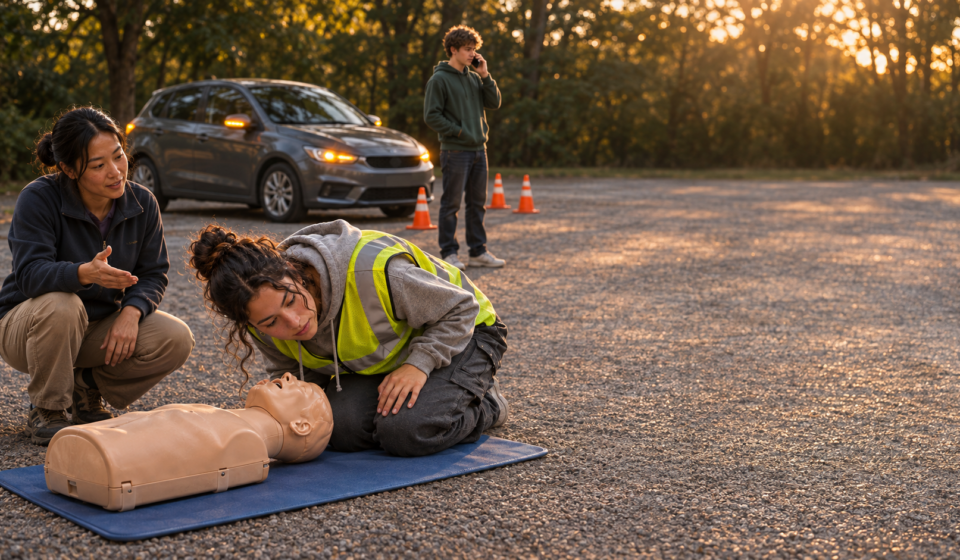

Picture a quiet road at dusk and a car stopped in the ditch. You’re the first driver to stop. What do you do next? Most people have never been taught, and that’s a gap worth closing. This guide, written for Peterborough, Ontario, Canada, covers the basics of helping at a roadside emergency, and how Coast2Coast Peterborough First Aid Training builds the skills to do it with confidence.
Emergency numbers and rules differ in other places, so check your own if you live outside Ontario.
What Should You Do First When You See a Crash?
Protect yourself before you help anyone. An injured rescuer can’t help anybody.
These are general first aid principles, and a course teaches them properly:
- Park safely. Pull over well away from the scene, switch on your hazard lights, and don’t block the road.
- Look before you step out. Check for traffic, fire, fuel, downed wires or anything else that could hurt you.
- Stay out of the traffic lanes. Keep to the shoulder, and keep other people back.
- Don’t move injured people unless they’re in immediate danger, such as from fire. Moving someone can make an injury worse.
If the scene isn’t safe, don’t approach. Call for help and wait at a safe distance.
How Do You Call for Help and Describe Where You Are?
Call 9-1-1 as soon as you can. Many Ontario sources give the same simple advice: stay calm, speak clearly and say what you need. Tell the call taker:
- What happened. For example, “A car has left the road and someone is hurt.”
- Where you are. Give the nearest cross road, a landmark, an exit number or a highway marker. Location is often the hardest part on a rural road, so look around before you call.
- How many people are hurt and whether anyone is not responding or not breathing normally.
- Your name and phone number.
Then stay on the line until the call taker says you can hang up. They can guide you through first aid until help arrives.
If English isn’t your first language, say the name of your language to the call taker. Interpreters are available.
What Can You Do Before Paramedics Arrive?
More than you might think, even without equipment.
Keep a conscious person calm and still. Talk to them, tell them help is coming, and ask them not to move.
Control serious bleeding. The usual advice is to apply firm, direct pressure with a clean cloth or dressing. A course shows you how.
Watch for someone who isn’t responding. Heart & Stroke lists the signs of a cardiac arrest as a sudden collapse, loss of consciousness, no response to touch or sound, and not breathing or not breathing normally.
If you see those signs, Heart & Stroke’s three steps apply: call 9-1-1 and shout for an AED, start CPR right away, and use an AED as soon as one is available. For an adult, the guidance is 100 to 120 compressions per minute, which is about two every second, at least 5 cm (2 inches) deep and no more than 6 cm (2.4 inches). Heart & Stroke stresses that you can’t hurt someone by trying, you can only help.
On a rural road, paramedics may take a while. Heart & Stroke notes that response times can be six minutes or more in urban centres, and longer in remote areas. The people already at the scene matter most in those minutes.
Does Ontario Law Protect You If You Help?
In Ontario, the Good Samaritan Act, 2001 is described as an Act to protect persons from liability in respect of voluntary emergency medical or first aid services. In plain terms, a person who voluntarily gives emergency first aid at the scene of an accident or emergency isn’t liable for damages caused by their negligence in acting or failing to act, unless the damages were caused by their gross negligence.
According to legal commentary, the help must generally be voluntary and without a reasonable expectation of compensation. The same commentary notes that Ontario generally doesn’t require a bystander to act. This is general information, not legal advice. If your situation matters legally, ask a lawyer.
What Should Be in a Vehicle First Aid Kit?
Keep a kit where you can reach it, not buried under luggage. Common items include:
- Sterile gauze and dressings for bleeding
- Adhesive bandages and medical tape
- Disposable gloves
- Scissors and tweezers
- A CPR pocket mask
- A reflective vest, warning triangles or a flashlight for scene safety
- An emergency card with your address, emergency contacts and 9-1-1
- A phone charger
Check the expiry dates every few months, and restock what you use. A kit is only useful if you know how to use it, so pair it with training.
What If Driving Is Your Job?
If you employ drivers in Ontario, workplace rules apply. Ontario’s workplace first aid requirements are set by WSIB Regulation 1101. It applies to workplaces with WSIB-covered employers. If you aren’t sure whether your business is covered, or how the rules apply to vehicles and mobile workers, the WSIB can confirm. The Ontario Occupational Health and Safety Act (OHSA) also sets general duties for employers to protect workers.
The thresholds depend on how many workers are on a shift:
- 1 to 5 workers per shift: at least one worker with Basic First Aid
- 6 or more workers per shift: at least one worker with Intermediate First Aid
- 200 or more workers per shift: a first aid room with a qualified attendant
Certificates are valid for three years. On June 22, 2026, the WSIB aligned its First Aid Program with the national CSA Z1210:24 standard. Emergency First Aid became Basic First Aid, and Standard First Aid became Intermediate First Aid. The thresholds did not change, and earlier certificates stay valid until they expire. Only providers the WSIB lists can deliver the new certifications.
How Do You Choose a Course?
Use this checklist:
- Match your purpose. Is it for your car, your family or your fleet?
- Look for hands-on practice. You want time with mannequins and an AED trainer, plus feedback from an instructor.
- Pick a format. According to the Peterborough page, the Intermediate/Standard First Aid & CPR/AED Level C course is offered in a blended format, with theory online and an in-person skills session. The certificate is valid for three years, and the page lists certificates issued within 48 hours and a free 90-day skill retake.
- Confirm provider status for work. If you need the certificate for a job, check that the provider is on the WSIB’s list.
- Think about groups. Fleets and teams can ask about private sessions. The Peterborough page lists group training for eight or more.
To compare formats and dates, see Coast2Coast First Aid courses for drivers and teams and ask any provider the same questions.
Why Does It Matter?
Because most emergencies don’t happen near a hospital. According to Heart & Stroke, about 60,000 cardiac arrests happen outside hospitals in Canada every year, and only one in 10 people survives. Nearly half happen to people under 65.
Heart & Stroke also says that doing CPR and using an AED can double a person’s chance of survival. Every minute without CPR or defibrillation lowers the odds by about 10%. The driver who stops, calls and acts can change the outcome.
If you are looking for first aid training near Rubidge Street and Aylmer Street North, in downtown Peterborough, Ontario, or surrounding areas, you may reach out to Coast2Coast First Aid & Aquatics in that area.
FAQs
Q: What should I do first if I see a crash on an Ontario road?
A: Park safely away from the scene with your hazard lights on, check for dangers, then call 9-1-1. Don’t move injured people unless they’re in immediate danger.
Q: What should I tell the 9-1-1 call taker?
A: Say what happened, give your exact location (nearest cross road, landmark, exit number or highway marker), how many people are hurt, and your name and number. Stay on the line.
Q: Does Ontario law protect people who give first aid?
A: Ontario’s Good Samaritan Act, 2001 protects people who voluntarily give emergency first aid at the scene from liability for their negligence, unless the damages were caused by gross negligence. This is general information, not legal advice.
Q: How long is the Intermediate/Standard First Aid & CPR/AED Level C certificate valid?
A: Coast2Coast’s Peterborough page lists a three-year certificate. BLS, for healthcare providers, is valid for one year.
Q: How many first aiders does a small workplace need in Ontario?
A: It depends on workers per shift. For one to five, at least one worker should hold Basic First Aid. For six or more, at least one should hold Intermediate First Aid. Confirm how it applies to you, including to vehicles, with the WSIB.