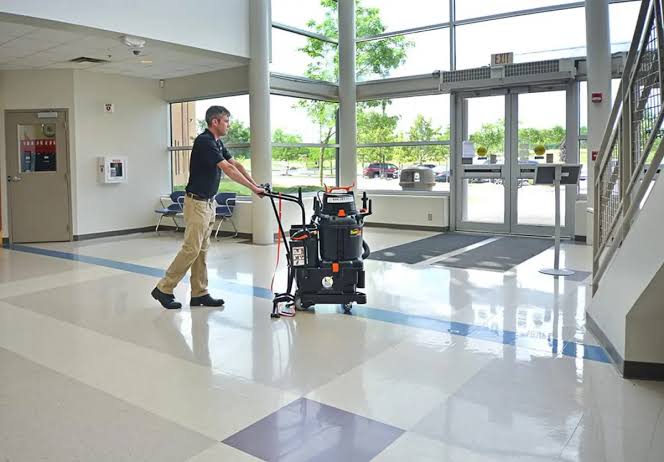

Yes, the same principles of minimizing waste motion, reducing weight of water to be pushed, minimizing bending associated with equipment use, and preparing surfaces before they are cleaned with a mop can be implemented in very large floor areas. If implemented, crews completing 20,000 sq. Ft. Areas without back pain are typically following a method to complete the floor area.
Fix the sequence before you fix the equipment
Most of the fatigue on large floors is caused by mopping soils that could have been removed as dry soil. Wet mopping grit turns the mop into a sanding block, increasing the friction that must be overcome with each pass. A quick pass with a dust mop or vacuum across the full area of floor before wet mopping greatly reduces the amount of work to clean the floor and the number of times the bucket must be refilled.
Work in zones with a fixed water budget
Divide the floor up into sections around 500-1,000 square feet. Assign each zone a certain volume of solution to passively determine the number of trips to the refill station. The close proximity of the bucket to where you are mopping means you won’t have to make long diagonal trips to empty the water in your mop. It will also make it clear how much soil a zone has by how much solution it uses up.
Use the figure-eight, not the scrub
Long, straight strokes of work tend to overtax the lower back. Instead, divide your floor into large “S” patterns and complete each section with a third, overlapping section of the next. Work in large, figure-eight patterns that allow you to move forward with the work of your floor while keeping your arms and shoulders engaged.
Choose equipment against the floor, not the catalog
Choose your floor cleaning equipment based on the type of surface(s) you are to clean, the square footage of the area(s) to be cleaned, and the number of obstructions in the floor space (i.e. Desks, display units, etc.). For example, a large open floor space with few fixed features will be best cleaned with a flat microfiber cleaning system on a wide frame. In contrast, a floor space that is heavily littered with fixed features (such as seating, desks, display units, etc.) will be best cleaned with a spin mop and a smaller, more maneuverable floor cleaning head.
Water weight is probably the biggest factor in determining how tired your crew will be. A foot pedal or rotating basket are the best ways to wring out a mop without having to twist at the waist. Inconsistent wringing causes a heavy mop head, so a system with a self-contained wringer and a light head, such as the Libman Wonder Spin Mop, is perfect for mid-sized commercial spaces that don’t need a full flat-mop system but need something better than what they currently have.
| System | Best suited to | Effort profile | Main trade-off |
| String mop and bucket | Textured or uneven surfaces, heavy spill cleanup | High, heavy saturated head and manual wringing | Slowest coverage, most water carried |
| Spin mop with basket wringer | Obstructed mid-size areas, hard tile and vinyl | Moderate, controlled moisture and low wrist strain | Narrower path than flat systems |
| Flat microfiber with pad changes | Large open floors, sanitation-sensitive sites | Low per pass, but frequent pad swaps | Pad inventory and laundering overhead |
| Walk-behind auto scrubber | Over 10,000 square feet of unobstructed floor | Lowest, machine carries the load | Capital cost, charging, and service |
Match the handle to the operator
Handle length should allow for the grip to be held at about chest to chin height. This is to stop the operator from constantly bending down and ending up tired by the end of the shift. Telescoping handles are worth the extra cost on shared equipment as they enable the operator to work at their optimal height.
Control solution chemistry and water temperature
Dirty or too concentrated cleaning solution can cause a residue on floor surfaces which can cause subsequent mopping to ‘drag’ and pick up dirt and grime faster, resulting in the need for deeper cleans more frequently. Use the solution at the correct dilution ratio and measure rather than pour to ensure the correct concentration every time.
- Change solution when it loses clarity, not on a fixed clock, since soil load varies by zone.
- Use warm rather than hot water, because very hot water flashes off and reduces dwell time.
- Keep a separate rinse bucket on finished floors where residue buildup causes visible dulling.
- Match pH to the surface, particularly on sealed concrete and natural stone.
Maintain the tools so the effort does not creep back
A never-collapsed mop head becomes too heavy to lift and does a poor job of holding enough solution to clean. Eventually it does more harm by spreading the dirt that you are trying to pick up rather than lifting it.
- Rinse heads in clean water at the end of every shift, then hang to dry rather than leaving them in a bucket.
- Launder microfiber without fabric softener, which coats fibers and destroys absorbency.
- Inspect wringer mechanisms monthly for stiffness and replace worn gears before they bind.
- Retire heads once they shed fibers or stop releasing water cleanly, usually well before they look finished.
Build the schedule around interim cleaning
Floors that receive on-going, light-interim cleaning in a timely fashion do not reach the level of soiling that requires aggressive scrubbing. Spread out restorative work in a timely manner and make sure to have adequate entrance matting to keep the dirt that is tracked into the building off of the floor.