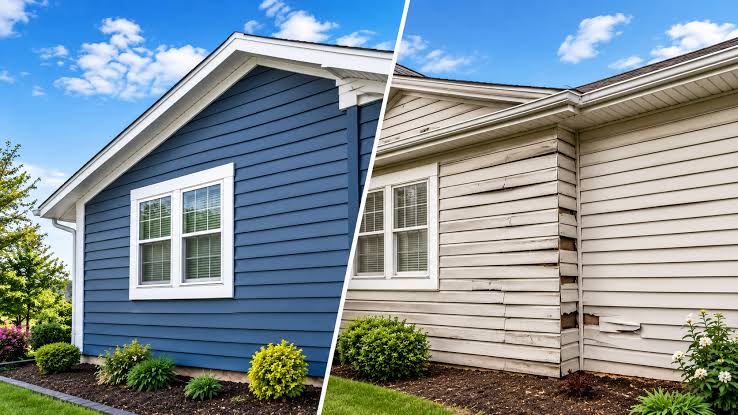

There is no schedule for siding failure. Failure occurs at specific details, such as around penetrations, changes in claddings or architectural details and typically occurs quietly for long periods of time until some sign of failure appears from the street. It is only when the wall behind the siding fails to adequately shed and drain water that siding failure becomes an issue and then only in relation to the wall’s failure, not the siding’s appearance.
As the appearance of weathered siding deteriorates, the structure must be evaluated to determine the extent to which the siding has failed as a wall assembly. How much useful life does the material have left? What work must be done in conjunction with the siding replacement?
Reading the warning signs that actually matter
Fading, chalking, and checking are types of weathering. They affect the look of your home and can impact the cost of painting wood siding over time. But they do not indicate that your siding needs to be torn off and replaced. Look for signs of wear that indicate movement, tracking of water, or pull of fasteners.
Signals that merit opening the wall
- Panels or boards that have cupped, buckled, or pulled away at butt joints, which suggests repeated wetting and drying rather than simple age.
- Soft or spongy sheathing found by probing beneath windows, at band joists, or at kick-out locations.
- Interior finish defects with no plumbing source, including flaking paint on an exterior wall, stained drywall corners, or a musty smell confined to one bay.
- Fastener staining or nail pops across a broad area, often a sign the substrate is no longer holding.
- Caulk joints that fail repeatedly in the same locations despite resealing, which usually means sealant is being asked to do a flashing’s job.
Moisture intrusion and why it decides the scope
Be aware that most exterior claddings are designed and operate as rain screens. That means that they are designed to allow water to enter the wall system in front of a water-resistive barrier, while the WRB will repel the water behind it. So, as long as the WRB is in place and being properly lap sealed, the exterior cladding is a single component that can be replaced as necessary.
A diagnostic sequence worth following
- Map the staining and damage. Patterns that follow window heads, roof-to-wall intersections, or deck ledgers point to flashing, not material.
- Remove cladding at two or three suspect locations and photograph the barrier, lap direction, and any tears in the building paper.
- Use a pin meter on the sheathing at each opening, recording readings during a dry spell for a usable baseline.
- Check the interior side of the rim joist and sill plate for discoloration, which often confirms long-term wetting that surface inspection misses.
If there are more than two openings in question, then oftentimes a spot repair can turn into a bigger repair down the road.
Expected service life by material
When choosing the siding for your home, you have to consider the realistic amount of time a certain type of siding will perform properly before having to be replaced. This is affected by many factors such as the home’s exposure, the home’s orientation, and the home’s maintenance history.
| Material | Typical service range | Common failure mode | Replacement trigger |
| Vinyl | 25 to 40 years | Brittleness, impact cracking, color loss | Cracks at multiple elevations or panels that no longer lock |
| Fiber cement | 35 to 50 years | Edge swelling, delamination at cut ends | Widespread swelling at butt joints and bottom courses |
| Wood lap or shingle | 20 to 40 years with upkeep | Rot, splitting, paint adhesion failure | Rot in more than roughly a quarter of boards |
| Engineered wood | 20 to 35 years | Substrate swelling where coatings are breached | Soft spots that compress under thumb pressure |
| Stucco over frame | 40 to 60 years | Cracking, drainage failure behind the lath | Elevated moisture readings at base of wall |
Choosing between repair, overcladding, and full tear-off
Repairing holes, scratches, or damage to individual sections of your exterior walls is cost effective, provided the water-resistive barrier behind the siding has not been damaged, and adequate materials of like kind and quality are available to make the repairs. Overcladding is a means to reuse existing siding for budget purposes, but it has the negative consequence of hiding wall defects. It is the best solution if the walls can be verified to be dry and to be substantially flat, but they must be capable of being coated with a layer of siding.
Criteria that favor full replacement
The tear-off and replacement of a siding covered wall is worth the high cost of tear-off only to replace the water-resistive barrier and to re-flash all of the exterior trim work. This would be the time to add exterior insulation to the wall. Many siding repairs can cost half as much as replacement over a period of several years. Before committing to that scope, it is worth asking two or three siding contractors in Charlotte NC to quote the water-resistive barrier, the flashing, and the trim work as separate line items so the numbers can be compared honestly.
Timing the work against the rest of the envelope
You can also repair or replace missing exterior insulation, roof edge and kick-out flashing, Weather-Tightness component failures, window failures, and deck ledger reflashing while the wall is open.
Practical scheduling notes
For demolition tear-off, plan to start with the best stretch of weather, and then control the exposure to ensure that the crews can get the work dried in by evening. This means that sealants and many coatings have minimum application temperatures. In general, shoulder season is better than mid-winter. For a home with a roof that is within three to five years of replacement, start with the roof and then complete the walls after they have been re-flashed.