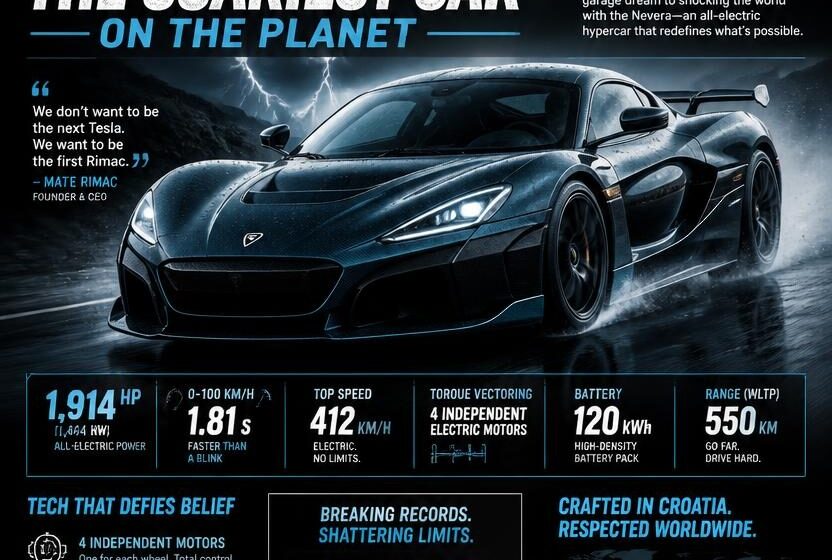

Some cars are fast. The Rimac Nevera is something else entirely. It doesn’t just beat records — it makes the concept of “fast” feel slightly embarrassing for everyone else involved. One point seven four seconds to sixty miles per hour. Let that sit for a second. That’s not a car. That’s a physics problem.
And it came from a garage in Croatia. A garage.
Quick Facts
| Detail | Info |
| Full Name | Rimac Nevera |
| Manufacturer | Rimac Automobili (now Bugatti Rimac) |
| Country | Croatia |
| Type | All-electric hypercar |
| Power | 1,914 hp (four electric motors) |
| Torque | 1,739 lb-ft (2,360 Nm) |
| 0–60 mph | 1.74 sec (record-verified) |
| Top Speed | 258 mph (412 km/h) — verified EV record |
| Battery | 120 kWh |
| Range | ~340 miles (WLTP) |
| Price | ~$2.4 million |
| Production Run | 150 units — all sold |
| First Customer | Nico Rosberg, F1 World Champion |
| Records Set | 23 in a single day (May 2023) |
| Founder | Mate Rimac, born 1988, Bosnia |
The Name Itself Is a Warning
The name “Nevera” comes from the Croatian word for sudden, short storms — typically accompanied by lightning — that occur along the Adriatic coast. They roll in from nowhere, tear everything up, and vanish. Nobody expects them. Nobody’s ready.
That’s the car. That’s the whole idea.
A nevera is a mighty storm that arrives suddenly from a clear sky off the Adriatic coast, often charged with lightning, and then disappears almost just as quickly. Mate Rimac didn’t name his hypercar after something serene. He named it after controlled chaos. He named it honestly.
And nobody in the automotive world saw it coming.
See also”Todd Dean Net Worth: The Selfie Scammer Who Built an Empire Out of Other People’s Money“
A Garage, a Blown BMW, and a Billion-Dollar Company
Here’s where the story starts getting ridiculous.
Mate Rimac did everything wrong. He raced his E30 BMW until the engine exploded. Most people would park the wreck and buy something sensible. Not this guy. He decided the solution was to strip out the engine entirely and go electric. In his garage. As a teenager.
Rimac Automobili was founded by Mate Rimac in 2009, when he modified his old E30 BMW by installing an electric motor to make what he called his e-M3. That weird little DIY experiment kicked off a chain of events nobody could have predicted. He started setting records with it. Electric records. In 2011.
Just 12 years after founding his company in a garage, Rimac found himself at the head of the 114-year-old Bugatti brand and allied with Porsche, one of the world’s leading high-performance and racing brands.
Read that again. A kid from a small Croatian suburb — who built his first electric car in a garage because his BMW engine blew up — ended up running Bugatti. The math on that doesn’t add up, except it literally happened.
Before turning 18, Mate won several international competitions for innovation and technical development in Germany, South Korea, and Croatia. So this wasn’t luck. This was someone who was always operating on a different level and just needed the right vehicle — literally — to prove it.
What 1,914 Horsepower Actually Feels Like
Let’s talk about the car itself, because the specs alone are almost insulting to your brain.
It has four electric motors and four gearboxes, each of which drives one of its four driven wheels. Four individual motors. One per wheel. So the torque vectoring isn’t a system bolted on as an afterthought — it’s the entire foundation of how the car moves. The Nevera doesn’t just go fast in a straight line. It goes fast everywhere.
Zero to 60 mph takes under 1.8 seconds according to Rimac, while 0–100 mph takes four seconds flat. You’ve read faster sentences than the time it takes this car to reach highway speed. You genuinely cannot process the acceleration with your body before it’s already over.
The 120 kWh battery provides a range of up to 345 miles and offers an unprecedented 500 kW charging capacity, meaning it can get an 80% charge in just 19 minutes. So it’s not just fast — it’s also liveable. You can actually drive this thing somewhere without plotting a charging strategy.
The butterfly doors open upward. The interior features three TFT displays, configurable by the driver. There’s an AI driving coach built in to help you actually learn the car’s limits rather than just discovering them at 150 mph on a track day. Smart. Very smart.
Genuine thought went into the interior. The Nevera has upward-opening butterfly-style doors, meaning you can walk right up to the car and sit down. No awkward gymnastics. No contortion required. It’s a hypercar that actually thought about what it’s like to use one.
The Day It Broke Physics (Or At Least 23 World Records)
May 2023. Automotive Testing Papenburg facility, Germany. Rimac showed up with one car, one driver, and seemingly unlimited ambition.
The all-electric Rimac Nevera is officially the ultimate record-breaking hypercar, setting a new 0-400-0 km/h (0-249-0 mph) benchmark on the same day that it set another 22 acceleration and braking records.
Twenty-three records. In one day.
The Nevera achieved 0-60 mph in 1.74 seconds at the Automotive Testing Papenburg test track in Germany, a number that was independently verified by data loggers from Dewesoft and RaceLogic. Not Rimac’s own numbers. Two separate third-party verification systems confirmed every single run. This wasn’t marketing. This was physics, witnessed.
During its record-breaking day, the Nevera even outperformed its own official specifications, recording 0-60 mph in 1.74 seconds, compared with its claimed 1.85 seconds. The car beat its own spec sheet. That’s the level of engineering margin we’re talking about here. They undersold it deliberately, and it still embarrassed the competition.
Zero to 60 mph in 3.2 seconds is considered fast. Just two decades ago, a time of 3.3 seconds made the Ferrari Enzo the quickest car you could buy. The Rimac Nevera goes from zero to 100 mph in 3.2 seconds. The Nevera does what the best Ferrari of 2002 did to reach 60, and uses that time to hit 100 instead. That’s how far things have moved.
The Nürburgring: Where It Crushed Tesla Without Even Trying Hard
August 2023. The Nordschleife. The 12.9-mile lap that separates serious cars from everything else.
Croatian electric hypercar maker Rimac smashed the Nordschleife EV lap record by 20 seconds with its quad-motor Nevera, completing a tour in a blisteringly quick 7:05.298. Tesla’s Model S Plaid had just set what was considered a strong EV benchmark. The Nevera came in and beat it by 20 full seconds. Not two seconds. Not five. Twenty.
That Nürburgring record cut over 20 seconds off the previous EV production time set by a Tesla Model S Plaid equipped with the optional Track Pack. That track pack costs extra money, by the way. Rimac didn’t need any of that.
To celebrate, Rimac revealed a Time Attack special edition, with a rear spoiler that has “Dedicated to those coming after us” written on its underside — only visible in the car’s most extreme driving mode.
That message on the underside of a spoiler that nobody sees unless they’re pushing the car to its absolute limit? That’s either the most badass detail in modern automotive history, or the most theatrical. Probably both.
Nico Rosberg Got Car #001
The first production Nevera didn’t go to some anonymous billionaire. It went to someone Rimac personally respects.
The unveiling follows the start of production and the delivery of car #001 to the first customer — the 2016 F1 World Champion and sustainability entrepreneur, Nico Rosberg. Car #001 was described by Rosberg as wanting to go for the ‘full Batmobile spec.
All black. All of it. The Batmobile spec. For a car that weighs over two tonnes and accelerates faster than a Formula 1 car to 60 mph, that’s arguably the correct choice.
Each example is tested and signed off personally by company founder Mate Rimac before final delivery. Every single one. Not a rubber stamp, not a delegated task. Mate Rimac personally clears every car that leaves his factory. All 150 of them. That’s either admirable dedication or a logistical nightmare, depending on how you look at it.
When there were still examples of the Rimac Nevera available to purchase, prices started from €2 million. Past tense. That’s the important part. They’re gone. All 150, spoken for.
The Bugatti Deal Nobody Saw Coming
This is the part of the Rimac story that makes Silicon Valley’s “disruptor” narrative look small.
In July, Bugatti merged with Rimac Automobili — creating Bugatti-Rimac, and transferring majority ownership of VW’s luxury performance icon from one of the world’s largest automakers to a small startup in the process.
Volkswagen — a company with hundreds of billions in revenue — handed a Croatian startup majority control of Bugatti. A brand with over a century of history. A brand that makes the Chiron. They handed it to a guy who was putting electric motors in his BMW garage project less than fifteen years earlier.
The Rimac Group owns 55% of Bugatti Rimac, and Mate is CEO.
Porsche didn’t disappear from this either. Porsche now owns 45% of Bugatti-Rimac. So the world’s most prestigious sports car brand essentially became a minority partner in a deal where a 33-year-old Croatian entrepreneur held the cards.
Rimac has a vision for Bugatti: the Chiron successor will be a hypercar rearranged as a hybrid. Bugatti is all about heritage and craftsmanship and 100 years of history — it’s a little bit of aristocratic perfectionism.
The kid who grew up in a small town outside Zagreb is now deciding what the next Bugatti looks like. You genuinely cannot write that story.
Then Came the Nevera R. And It Got Worse.
Just when you thought the Nevera had done everything it could possibly do, Rimac did what records-obsessed engineers always do. They made it more.
Rimac Automobili revealed the Nevera R at Monterey Car Week. While the original Nevera was tuned to be equally at home on the autobahn as on a track, this more radical version unbalances the scales with a far keener focus on outright performance.
Unveiled in August 2024, the Nevera R officially beat every performance benchmark previously set by the standard Nevera, establishing 24 new world records. That includes clocking a 0-60 mph time of 1.66 seconds, making it the world’s fastest-accelerating production car — electric or otherwise.
1.66 seconds. To sixty miles per hour. In a road car. That you can technically drive to a restaurant.
In 2025, Rimac reported the Nevera R clocked a 0-400-0 km/h time of 25.79 seconds, regaining the world record that had briefly been taken by the Koenigsegg Jesko Absolut. The Jesko — a $3 million combustion car from one of the most respected hypercar makers alive — held the crown for about a year. Then Rimac came back and reclaimed it.
The Nevera R posted an astonishing top speed of 431.45 km/h, which is 268.2 mph — a new world record for any electric vehicle.
268 miles per hour. In an electric car. From a company that didn’t exist 17 years ago.
What Critics Actually Said
Top Gear, after driving a pre-production version, praised the “head-spinning performance, incredible tech, ultra-stiff chassis, engineering and build quality” but noted that the brakes need getting used to and some detail finessing, ultimately calling it ‘the most advanced, most powerful, quickest car out there.
Car and Driver was similarly impressed, stating that ‘hypercars like the Nevera aren’t for everyone, but there’s no denying its significance.
Evo, who drove production cars repeatedly over the years, described the Nevera as ‘far from a one-trick pony, proving to be one of the most involving hypercars’ they’d driven, even years after its launch.
Here’s what nobody’s really saying loudly enough though: a car that weighs over 4,700 pounds — a real heavyweight by any measure — manages that weight well enough that its handling remains genuinely impressive. The torque-vectoring setup means each wheel does what it’s supposed to do, precisely when it’s supposed to do it. The software is doing physics calculations in real time that no human driver could manage consciously.
Is there criticism? Of course. Brake-by-wire puts some drivers off. The weight is hard to hide completely. The price excludes 99.999% of the human population. But none of that changes what this car actually is.
Why This Story Is Bigger Than the Car
Rimac isn’t just a hypercar manufacturer. Rimac is one of only a few automakers that develops and manufactures its own electric drive technology, offering this as a service to external companies. The battery technology in the Aston Martin Valkyrie and Koenigsegg Regera comes from Rimac.
So when you buy a Koenigsegg or drive the upcoming Bugatti hybrid, there’s Croatian engineering inside it. The startup that started in a garage became the company supplying technology to every other serious name in the hypercar game.
Rimac grew a beard so he’d look older. He received an offer of investment and a five-year tax exemption — all he had to do was move the company from Croatia to Germany, where a huge supplier network and experienced help awaited. He refused. Multiple times. Different countries, same answer. He kept it in Croatia on purpose, even when it would have been financially smarter not to.
From the very start, our business has been proudly Croatian. The Nevera is named after a legendary Croatian storm and carries a cravat motif on its flanks, in honor of the necktie — a Croatian invention.
The necktie is a Croatian invention, by the way. Most people don’t know that. Rimac put it on the flanks of his hypercar because he thought you should.
Final Words
The Rimac Nevera matters for reasons beyond the numbers, and there are a lot of numbers to hide behind. It matters because of what it disproves.
It disproves the idea that serious automotive engineering only comes from Germany, Italy, or Britain. It disproves the idea that EVs are inherently boring — clinical appliances dressed up in performance clothing. And it disproves the narrative that a kid without legacy connections, without a famous last name, without decades of industry experience, can’t build something that makes the established names look slow.
It took five years and 1.6 million hours of research and development to get the Nevera ready for production. That included 18 prototypes and 45 crash tests. This wasn’t rushed. This wasn’t hype. This was obsessive, meticulous engineering from people who had something to prove and kept proving it until there was nothing left to doubt.
The Nevera holds 23 world records. Its successor holds 24. Every time someone beats one, Rimac builds something faster. That’s not a company playing defense. That’s a company that genuinely believes the limit hasn’t been found yet.
The Nevera is named after a storm that appears from nowhere and disappears before you can react to it. Mate Rimac named his company the same way his career went. And if you blinked somewhere between 2009 and now, you completely missed how the whole automotive world got rearranged.
FAQs
1. What does “Nevera” actually mean?
It’s a Croatian word for a sudden, fierce storm that develops off the Adriatic coast — powerful, fast, and unpredictable. Rimac named the car after it intentionally.
2. How many Rimac Neveras exist?
150 units total. All sold. You can’t order one. If you want one, you’re looking at the secondhand market and a lot of zeros.
3. Is the Rimac Nevera faster than a Formula 1 car from 0-60?
In a straight drag from standstill — yes, the Nevera’s 1.74-second verified time actually outpaces an F1 car off the line, which has launch traction limits from regulations.
4. Who bought the first Rimac Nevera?
The 2016 Formula 1 World Champion is Nico Rosberg.He chose what the company called the “fullBatmobile spec” — all black exterior, black Alcantara interior. He got chassis #001.
5. Does Mate Rimac personally check every car?
Yes. Every single Nevera was tested and signed off by Mate Rimac himself before delivery. 150 cars, personally cleared by the founder.
6. Is Rimac connected to Bugatti?
Yes — and not in a small way. Rimac Group owns 55% of Bugatti Rimac, the joint venture formed in 2021. Mate Rimac is the CEO. Porsche owns the remaining 45%.
7. What’s the range of the Rimac Nevera?
Around 340 miles on a full charge under WLTP testing. It also supports up to 500 kW DC fast charging — getting to 80% in roughly 19 minutes.
8. Can the Nevera actually drift?
Yes. Multiple drivers and journalists have confirmed it. The individual torque-vectoring setup allows the car to initiate and hold controlled slides. It’s not a stripped-out track car — it drifts and it also cruises comfortably.
9. What happened with the Koenigsegg record battle?
The Nevera set the 0-400-0 km/h record in 2023. Koenigsegg’s Jesko Absolut beat it in 2024. Then the Nevera R came back in 2025 and beat the Koenigsegg’s time by over 2 seconds. It went back and forth. Rimac currently holds it.
10. What is the Nevera R?
The more extreme version, revealed in August 2024. It makes 2,107 hp, hits 268 mph, and does 0-60 in 1.66 seconds. Only 40 units, at $2.5 million each. It set 24 world records in July 2025.
11. Where is the Rimac Nevera built?
At Rimac’s facility in Sveta Nedelja, near Zagreb, Croatia. The company has since built a massive new campus. Every major component is designed and manufactured in-house.
12. Why is Rimac considered important beyond just being fast?
Rimac Technology also supplies battery and EV systems to Aston Martin, Koenigsegg, Hyundai, Kia, Porsche, Pininfarina, and others. The company isn’t just a hypercar maker — it’s one of the most important EV technology suppliers in the world.
Discover stories that stand at the top with The Pinnacle Magazine.