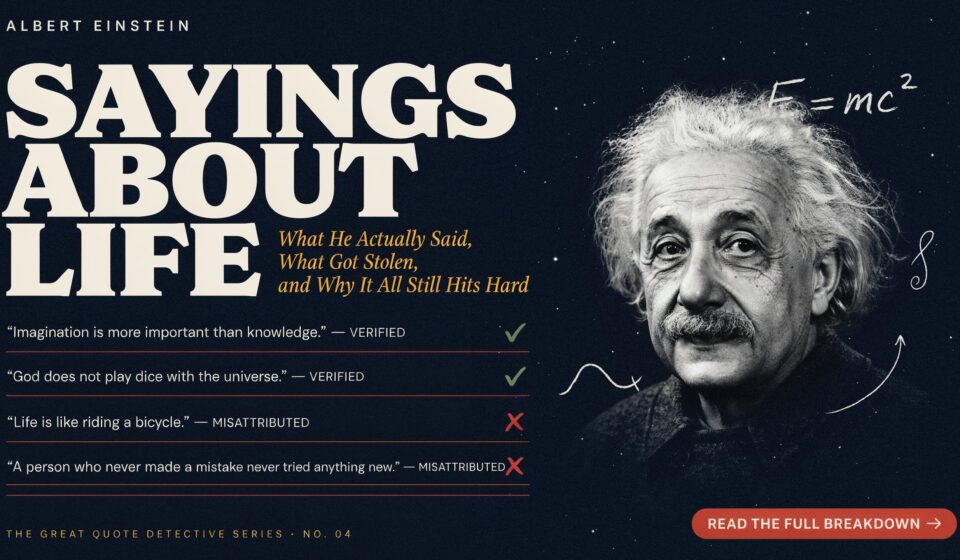
Albert Einstein Sayings About Life: What He Actually Said, What Got Stolen, and Why It All Still Hits Hard

Let’s start with a fact that might ruin your next Instagram caption. Most of the “Einstein quotes” floating around the internet — the fish climbing a tree one, the insanity definition one, the energy-frequency-reality manifesting one — Einstein never said any of them. Not a single word. They got slapped onto his name because the internet figured out that putting “— Albert Einstein” after literally any sentence makes people stop scrolling.
But here’s the thing: the real ones he actually said? Way better. And way weirder.
Quick Facts
| Detail | Info |
| Born | March 14, 1879 — Ulm, Germany |
| Died | April 18, 1955 — Princeton, New Jersey |
| Field | Theoretical Physics |
| Nobel Prize | 1921—not for relativity, but for the photoelectric effect |
| Famous theory | Special and General Theory of Relativity |
| First wife | Mileva Marić (physicist; divorced 1919) |
| Second wife | Elsa Löwenthal (his cousin; married 1919) |
| Children | Lieserl (fate unknown), Hans Albert, Eduard (institutionalized with schizophrenia) |
| Hobbies | Violin, sailing, philosophy, thought experiments |
| FBI file | 1,427 pages — for pacifist and socialist associations |
| Declined | Presidency of Israel (1952) |
| Archive | Albert Einstein Archives — over 30,000 documents |
| Definitive quote book | Einstein’s Ultimate Quotable (Princeton University Press, 2010) |
The Quote Problem Nobody Wants to Talk About
Before anything else, let’s address the elephant crushing every motivational poster in existence. The internet has turned Einstein into a quote vending machine. You put in “inspirational phrase,” out pops “— Albert Einstein.” Garson O’Toole, who runs Quote Investigator, calls people like Einstein, Mark Twain, and Abraham Lincoln “quote superstars” — famous figures whose reputations become dumping grounds for any sentence someone wants to sound profound.
The fish-climbing-a-tree thing? No verified source anywhere connecting it to Einstein. The “definition of insanity” quote? Actually traces back to a 1983 novel by Rita Mae Brown. Everything is energy and corresponds to the desired reality’s frequency. Researchers found zero evidence Einstein ever said anything remotely like that. Zero.
Why does this matter? Because the fakes are so embedded now that the real Einstein quotes — which are genuinely striking — get buried under the noise.
See also “Consolidated Gulf Company (CGC): Qatar’s Quiet Tech Giant That Built a Nation’s Backbone“
The Paper That Sold for a Lot of Money and Said Something Quiet
In late 2017, a handwritten note from Einstein went up for auction in Jerusalem. A small piece of paper with 13 German words on it. The bidding started at a few thousand dollars and ended at — let’s say substantially more.
“A peaceful and modest life provides greater enjoyment than the chase of success paired with persistent restlessness” is the translation.
That sold because it’s verifiable. Einstein’s own handwriting. His own words. And it cuts right through the noise in a way that no fish-climbing-a-tree metaphor ever could. He wasn’t saying hustle harder or match your frequency to abundance. He was saying that grinding yourself into dust for status is, in his view, a bad trade.
That’s kind of stunning coming from the guy who rewrote humanity’s understanding of space and time.
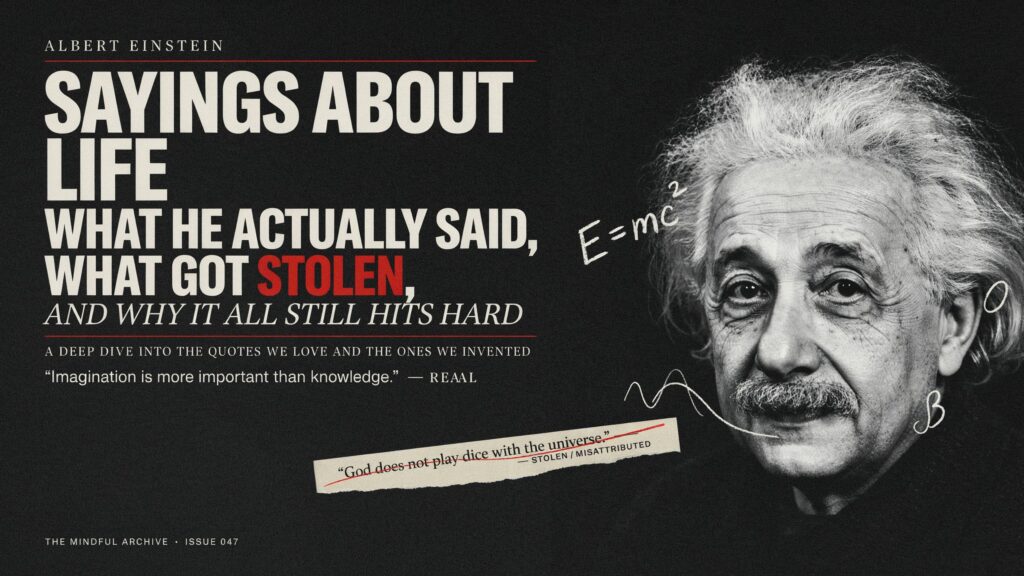
What He Actually Said About Life (The Verified Ones)
Here’s where the real Einstein shows up. Not the meme version. The actual man.
One of the most consistently verified Einstein quotes on life comes from a 1955 Life magazine interview, conducted just before his death. He told the interviewer: “Try not to become a man of success, but rather try to become a man of value.” Read that again. He wasn’t saying don’t succeed. He was drawing a line between chasing achievement as an end in itself versus building something worth having.
Then there’s this, which he said in the same period: “Only a life lived for others is a life worthwhile.” That quote appears in verified sources, cross-checked through the Albert Einstein Archives and Alice Calaprice’s edited volume The Quotable Einstein, which is considered the definitive curated collection. It wasn’t a throwaway line. It reflected a worldview he consistently held across decades.
Imagination Wasn’t Just a Cute Talking Point For Him
You’ve seen the quote. “Imagination is more important than knowledge.” Everyone has. But the full line is richer: “Knowledge is limited. Imagination encircles the world.”
This came from a 1929 interview with journalist George Sylvester Viereck, where Einstein talked about his creative process. He described himself as enough of an artist to draw freely on his imagination. The context was a man who spent years running thought experiments in his mind before he ever touched a chalkboard. He wasn’t being poetic. He was describing his actual method.
He also said, in the last interview he gave to LIFE magazine in May 1955: “The important thing is not to stop questioning. Curiosity has its own reason for existing.” He called it a “holy curiosity.” The original source is documented. It’s real. And coming from a man who died with unsolved problems still on his desk, it means something different than when it’s printed on a notebook cover.
The Life He Actually Lived (It Was Messy)
Here’s the part of the Einstein story that gets cleaned up for inspirational content. His personal life was genuinely complicated, and his sayings about life make more sense when you see them against that background.
His first marriage to Mileva Marić — a fellow physicist who some historians believe contributed to his early work in ways that were never credited — ended in divorce in 1919. When he received the Nobel Prize in 1921, he had already promised Mileva the prize money as part of their divorce settlement. He then married Elsa Löwenthal, his cousin. His son Eduard developed schizophrenia and spent most of his adult life institutionalized. The FBI kept a file on Einstein that eventually reached 1,427 pages, tracking his pacifist and socialist associations.
So when Einstein says “only a life lived for others is worthwhile,” you’re hearing it from a man who also had complicated relationships, a son he couldn’t help, a first wife whose contributions may have been erased, and a government watching his every move.
That doesn’t make the quote less true. It makes it more human.
The Sayings About Curiosity and Learning (And What He Really Meant)
Einstein grew up being told he was a slow learner. There’s a persistent myth that he was a bad student, which partly comes from a grade-scale change at his school that flipped what a “1” meant. He was actually one of the top students in his class. But the myth stuck because it made a better story.
What he actually thought about learning was that facts weren’t the point. “It is not so very important for a person to learn facts,” he stated in certified correspondence.For that he does not really need a college. He can learn them from books. Learning a lot of knowledge is not as valuable as developing one’s ability to think creatively be learned from textbooks.”
He said this in 1921. Feels like something someone should’ve been saying louder in 2015 when everyone was disrupting education with lecture videos.
The other saying that is verified and worth sitting with: “Anyone who has never made a mistake has never tried anything new.” That one appears consistently across verified sources and is in the Quotable Einstein compendium. It also happens to be the practical opposite of playing it safe, which is interesting from the same man who spent years at a patent office in Bern because no university would hire him.
The Saying About Bicycle Riding (Complicated)
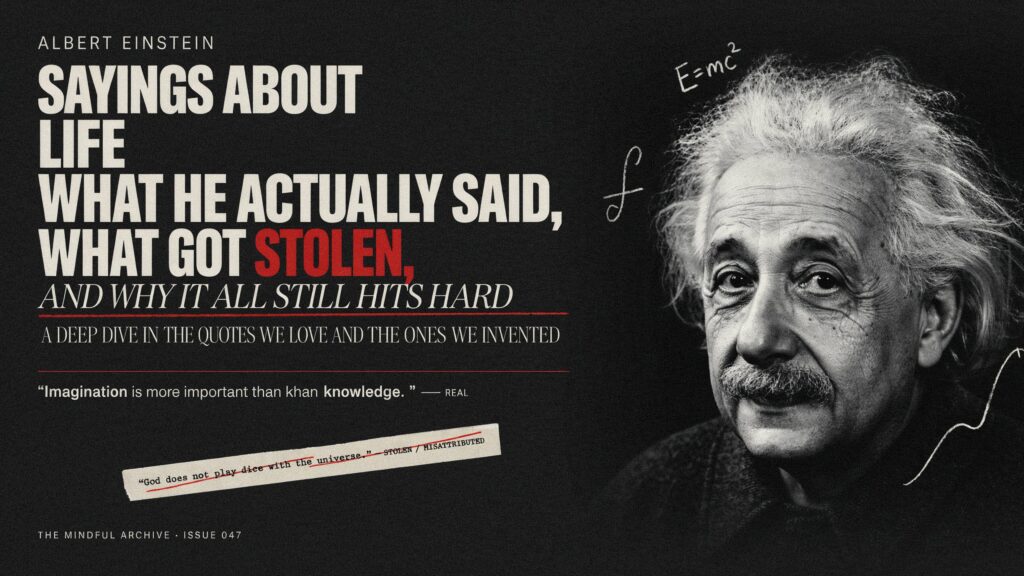
This one gets tricky. “Life is like riding a bicycle. To keep your balance you must keep moving.” You’ve seen it. Everyone has seen it. The gracious quotes verification project notes that only the second sentence — “to keep your balance you must keep moving” — is traced directly to Einstein, sourced to a 1930 letter he wrote to his son Eduard. The framing of the full thing as a complete polished saying is a later construction.
Which is actually more interesting than the clean version. Einstein wrote to his institutionalized son, in a personal letter, that you keep your balance by moving. He wasn’t writing a self-help book. He was writing to his kid. The rawness of that context makes the line land differently.
His Views on Success Versus Value
Einstein said in his verified writings that he considered himself a failure at whatever he valued most about his life — meaning deep human connection — and brilliant at the thing he cared about but didn’t prioritize — meaning physics. He was uncomfortable with celebrities. He reportedly found his own fame bewildering and was uninterested in accumulating money for the sake of it.
The man of value quote captures his actual philosophy: success is external measurement, value is internal contribution. He made this distinction repeatedly across interviews and letters documented in the Albert Einstein Archives, which now hold more than 30,000 documents.
He also said — and this one is verified — “If you want to live a happy life, tie it to a goal, not to people or objects.” That showed up in interviews and is in The Quotable Einstein. Given his personal history of relationships that fractured under the pressure of his career, there’s a certain self-awareness in that line.
On Peace, War, and The Uncomfortable Contradiction
One of the most underappreciated Einstein sayings about life has nothing to do with science or happiness. After World War II, he wrote about the horror of nuclear weapons — weapons made possible by his equation E=mc² — and he spent the last decade of his life trying to undo some of that. He said: “The release of atomic energy has so changed everything that our ways of thinking must change or we will drift toward catastrophe.” Published in the New York Times in 1946.
He was a pacifist who signed the letter that eventually nudged Roosevelt toward the Manhattan Project. That’s a contradiction he carried publicly and never fully resolved. And his sayings about life in that final period — the importance of curiosity, the value of others, the danger of restlessness — read differently when you understand he was speaking as someone genuinely grappling with legacy.
The Habit Nobody Associates With Genius
Here’s something almost nobody puts in Einstein quotes collections. The man played the violin his entire life. He named his violin “Lina.” He played Mozart and Bach and reportedly used music not as relaxation but as active thinking. Multiple sources document that when he was stuck on a problem, he’d pick up the violin and play until something loosened.
He said: “I see my life in terms of music.” That’s in verified sources. And it reframes what “life” meant to him. Not a physics problem to solve. Music. Something that exists in time, shifts, resolves, and returns.
Final Thoughts
Here’s my honest position after going through all of this. The fake Einstein quotes are more comforting than the real ones. The fish-climbing-a-tree one is reassuring. The frequency-matching-reality one is basically a permission slip to believe whatever you want. The insanity definition one gives you a clever-sounding thing to say at meetings.
The real Einstein quotes are harder. They ask you to be a person of value instead of success. They tell you the calm life is actually the happy one. They suggest that only living for others makes a life worthwhile — not for your personal brand, not for your metrics, for others.
And they come from a man who had a complicated marriage, an institutionalized son, a government file the size of a novel, and a quiet anxiety about what his equations had helped put into the world.
That Einstein — the real one — is more interesting than any quote someone stapled to his name. And what he actually said about life is more challenging than anything you’d put on a coffee mug.
FAQs
1. What is Albert Einstein’s most famous saying about life?
The most widely cited verified one is “Only a life lived for others is a life worthwhile.” It consistently appears in documented sources including the Albert Einstein Archives and The Quotable Einstein (Princeton University Press). Another heavily verified one is “Try not to become a man of success, but rather try to become a man of value,” sourced to a 1955 Life magazine interview.
2. Did Einstein really say “life is like riding a bicycle”?
The second part — “to keep your balance you must keep moving” — appears in a documented 1930 letter Einstein wrote to his son Eduard. The full framing as a tidy inspirational quote is a later construction. So: partially verified, but the clean version you see online is an embellishment.
3. Did Einstein say “the definition of insanity is doing the same thing over and over”?
No. This quote has no verified connection to Einstein whatsoever. Quote investigators trace it to Rita Mae Brown’s 1983 novel Sudden Death. It almost certainly predates even that. Einstein’s name was added later.
4. Did Einstein say “if you judge a fish by its ability to climb a tree”?
No. History.com, Gizmodo, and multiple quote verification sources have confirmed there is no substantive evidence Einstein ever said this. It’s one of the most widely spread fake Einstein quotes.
5. What did Einstein really say about imagination?
The verified quote is: “Imagination is more important than knowledge. Knowledge is limited. Imagination encircles the world.” This comes from a documented 1929 interview with George Sylvester Viereck. He also said “The important thing is not to stop questioning” — verified in a LIFE magazine interview from May 1955, his last major interview before death.
6. Did Einstein say “a calm and modest life brings more happiness”?
Yes. This one is verified in Einstein’s own handwriting. A note bearing this sentence went to auction in Jerusalem in 2017 and sold for a significant sum precisely because the handwriting and provenance were authenticated.
7. What did Einstein say about curiosity?
He described curiosity as having “its own reason for existing” and called it a “holy curiosity” in his last LIFE magazine interview in 1955. He also described his own intellectual development as being “retarded” — meaning delayed — which he believed made him keep asking questions about space and time that adults normally stop asking.
8. What is the verified source for checking Einstein quotes?
The most authoritative single source is The Ultimate Quotable Einstein, edited by Alice Calaprice, published by Princeton University Press in 2010. It contains over 1,200 quotations, rigorously sourced, with a dedicated section on misattributed quotes. The Albert Einstein Archives in Jerusalem also holds over 30,000 documents.
9. Did Einstein believe in God?
This is one of the most misrepresented topics around him. He explicitly rejected the idea of a personal God who intervenes in human affairs. He wrote in a private letter that “the word God is for me nothing more than the expression and product of human weaknesses.” However, he spoke often about a sense of cosmic wonder — what he called a “cosmic religious feeling” — which is different from theism. Both sides of the argument about his beliefs tend to overstate their case.
10. What did Einstein say about success?
The most sourced quote is “Try not to become a man of success, but rather try to become a man of value.” He also said “He is considered successful in our day who gets more out of life than he puts in” — which he offered as a critique, not an aspiration. His point, consistently, was that success measured by external achievement was a less meaningful goal than contribution.
11. Did Einstein say “if you want to live a happy life, tie it to a goal”?
This quote appears in The Quotable Einstein and in documented interviews. The full line is “If you want to live a happy life, tie it to a goal, not to people or objects.” It’s verified as Einstein’s, though the exact original context isn’t always cited consistently.
12. Why do so many fake quotes get attributed to Einstein?
Because once you become a “quote superstar” — a term coined by quote investigator Garson O’Toole — your name lends authority to almost anything. Einstein is famous for being wise, so people assume wise things must be his. The internet amplified this massively. Researchers note that many misattributed Einstein quotes didn’t get attached to his name until decades after his death, often through self-help books and motivational content.
Discover stories that stand at the top with The Pinnacle Magazine.