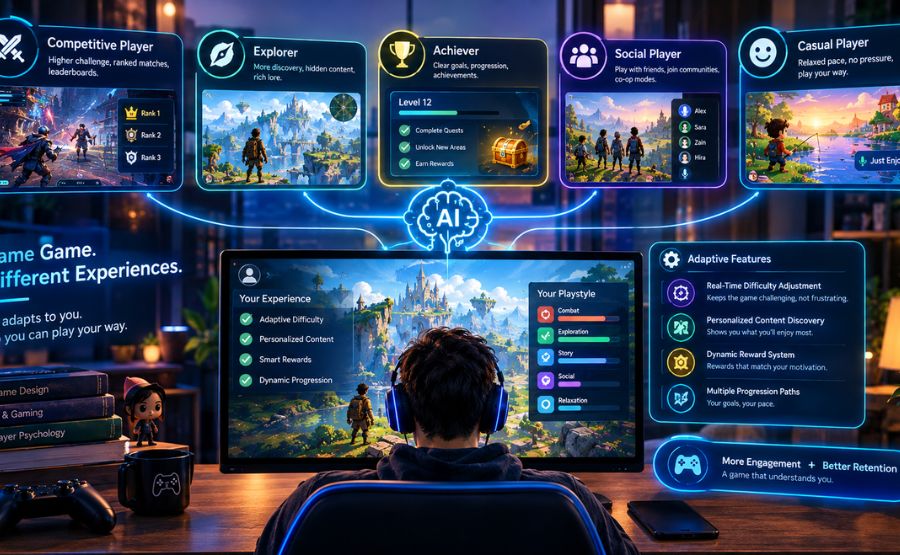

Every player is different. One player wants hardcore challenge. Another wants story. A third wants relaxation. Traditional game development meant choosing one target audience and hoping enough players fit that mold. AI changes this. Games can now adapt to individual players, learning their preferences and adjusting the experience in real-time. Personalization moves from theoretical feature to practical reality that keeps players engaged longer.
The Problem AI Solves
One-Size-Fits-All Design
Games have traditionally offered fixed difficulty, fixed progression, fixed reward schedules. Either the game was too hard and the player quit, or it was too easy and they got bored. There was no middle ground. The designer picked a difficulty and that difficulty applied to everyone.
This approach wastes massive amounts of player potential. A player who would have loved the game at slightly easier difficulty never finds it. Another player who would have loved the challenge at harder difficulty gets bored. The game misses both.
Engagement Drops at Predictable Points
Game designers knew where players would quit. Too-hard boss fight? Players quit. Too-long grind? Players quit. Too-easy section? Players quit. The game couldn’t adapt. The designer had to guess what difficulty would keep the most players engaged longest. They almost always guessed wrong for significant portions of their audience.
How AI Enables Personalization
Real-Time Difficulty Adjustment
AI can analyze how players perform and adjust difficulty dynamically. A player struggling gets slight help. A player breezing through gets increased challenge. The game stays in the flow state where players feel challenged but capable. This keeps engagement high because players never feel frustrated or bored.
This isn’t rubber-banding or artificial handicapping. It’s sophisticated analysis of player skill, learning curve, and preferences. The adjustment feels natural because it’s responding to actual performance.
Adaptive Progression Paths
Different players learn at different speeds. One player needs 10 repetitions to master a mechanic. Another needs 2. AI can track individual learning curves and adjust pacing accordingly. A player isn’t held back by a slow learner’s pace. A player isn’t rushed before they’re ready.
This means progression feels natural for everyone. No artificial gates. No artificial rushing. Everyone progresses at the pace that suits them.
Personalized Content Discovery
AI learns what content appeals to individual players. A player who gravitates toward combat gets more combat opportunities. A player who engages with story gets more narrative. The game presents personalized content recommendations, discovering the parts of the game each player will love most.
This is especially powerful in open-world games where players can easily miss content. Personalization ensures players discover what they’ll actually enjoy.
Individualized Reward Schedules
AI learns what rewards motivate different players. One player cares about visual cosmetics. Another wants progression indicators. A third wants social recognition. The game can adjust which rewards it emphasizes for different players. Everyone gets motivated by what actually motivates them.
Personalization Without Feeling Like Cheating
Transparency About Adjustments
Players appreciate knowing the game is adapting to them if it’s transparent. A difficulty indicator that shows “this is set for your skill level” feels fair. Hidden adjustment feels like manipulation. Be clear about what’s being personalized and why.
Respecting Player Agency
Personalization should enhance player choice, not replace it. If a player wants harder difficulty despite struggling, let them choose it. If they want easier despite excelling, respect that. Personalization should be an option, not a mandate.
Maintaining Challenge for Skilled Players
The biggest risk is personalizing difficulty down to the point where the game has no challenge. This bores skilled players fast. Personalization should adjust the floor, not the ceiling. Everyone can find appropriate challenge, but skilled players can still push into genuinely difficult content.
Real-World Example
1 Speed Run demonstrates how personalization works in practice. The game responds to individual player skill levels, adapting pacing and challenge to keep players engaged. What would frustrate one player becomes natural progression for another because the game adjusts to them.
Personalization Across Different Game Types
Story Games
AI can personalize narrative pacing. A player who reads dialogue slowly gets more time per scene. A player who skips cutscenes gets to action faster. The story paces itself to the player instead of forcing everyone through the same rhythm. AI can also personalize story difficulty. A player struggling with complex moral decisions gets clearer framing. A player wanting ambiguity gets it.
Competitive Games
AI can identify skill level quickly and match players with appropriate opponents. New players don’t face veterans. Veterans don’t face beginners. Everyone plays against competition that’s actually competitive. This improves skill development for everyone. New players learn faster against appropriately skilled opponents. Veterans always face real challenge.
Puzzle Games
AI learns how players solve problems. A player who works systematically gets puzzles designed for systematic solving. A player who works intuitively gets puzzles designed for intuitive solving. Different players can solve the same puzzle game in completely different ways, all feeling natural.
Social Games
AI personalizes social experiences. A player who primarily solos gets optional cooperative content. A player who primarily groups gets group-oriented progression. The game serves solo and social players simultaneously without forcing compromise.
The Data Privacy Consideration
Balancing Personalization With Privacy
Games collect significant data to personalize effectively. Player behavior, preferences, skill level, time spent on different activities. This data needs protection. Players ought to understand what information is gathered and how it is put to use. Transparent data practices build trust. Hidden data collection erodes it.
Local Processing Where Possible
Not all personalization requires sending data to servers. Some adaptations can happen locally on the player’s device. Difficulty adjustment based on performance can happen client-side. This reduces data transmission while still enabling personalization.
Implementation Challenges
Avoiding Over-Personalization
If the game adapts too aggressively, players feel like they’re not playing the “real” game. They’re playing a version edited for them. This can feel isolating. Personalization should be subtle enough that players feel like they’re playing the actual game, just with content adjusted to their preferences.
Balancing Individual and Shared Experiences
Multiplayer games need shared experiences. If everyone’s difficulty is personalized, cooperative play becomes complicated. One player’s “hard” is another’s “easy.” Personalization works in some areas, but shared progression matters for community. The balance between individual adaptation and shared experience requires careful design.
Training AI Effectively
AI personalization requires significant data to work well. Early in a game’s life, the system doesn’t know enough about players. Initial recommendations are often mediocre. As the game runs longer and collects more data, personalization improves. Players need to understand that early personalization isn’t perfect.
Personalization as Retention Tool
Reducing Quit Points
By adapting to player skill and preferences, personalization eliminates most quit points. A player doesn’t quit because the game is too hard, because it adapts. A player doesn’t quit because content doesn’t match preferences, because the game learns preferences. This dramatically improves retention.
Extending Playtime
When content is personalized to player preferences, players stay engaged longer. They encounter more content they actually want. They feel understood by the game. This psychological effect drives retention beyond what unpersonalized games achieve.
Building Player-Specific Communities
Personalization can identify players with similar preferences and suggest they play together. A solo player who sometimes groups gets matched with players who also prefer occasional grouping. This builds communities around shared playstyle preferences rather than forcing everyone into the same social mold.
The Future of Personalization
Predicting Player Needs
Advanced AI can predict what players will want before they know they want it. If a player’s engagement is dropping, the system can proactively introduce new content likely to re-engage them. This is more effective than waiting for players to quit before trying to save them.
Cross-Game Personalization
As players engage with multiple games from the same studio, personalization can span across titles. A player who preferred story in one game gets story emphasis in the next. Their preferences carry across the studio’s portfolio.
Collaborative Personalization
Players could adjust how much personalization they receive. A hardcore player might turn off difficulty adaptation. A casual player might maximize it. Giving players control over their personalization level respects their preferences.
Final Thoughts
Game personalization has moved from theoretical possibility to practical reality. AI enables experiences that adapt to individual players, keeping them engaged by respecting their skill level and preferences. This means fewer quit points, longer engagement, and players feeling like the game was built specifically for them. Building personalized experiences requires collecting and processing data thoughtfully, respecting player privacy, and maintaining balance between individual adaptation and shared community. Games that master personalization will build loyalty that unpersonalized games can’t match. The players will feel understood. They’ll return because the game meets them where they are, not where the designer assumed they’d be. That’s the power of game maker online platforms that build personalization into their foundation.