Rhys Griffiths Sleep Token: Why Fans Are Searching for His Name
Here’s a take you might not hear very often: the most quietly fascinating person in Sleep Token isn’t Vessel. It’s the Welsh guitarist standing slightly to the side, wielding an eight-string Jackson, feeding riffs into one of the biggest band machines in modern heavy music — and technically, officially, he doesn’t even exist.
That’s Rhys Griffiths. Known to the Sleep Token faithful as IV. And if you’ve been paying attention to what’s actually happening on stage during those sold-out arena runs, you’d know he’s carrying a huge chunk of the sonic weight that made Even in Arcadia go to number one on the Billboard 200 in 2025.
Let’s dig into it.
Quick Bio
| Category | Details |
| Stage Name | IV (Sleep Token) |
| Nationality | Welsh |
| Role in Sleep Token | Lead Guitarist, Backing Vocalist |
| Previous Bands | Continents (2013–2019), Mourn |
| Former Label (Continents) | Victory Records |
| Guitars Used | Jackson Custom Shop Monarkh 8-string, Aristides 080SR, Gretsch G5260 Electromatic Jet Baritone, Balaguer Espada 7-string |
| Guitar Tuning | Double Drop E (EAEADGBE) |
| Processing | Neural DSP Quad Cortex |
| Identity Status | Widely reported — not officially confirmed by Sleep Token |
| Entry into Sleep Token | Reportedly started as guitar tech, became full member |
South Wales to Sold-Out Arenas. Not a Straight Line.
Before any of the masks and mythology, Rhys Griffiths was just a guitarist from South Wales in a metalcore band called Continents. They were signed to Victory Records by 2012, which was actually a big deal in that scene. Alternative Press was calling them one of the top 20 bands to watch in 2013. They toured Japan. They shared bills with The Ghost Inside, Emmure, Comeback Kid. Real, legitimate underground credibility.
Griffiths joined Continents around 2013 — the band even talked about it at the time, noting how well he fit into their chemistry almost immediately. He provided background vocals and played the guitar. Continents put out two albums on Victory before parting ways with the label ahead of their 2017 record Preacher. They were a solid band. Not massive, but respected.
He also fronted a UK outfit called Mourn around the same period. So this is a guy with range — not just a riff machine, but someone who knows how to hold a microphone too. That matters a lot for what came next.
Continents went quiet after 2019. And right around that window, Sleep Token’s lineup was quietly shifting in ways nobody outside the inner circle knew about.
See also “Camron Guthrie Wife and Children: The Man Behind the Famous Name Finally Gets a Spotlight“
The Guitar Tech Thing Is Actually Fascinating
Here’s the detail that genuinely trips people out. Rhys Griffiths allegedly didn’t walk into Sleep Token as its guitarist. He came in as the guitar tech first. Roadie. The person who tunes the guitars backstage, makes sure everything’s plugged in right, stands off to the side invisible.
Think about that for a second.
At some point, either the original guitarist left or the band needed someone new, and the person best positioned to step into that role was already there — already knew the setlist, knew the gear, knew the sonic requirements. Griffiths reportedly made that transition from tech to full member.
It’s an unusual path. And honestly? It makes a lot of sense for a band built entirely on the principle of controlled mystery. You don’t audition strangers. You elevate people already inside the circle. People who’ve already proven they can keep their mouths shut.
What IV Actually Does On Stage
People talk endlessly about vessels. The voice, the mythology, the communion chalice stuff at shows. And yeah, that’s all deserving of the attention. But someone has to produce the musical architecture that makes those performances land.
That’s IV’s job. And it’s not simple.
Sleep Token’s guitar parts are genuinely tricky to execute. The band pivots constantly — from chunky, low-tuned djent-adjacent riffs to shimmering clean passages to melodic lead lines — sometimes within the same song. The main track from Even in Arcadia, “Emergence,” is more than six minutes long and traverses several different sound zones. Hitting that with precision, masked, under arena lighting, night after night? That takes serious professional discipline.
His main arsenal includes the Jackson Custom Shop Monarkh 8-string tuned down to double drop E, with Fishman Fluence Modern pickups and an Evertune bridge. There’s also an Aristides 080SR 8-string with Bare Knuckle Ragnarok pickups, and a custom Balaguer Espada 7-string. Running through a Neural DSP Quad Cortex for his amp simulation. This is not someone messing around with off-the-shelf gear. This is a rig built specifically to get extremely heavy sounds with extreme precision and consistency.
The extended range matters. Sleep Token’s sonic identity is built on that low-end mass. The eight-string gives IV access to frequencies that a standard six-string simply can’t reach cleanly at that level of crunch. When those riffs drop during the big moments in songs like “The Summoning” or “Take Me Back to Eden,” that weight has to be real. And it is.
He’s also doing backing vocals on top of all of this. Not easy.
The Anonymity Game: Clever, Yes, But Also Leaky
Sleep Token’s whole brand is built on the idea that you don’t know who these people are. The masks, the robes, the Roman numerals instead of names. Vessel supposedly encountered the deity Sleep in a dream. The songs are “offerings.” The fanbase calls itself “Worshippers.” It’s an immersive mythology and, credit where it’s due, it genuinely worked for years.
But here’s the thing. The internet doesn’t respect mythologies.
By late 2023 and into 2024, the detective work done by fan communities had essentially put real names to every mask. For IV specifically, the connection to Rhys Griffiths comes from multiple directions: his documented history with Continents is publicly verifiable, the timeline of his departure from that band maps onto Sleep Token’s touring activity, there’s reportedly a photo of him and Dave Ball (III) where his eyes match those visible through the IV mask, and his guitar tech background has been cited across multiple fan-research threads and music journalism sites.
Killthemusic.net ran what they called an exclusive breakdown of member identities that laid out much of this evidence. The detail about Griffiths having also fronted Mourn — that showed up in that piece too.
None of this has been confirmed by the band. Sleep Token stays silent. They still wear the masks. They still perform as Vessel, II, III, IV. And honestly? That restraint is probably part of why it still works commercially even now that the secret is basically out.
Meanwhile, The Numbers Don’t Lie
Let’s be clear about where Sleep Token is in 2025 and into 2026. Even in Arcadia, released in May 2025 through RCA Records, hit number one in the United States, United Kingdom, Australia, and Germany. It opened with roughly 127,000 first-week equivalent units in the US alone — the largest streaming week ever recorded for a hard rock album at that point. The band headlined Download Festival. They sold out their first North American arena tour. The New York Times named “Caramel” the greatest song of 2025. The album went Gold in both the US and UK.
This is stadium-tier stuff now.
And the Billboard Hot Hard Rock Songs chart for 2025 had Sleep Token occupying six of the top fifteen spots simultaneously. Six tracks. One band.
Rhys Griffiths, playing eight-string Jacksons under a mask, is part of that. His guitar work is embedded in every one of those chart placements. The riffs that made “Emergence” feel massive on first listen, the tonal contrast that makes the quieter moments on the record actually hit — that’s the contribution of IV.
The Spitting Glass Moment: When the Mask Slipped
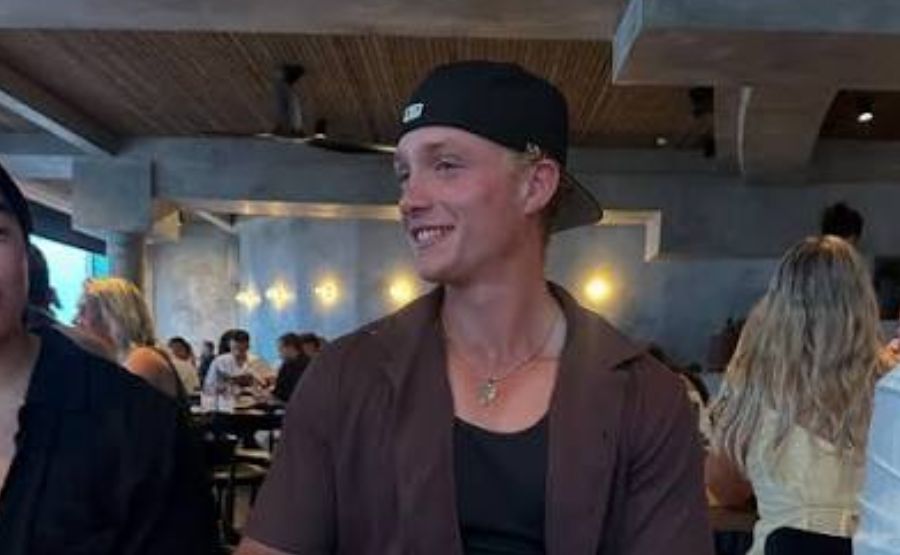
In June 2026, something interesting happened. A supergroup called Spitting Glass played the Dogtooth Stage at Download Festival. Their second single, “Full Send,” featured a guest vocal appearance credited explicitly to Rhys Griffiths of the UK outfit Mourn.
Griffiths has long been connected by fan forums to Sleep Token’s IV. Stepping onto that stage, under his own name, attached to a credited appearance — that’s as close to an unmasking as anyone associated with Sleep Token’s guitar chair has come.
The band stayed quiet about it. They usually do.
But it added another data point to a pile that was already fairly convincing.
Why IV Gets Overlooked and Why That’s Actually Fine
Part of the reason Rhys Griffiths doesn’t dominate the Sleep Token conversation is structural. Vessel is the front-of-stage presence, the singer, the face of the mythology. That’s who people photograph, who generates the fervent online discussions, who gets the close-up at festivals.
IV stands behind a mask, holding an eight-string, doing technically demanding work that mostly goes unnoticed unless something goes wrong.
That’s just how bands work. The rhythmic and harmonic architecture of great heavy music rarely gets the same level of public appreciation as the voice sitting on top of it. Think about how many great guitarists are permanently second-tier in the public consciousness simply because they’re not the singer.
But the playing is there. You can hear it. It’s doing exactly what the record needs it to do — which is probably the most honest measure of whether a musician belongs in the room they’re in.
Final Words
Look, the Sleep Token mystery machine is impressive and I get why people buy into it. The lore is fun, the masks are visually interesting, the community aspect of being a “Worshipper” is genuinely engaging for the people in it.
But there’s a real Welsh musician inside that mythology, someone who spent years earning his place in the UK metal underground through Continents, through Mourn, through apparently grinding it out as a guitar tech before stepping into one of the most commercially successful rock outfits in recent memory.
Rhys Griffiths is reportedly the person behind the IV mask. And if the evidence holds up — the career timeline, the photo, the June 2026 festival appearance under his actual name — then he’s been doing quiet, serious, technically impressive guitar work at the center of one of heavy music’s biggest success stories.
That’s worth knowing. Even if the band never officially tells you so.
FAQs
1. Who is Rhys Griffiths?
Rhys Griffiths is a Welsh musician widely identified as IV, the lead guitarist and backing vocalist of Sleep Token. Before Sleep Token, he was a guitarist and backing vocalist for the Welsh metalcore band Continents from 2013 to 2019, and he also fronted a UK band called Mourn.
2. What is IV’s role in Sleep Token?
IV plays lead guitar and provides backing vocals. He’s a core part of Sleep Token’s live and recorded sound — responsible for the heavy riffs, melodic lead lines, and harmonic texture that defines much of the band’s style.
3. Has Sleep Token confirmed that IV is Rhys Griffiths?
No. Sleep Token has never officially confirmed the real identities of any of their members. The Rhys Griffiths identification comes from fan research, music journalism, career timeline analysis, and an appearance under his own name at a 2026 festival — not from the band itself.
4. What guitars does IV use?
IV’s main rig includes the Jackson Custom Shop Monarkh 8-string, the Aristides 080SR 8-string, a custom Balaguer Espada 7-string, and the Gretsch G5260 Electromatic Jet Baritone. He runs through a Neural DSP Quad Cortex for amp modeling. His eight-strings are typically tuned to double drop E.
5. What bands was Rhys Griffiths in before Sleep Token?
Primarily Continents, a South Wales metalcore band signed to Victory Records, where he played guitar and provided backing vocals from around 2013 to 2019. He also fronted a UK band called Mourn.
6. Did Rhys Griffiths start as a guitar tech for Sleep Token?
That’s the widely reported story, yes. Multiple fan and journalistic sources have noted that he reportedly entered the Sleep Token orbit as a guitar technician before transitioning into the full guitarist role — likely when the band’s lineup shifted around 2020.
7. Has Sleep Token been successful recently?
Extremely. Their 2025 album Even in Arcadia hit number one in the US, UK, Australia, and Germany. It set the record for the largest streaming debut week ever for a hard rock album. The New York Times picked “Caramel” the best song of 2025. They headlined Download Festival and sold out a North American arena tour.
8. When did Rhys Griffiths appear publicly under his own name?
In June 2026, he was credited as a guest vocalist on the Spitting Glass single “Full Send” at Download Festival — appearing under the name Rhys Griffiths with the descriptor “of the UK outfit Mourn.”
9. Why does Sleep Token stay anonymous if everyone knows who they are?
Commercially and artistically it still works. The mythology around the band’s identity draws people in, and even a partial veil of mystery functions better than no mystery at all. The masks are now also a recognizable visual brand, separate from the anonymity question.
10. What was Continents’ connection to mainstream metal?
Continents were signed to Victory Records in 2012, earned a featured placement on YouTube’s homepage that year, and were highlighted by Alternative Press as one of the top 20 bands to watch in 2013. They toured with established acts including The Ghost Inside, Emmure, Comeback Kid, and Defeater. Griffiths joined their lineup in 2013.
11. Is IV the same person who has always played guitar for Sleep Token?
No. Sleep Token’s lineup has changed over time. A guitarist named Jasper Lyons reportedly held the role from around 2016 to 2020 before IV joined. The anonymous framework means lineup changes don’t generate public announcements the way they would for a normal band.
12. What makes IV’s guitar playing distinctive for Sleep Token?
The combination of extended-range instruments, precise downtuned riffs, and his ability to navigate between crushing heaviness and delicate atmospheric playing without losing emotional continuity. His Continents background trained him in technical metalcore playing, and that technical foundation comes through in how Sleep Token’s heaviest moments are delivered live.
Discover stories that stand at the top with The Pinnacle Magazine.