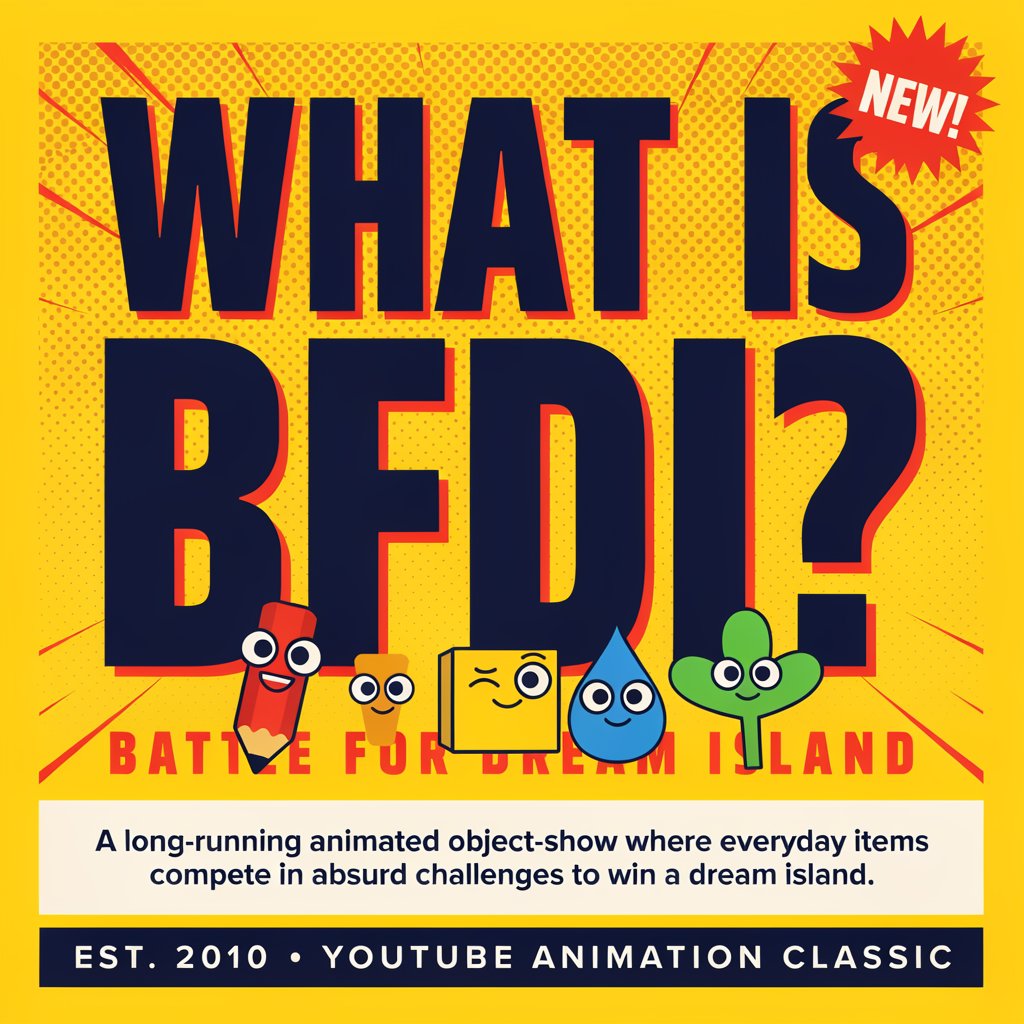
What Is BFDI? The Weird, Wonderful YouTube Show Your Kid Won’t Stop Talking About
Okay so a cartoon about a pencil and a fire and a leaf competing for a luxury island sounds like something a bored eight-year-old drew on a napkin. And that’s basically what it was. Now it’s selling out AMC theaters and winning Webby Awards. Let that sink in.
Quick Facts
| Info | Details |
| Full Title | Battle for Dream Island |
| Abbreviation | BFDI |
| Created by | Cary and Michael Huang (the “Huang twins”) |
| Channel | jacknjellify (YouTube) |
| First Episode | January 1, 2010 |
| Genre | Object show / animated parody / game show |
| No. of Seasons | 6 (and counting) |
| Total Episodes | 116+ |
| Competitors’ Origin | Algebra class homework. Seriously. |
| Influences | Total Drama Island, Survivor, Homestar Runner |
| Subscriber Count | ~3.5 million (as of 2026) |
| Awards | 2026 Webby Awards — three People’s Voice wins |
| Status | Actively airing, still growing |
It Started as a Homework Assignment
And not even a cool one. An algebra assignment. In 2009, Cary Huang — one half of the twin duo behind BFDI — got tasked with creating a fake catalog for class. His solution was a comic strip built around a rock-paper-scissors variant he invented: water, sponge, and fire. The characters from that game became Firey, Teardrop, and Spongy. The spark for an entire universe, born from a school project about made-up products.
Their mom taught them Macromedia Flash. They’d been making videos since age eight — stop-motion Jenga shorts on VHS, little games on a website called htwins.net. Animation was already in their blood. The algebra comic just happened to be the thing that clicked into place.
After a trip to Hawaii and some shared enthusiasm for making it move, the brothers went into production. The result: episode one, “Take the Plunge: Part 1,” dropped on New Year’s Day 2010. Cary was 12. Michael too — they’re twins, born March 18, 1997, both 13 when it aired.
See also “How to Stream Disney Plus on Discord (And Why It’s More Complicated Than Anyone Tells You)“
Wait, So What Is It Actually?
Think Survivor. Now make every contestant an inanimate object with a name like “Golf Ball” or “Pencil” or just “Bubble.” Give them personalities, alliances, petty arguments, and surprisingly real emotional arcs. Make the elimination process driven entirely by viewer votes in the comments. Then run it for over fifteen years.
That’s BFDI. A game show parody. An animated web series. The accidental founder of an entire genre.
Twenty contestants start Season 1. Two teams — the Squishy Cherries and the Squashy Grapes. Every episode involves a challenge. Losers go up for elimination. Viewers vote in the comments to decide who stays and who gets shipped off to the “Tiny Loser Chamber.” The winner gets Dream Island: a square mile of paradise with a five-star hotel, restaurants, a casino, and robot servants.
Who won Season 1? Firey. A flame. Basic? Maybe. But the whole point is the viewers picked him — not the creators. Cary genuinely didn’t know who was going to win his own show. That’s not a gimmick. That’s how the thing actually works.
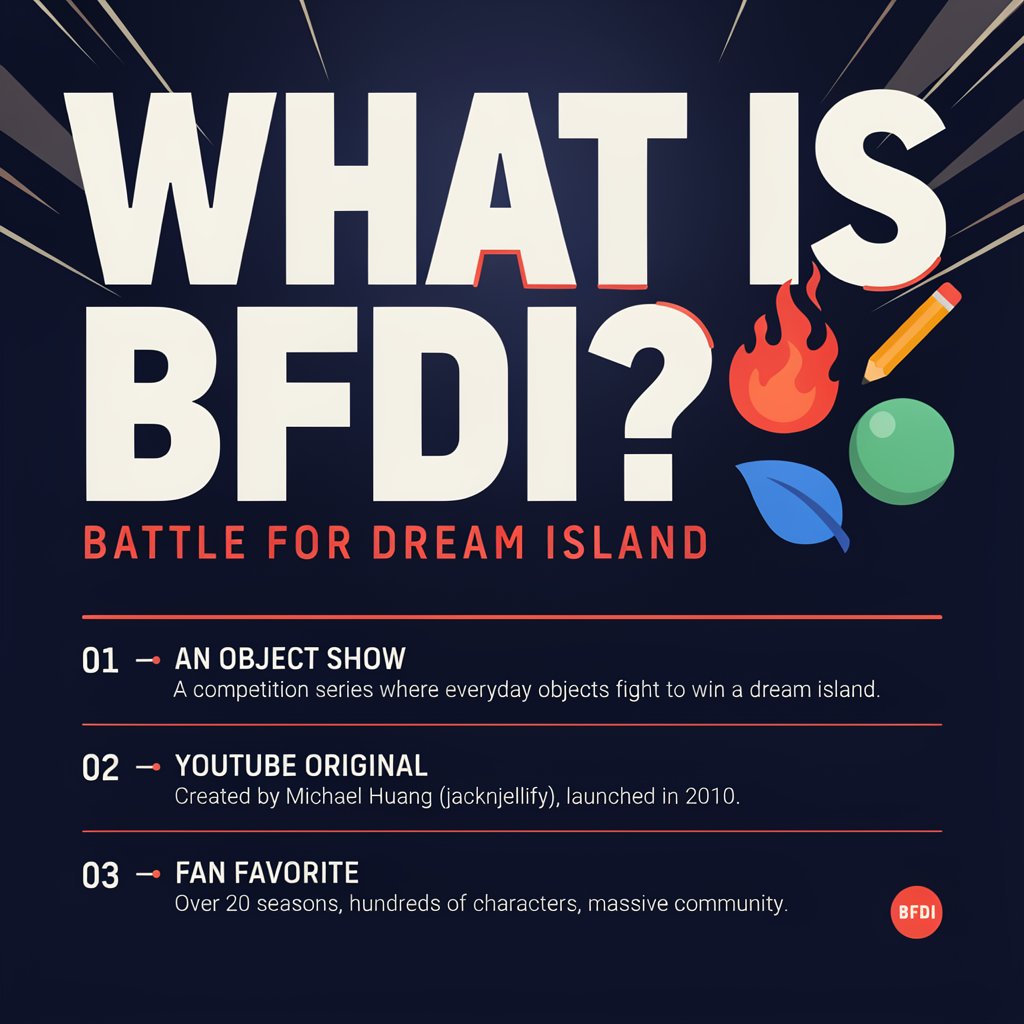
The Genre It Accidentally Invented
Before BFDI, “object show” wasn’t a phrase anyone used. It wasn’t a genre. It didn’t exist.
Now there are hundreds of them. Independent animations across YouTube, all following the same rough template: anthropomorphic objects, competition format, viewer voting, episodic elimination. BFDI didn’t just succeed — it invented the framework everyone else copied.
The community that formed around this is called the OSC. Object Show Community. It has its own discourse, its own fan art pipelines, its own drama. Kids who grew up watching BFDI learned to animate making their own object shows. Michael Huang noted that it’s practically a rite of passage — you watch BFDI, you fall in love with the format, you eventually start your own show.
One of those kids was Adam Katz. He was 13 in 2011 when he launched Inanimate Insanity, directly inspired by BFDI. For a while Cary was privately frustrated — someone copying his thing felt threatening. He later disliked Katz’s videos on YouTube. He eventually pulled those dislikes and came around. By 2024, BFDI and Inanimate Insanity were touring the country together for sold-out live screenings. That’s a full arc.
The Chaos of the Middle Years
Season 1 ran clean — 25 episodes, January 2010 to January 2012. Firey wins. Done.
Then came Season 2, “Battle for Dream Island Again” (BFDIA), launching June 2012. And this is where it gets messy.
Production slowed. High school demanded attention. Then in August 2013, Michael announced they needed a break to deal with their junior year. The show ground to a halt mid-episode at “The Long-lost Yoyle City.” Five episodes and a partial sixth. Just… stopped.
Then in March 2014, YouTube suspended the jacknjellify AdSense account. No clear explanation. Invalid activity, the email said. Two appeals sent. Both rejected. No income meant no motivation to animate. The channel went dark. They had over 100 million views at this point. Still growing. Still gaining subscribers. With no new episodes whatsoever.
AdSense came back in June 2016, after 1,454 days offline. Then came Season 3 — “IDFB” (yes it stands for the series title backwards) — which dropped one episode in September 2016 and immediately went on hiatus again because Cary and Michael were in college. Stanford for Cary, UC Berkeley for Michael.
One episode. An entire season. Three years. It would be maddening if the community weren’t already completely used to waiting.
Season 4 Changed Everything
November 2017. No announcement. No build-up. “Getting Teardrop to Talk” just appeared. And it was different.
Season 4, called Battle for BFDI (or BFB), dropped the cast count from about twenty to sixty-four contestants. Sixty-four. New characters, rebuilt assets, two new hosts called Four and X — bizarre, abstract entities called “Algebraliens.” The style shifted. The humor got looser and weirder. Episodes came out faster than any point in BFDI history.
The channel got affiliated with Frederator. The subscriber count started genuinely climbing. The fandom exploded.
Then in Episode 16, something unprecedented happened. The show split in two. Literally. Forty of the sixty-four remaining contestants walked out to join a different show hosted by a new entity called Two. The remaining fourteen kept competing in BFB. The forty joined “The Power of Two” (TPOT), Season 5. Two concurrent BFDI seasons, telling different stories in parallel, aimed at different audience preferences.
One wanted callbacks to old seasons and smaller stakes. One wanted more ambitious storytelling. Rather than pick, the Huang twins gave fans both.
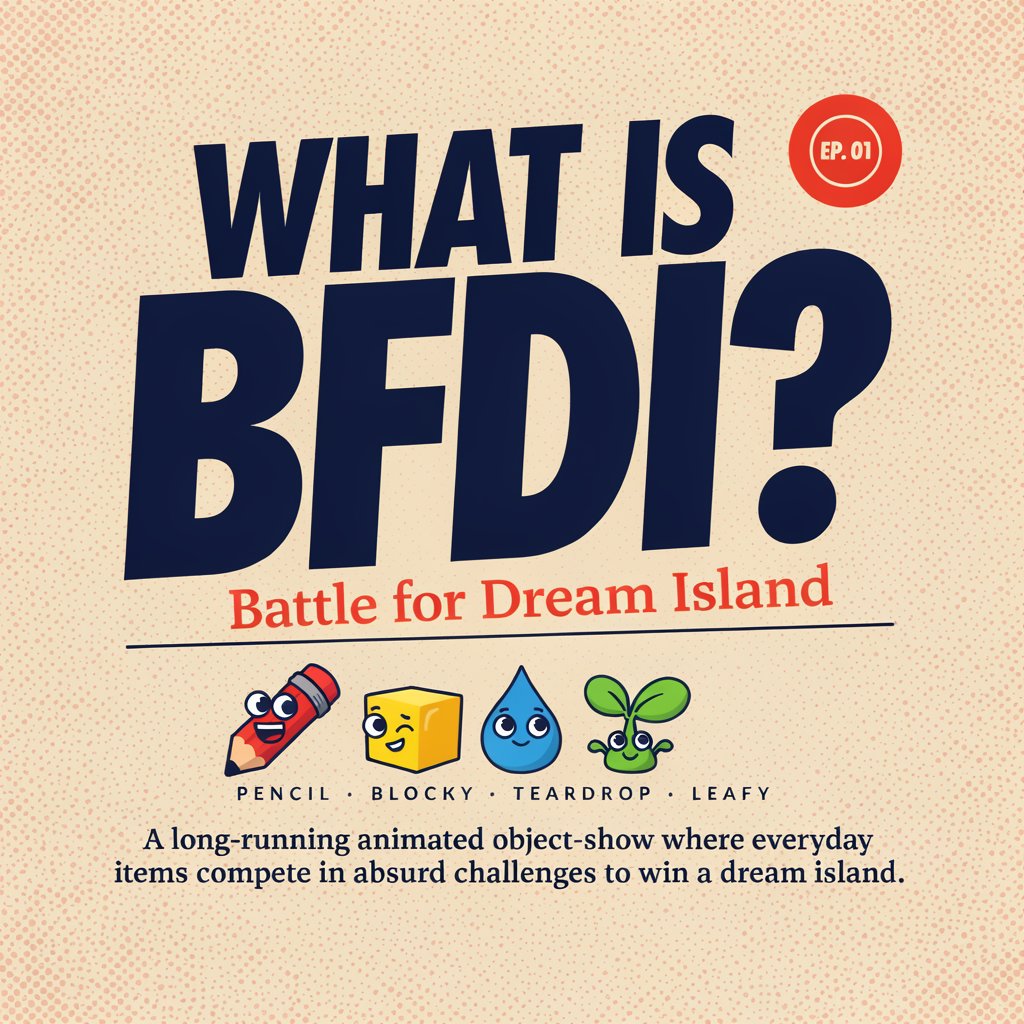
The Leafy Problem (And Why It’s Perfect)
You want to understand BFDI’s storytelling? Look at Leafy.
She’s the runner-up of Season 1. A bright green leaf who’s almost aggressively kind and helpful — friends with everyone, radiating positivity. She made it to the end, losing to Firey by 406 votes to 236. And then Firey did something that broke her: he won Dream Island, and when he let everyone in, he excluded Leafy. No explanation. Just… she didn’t get to come.
So Leafy bought Dream Island from the show’s host. Using a paper slip from another character’s “Box of Paper Slips.” And this is considered theft by basically everyone else in the show. The fandom. The other characters. All of them decided she stole it. She became a pariah hunted across the world of BFDI for multiple subsequent seasons.
The thing is — she bought it. She didn’t steal it. But everyone’s so convinced she did that it doesn’t matter. That’s storytelling that holds up across six seasons and fifteen years.
And the fan split on Leafy is completely real. Half the viewers think she’s unfairly maligned. Half think she’s manipulative and hypocritical. For an animated pencil-case show, that’s an impressive level of engagement.
From 10 Fans in a Hotel to 25,000 at Live Shows
The first BFDI fan meetup happened at VidCon in 2017. A hotel lobby. Ten people showed up. Cary called it “crazy.” Ten whole people.
Fast forward to 2025. The Huang twins were running a sold-out national tour — New York, Los Angeles, Houston, Chicago, Seattle. Live theatrical screenings of never-before-seen episodes before they dropped on YouTube. Q&A sessions with creators and voice actors. Kids in BFDI merch trading bracelets with strangers. The 2026 tour hit London. Cary estimated 25,000 fans attended the 2025 run across all stops.
A YouTube show about inanimate objects sold out movie theaters. Not as a stunt. As its normal release strategy.
Episode 20 of TPOT screened at AMC, Cinemark, and Marcus theaters in October 2025 before going live on YouTube the next day. A million views within nine hours of the upload. In December 2025, a 60-minute episode of BFDIA screened in theaters. Sold out. They added screenings to meet demand. Then the 2026 tour included London as a final stop.
This is not a kid-content anomaly. This is a cultural thing. A real one.
What Makes the Fan Community Different
Walk into a BFDI screening and something slightly unusual happens. People are nice to each other. Strangers compliment each other’s outfits. Bracelets get swapped between people who’ve never met. The TV Guide journalist who covered the Seattle stop noted that his tween daughter was told “nice ‘fit” by strangers multiple times.
The community skews heavily toward Gen Alpha — kids born between the early 2010s and 2024. A lot of them are neurodivergent, gender fluid, or otherwise feel like outsiders. And BFDI’s community specifically has built a reputation as accepting in a way that other fandoms just… aren’t.
Part of that comes from the Huangs’ approach to fan creativity. If someone builds a BFDI Roblox game using the characters? Cary’s response is basically: that’s amazing. No cease and desist. No lawyers. The creators visibly enjoy when fans engage with and expand on the work. That permission — implicit and sometimes explicit — shapes how the community treats each other.
The Numbers Are Genuinely Wild
The first episode of BFDI, posted January 1, 2010, has over 74 million views. That’s not a typo. A 15-year-old Flash animation posted by 13-year-old twins now has 74 million views and is still climbing.
The jacknjellify channel had 1 million subscribers in 2019. By 2026 it’s nearly 3.5 million. New episodes regularly hit 4 million views. The Scholastic character guide published in 2019 — an actual physical book sold through Scholastic, the same company that does your school book fairs — covers all 64 BFB contestants. A BFDI comic book dropped in November 2025. A board game launched in July 2026. A Nintendo Switch game was teased at San Diego Comic-Con 2026.
Webby Awards 2026: three People’s Voice wins. Social – Family & Kids. Social – Weird. Social – Best Use of Video.
Social – Weird is honestly the most on-brand category BFDI could possibly win.
Is It Actually Good Though?
That’s the thing people keep being surprised by. Yes. It’s genuinely good.
The animation style is intentionally rough — simple, colorful, designed to be recognizable rather than technically impressive. Critics have called it “almost old-school in its appeal” and “deliberately rough around the edges.” One reviewer compared its minimalist character designs to how XKCD uses stick figures — the simplicity isn’t a flaw, it’s the point.
TV Guide compared it to Cartoon Network scripted animation from a decade ago. The characters have real arcs. The Leafy-Firey storyline spans fifteen years and multiple seasons and actually pays off. The comedy is legitimately funny. The writing respects that kids are smart.
And the format — viewers literally deciding who wins, with creators having no control over the outcome — creates stakes that scripted television can’t replicate. Nobody watching Survivor gets to vote. BFDI viewers do. That’s not a gimmick. That’s the whole engine.
Final Words
Here’s my take: BFDI is one of the most interesting things to come out of YouTube, and most adults have never heard of it. It invented a genre. It built a community that genuinely takes care of its members. It started as a 13-year-old’s algebra homework and ended up screening in AMC theaters in fifteen cities.
The Huangs went to Stanford and Berkeley. They could be doing something prestigious and corporate. Instead they’re making animated shows about personified notebooks for kids who feel like outsiders, and those kids are showing up by the thousands to watch them live. Cary described the whole project as “throwing a wrench into the system and seeing what happens.”
You know what? It worked.
If your kid is obsessed with BFDI, good. The show is smart, the fandom is kind, and the community it built might be one of the healthier corners of the internet right now. That’s not nothing. That’s actually hard to do.
FAQs
1. What does BFDI stand for?
Battle for Dream Island. It’s the name of both the first season and the overall franchise. When people say “BFDI” they usually mean the whole thing.
2. Who created BFDI?
Cary and Michael Huang, identical twins born March 18, 1997. They go by the channel name “jacknjellify” on YouTube. They started it when they were 13 years old.
3. What is Dream Island?
The grand prize of Season 1 — a square mile of paradise described as having a five-star hotel, casino, restaurants, and robot servants. The winner gets to decide who can visit. Firey won it. Then Leafy bought it. Then things got complicated.
4. Is BFDI appropriate for kids?
Largely yes. There’s some cartoon violence — characters get launched into space, eaten, frozen, dissolved — but it’s absurdist and played for laughs. One early episode has a background middle finger gesture that’s barely visible. It’s not the kind of content parents need to worry about.
5. How does the voting work?
Viewers vote in YouTube comments to eliminate or save contestants. The format has evolved across seasons — sometimes vote to eliminate, sometimes vote to save. The creators genuinely don’t control who wins. Cary has said he didn’t know who would win his own show.
6. What is an object show?
The genre BFDI accidentally invented. An “object show” is any animated series where the characters are anthropomorphic inanimate objects — a pencil, a ball, a leaf — competing in some kind of elimination-format game show. Hundreds exist now. BFDI was first.
7. What season should I start with?
Most fans say they start from Season 1 for the full experience, but Season 4 (BFB, starting with “Getting Teardrop to Talk”) is often recommended as an entry point because the animation quality is higher and episodes come out faster. Both work.
8. How many seasons are there?
Six, depending on how you count. Season 4 split mid-run into two branches (BFB and TPOT). There’s also Season 3, which is technically one episode from 2016 and has been on indefinite hiatus. It’s complicated.
9. Why did BFDI go on hiatus in 2013?
Two reasons hit almost simultaneously: the creators needed to focus on high school, then Google suspended their AdSense account with no clear explanation. They couldn’t earn money from the channel for over 1,400 days. Production basically stopped.
10. Are there BFDI episodes in theaters?
Yes, genuinely. Starting in 2025, episodes have premiered in AMC, Cinemark, and Marcus theaters before dropping on YouTube. The screenings sell out. A national tour with live Q&As and merch has run in 2024, 2025, and 2026.
11. What is the OSC?
Object Show Community. The broader fandom that includes BFDI and all the shows it influenced. Inanimate Insanity is the most prominent “sister show.” The OSC is known for being unusually welcoming, particularly to neurodivergent and LGBTQ+ fans.
12. Where can I watch BFDI?
All on YouTube, on the jacknjellify channel. It’s completely free. Episodes vary from 5 minutes to over an hour.
Discover stories that stand at the top with The Pinnacle Magazine.